
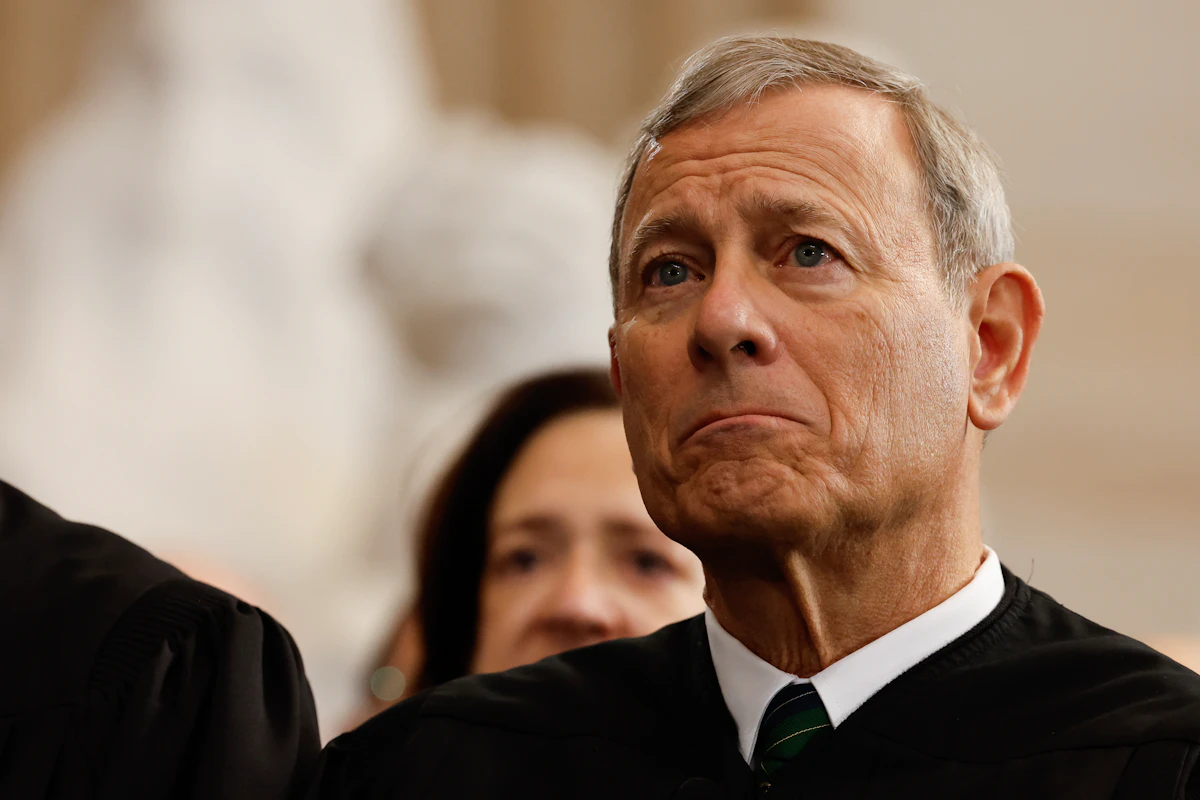
The New York Times on Saturday published a series of Supreme Court internal memos that amount, in hindsight, to a major milestone in the decline of American democracy. The closely held memos show how the justices’ shadow docket—particularly their use of brief, unsigned decisions on cases before they’ve even reached the court—transformed from a simple administrative mechanism into a major roadblock for progressive governance.
There are caveats, of course: It is impossible to know whether these memos, from a 2016 climate-change case, represent the entire conversation between the justices. No memos were published from Justices Antonin Scalia, Clarence Thomas, or Ruth Bader Ginsburg. And while it is tempting to think they are a complete snapshot of the court’s deliberations, there are signs that they may not be. One memo omits a page with the signature line of the justice who wrote it; we can only infer that it is from Justice Sonia Sotomayor because Justice Samuel Alito later references her by name when describing its contents.
Even if this is not the entire discussion from the justices, it is nonetheless damning for them and for the shadow docket itself. The memos show how Chief Justice John Roberts pressured the other justices to lean heavily in favor of the oil and gas industry so they could kneecap a major EPA climate-change regulation, even as the court’s liberal justices warned that it was an unprecedented and unjustified expansion of the court’s powers.
The shadow docket’s origins are not as mysterious as its workings. The Supreme Court has used its motions docket for the last decade to shape the outcome of major policies through selective stays and injunctions. Legal scholars and court watchers have known all along that the first real step towards this dynamic came in West Virginia v. EPA in 2016.
In February 2016, the state of West Virginia, a coalition of other Republican-led states, and major energy companies were mounting a legal challenge to the Obama administration’s Clean Power Plan, or CPP. The Environmental Protection Agency had enacted the CPP through its regulatory progress under its Clean Air Act authority to regulate carbon emissions from coal-fired power plants. If it had gone into effect, it could have significantly reduced U.S. carbon emissions and boosted the nation’s efforts to curb climate change.
At the time, the D.C. Circuit Court of Appeals was already considering whether the EPA had exceeded its powers under the Clean Air Act when promulgating the CPP. The plaintiffs had asked the D.C. Circuit to stay the CPP from taking effect during litigation, but it declined to do so in January 2016. In response, the plaintiffs then asked Roberts to grant a stay instead.
Americans are most familiar with the court’s merits docket—the big-name cases where the justices review briefs from litigants and interested third parties, hold oral arguments where they can publicly ask questions of each side, and then write formal opinions that are binding on the parties and the lower courts. Virtually every case name that comes to mind, from Brown v. Board of Education to Trump v. United States, followed this pattern.
Beyond the merits docket, however, the Supreme Court is also constantly at work on a variety of administrative and procedural motions for each case. William Baude, a University of Chicago law professor, first described this workload in 2015 as the “shadow docket,” which he used to refer to “a range of orders and summary decisions that defy its normal procedural regularity.” As originally used by Baude, “shadow” did not mean “sinister,” but rather “partially hidden”: Court watchers could see the outcomes of these decisions through the court’s orders, but not the rationale behind them because the justices did not write opinions to explain them. “People criticize the Court’s merits cases for being political, unprincipled, or opaque,” Baude explained in the 2015 law-review article. “But those criticisms may be targeted at the wrong part of the Court’s docket. It is the non-merits work that should most raise questions of consistency and transparency.”
To understand how the shadow docket works, it is worth explaining how the court distributes its massive administrative workload. Most of this work is performed by the nine members of the court in their roles as circuit justices. Each member is assigned to one of the geographic circuit courts of appeal. Since there are twelve circuits—eleven for the states plus one for the District of Columbia—some justices get multiple circuits. The chief justice, for example, traditionally gets the D.C. Circuit, as we’ll see later.
In this role, a circuit justice typically gets the first look at each motion filed in a case. Their job is to dispense with the easiest ones—when one side requests additional time to file a reply brief, for example—and refer more substantial motions to the rest of their colleagues. When the Justice Department requests a spot in oral arguments in a merits case that they aren’t already involved in, for example, all nine justices will consider that request. As a result, the circuit justices act like a filter to ensure that all nine members need not constantly meet to decide trivial administrative matters.
Some of these motions could also be quite consequential. The most prominent examples were death-penalty cases where the entire litigation was defined by a ticking clock. A death-row inmate in Virginia, for example, could file a last-minute petition on the eve of their execution. Election cases, which are also driven by immutable deadlines, occasionally received some attention through the shadow docket as well. When the Supreme Court agrees to hear a case, it can also grant a stay to preserve the status quo until it delivers a ruling.
None of those factors were at play in the West Virginia case. Roberts instead argued that the court should intervene because an EPA rule on mercury in a previous case had led to structural changes by polluters, even though it was later partially struck down by the Supreme Court. In that 2014 case, Utility Air Regulatory Group v. EPA, the court began to sketch out what would later become the major-questions doctrine.
“Past experience makes the case for irreparable harm,” Roberts claimed. “On June 29, 2015, we ruled that the EPA’s Mercury and Air Toxics Standards violated the Clean Air Act. One day later, the EPA announced that it was ‘confident [it was] still on track to reduce’ the targeted pollutants in part because ‘the majority of power plants are already in compliance or well on their way to compliance.’ In other words, the absence of a stay allowed the agency to effectively implement an important program that we held contrary to law.”
This is less persuasive than it sounds. First, as one of the other justices noted in a later memo, most of the CPP’s requirements wouldn’t kick in for years, giving plenty of time for courts to resolve legal questions. Second, Roberts had been pretty flexible on this subject before. In a shadow-docket order in a 2012 case involving a warrantless DNA-swabbing program for Maryland arrestees, Roberts declined in his circuit-justice capacity to block the state law from taking effect while the justices considered the case. (They eventually upheld it.)
Roberts appeared to favor the law’s constitutionality in his in-chambers opinion and wrote that blocking it would represent “an ongoing and concrete harm to Maryland’s law enforcement and public safety interests.” He then delivered a line that he and the court’s conservatives would rely on frequently in Trump-era cases: “Any time a State is enjoined by a court from effectuating statutes enacted by representatives of its people, it suffers a form of irreparable injury.”
That reasoning was absent in West Virginia, and unsurprisingly so: The Roberts court rules against the EPA so frequently and so energetically that one almost wonders if they wish they could abolish it altogether. The court’s liberals at the time tried to mollify Roberts’s sweeping demands but were unsuccessful. Justice Stephen Breyer noted, with no small amount of understatement, it was “unusual for this court to issue a stay of an agency’s order during the time that the court of appeals is considering its lawfulness.” Now it is so routine, at least when Democrats hold the White House, that the absence of a stay is a notable exception.
The timing of history can be remarkably cruel. On February 9, Justice Anthony Kennedy wrote a three-sentence memo that appeared to be the final step to confirm the five-justice majority for the stay of the CPP; the court issued its order later that day. Scalia died four days later, on February 13, leaving the court with a 4-4 ideological split until the Senate confirmed Justice Neil Gorsuch to replace him in March 2017.
Kennedy explained that he saw no harm in imposing a stay because the court would likely issue one when it likely took up the case later that year. “The memoranda from the conference have been very helpful,” he wrote. “In my view, a stay would be granted in four to six months in any event, and fairness to the parties counsels that we should grant it now.”
But the Supreme Court didn’t get that opportunity: The D.C. Circuit didn’t issue a ruling before Trump won the 2016 presidential election and took office in 2017, at which point his administration began working to repeal the CPP. Along the way, it asked the D.C. Circuit to hold its ruling in “abeyance,” meaning that it would take no further action one way or the other. The court ultimately dismissed the case in August 2018 after the Trump EPA enacted a new rule to repeal the CPP.
Had the Supreme Court followed its normal practices, the CPP would have stayed on the books for at least two years before the Trump administration could have repealed it—and perhaps longer, depending on how litigation over the repeal went. The United States could have made significant progress in reducing carbon emissions from one of their most pernicious sources. The Obama administration would have been able to carry out their governing mandate from the electorate.
Finally, I do not think we should underestimate the impact of the Times’s report on the Supreme Court itself. Memorandums like these are typically not made public until a deceased Supreme Court justice opens their papers to researchers. Many justices (though not all of them) often donate their archives to universities on the condition that their papers won’t be released until all serving members of the court at the time have left it. Under normal circumstances, the American public may not have seen these memos until the 2060s.
This leak arguably represents an even greater breach of the court’s secrecy than when Politico obtained a copy of Alito’s draft majority opinion in Dobbs v. Jackson Women’s Health Organization in 2022. That draft represented the end of the court’s internal deliberations; these memos represent the beginning of it. Prominent law firms offer hundreds of thousands of dollars in bonuses to former Supreme Court clerks to get the insights into each justice’s thinking that these memos offer.
These memos provide little insight into the justices’ current thinking, of course. Four justices who took part in the 2016 case have since left the court. But the leak of them may prompt members of the court to be even more secretive and guarded with one another in the future, fearing another Dobbs-like leak on the horizon from an errant clerk or renegade justice in a high-stakes case. The quality of the court’s reasoning might decline even further if the court’s members have fewer opportunities to challenge and critique one another. Then again, perhaps it might show the justices why such consequential decisions do not belong in the shadows.
For now, we can only regret the court’s failures that have already taken place. Future generations will lament the Supreme Court’s departure from its own practices, both in practical terms and in democratic ones. The court these days is remarkably willing to let the Trump administration govern the country however it wishes nowadays, so long as it does not impose billions of dollars in illegal tariffs or try to fire a member of the Federal Reserve Board of Governors. I look forward to seeing if it maintains this expansive approach during the next Democratic administration.
Hence then, the article about the supreme court s shadow docket secrets have been spilled was published today ( ) and is available on The New Republic ( Middle East ) The editorial team at PressBee has edited and verified it, and it may have been modified, fully republished, or quoted. You can read and follow the updates of this news or article from its original source.
Read More Details
Finally We wish PressBee provided you with enough information of ( The Supreme Court’s Shadow-Docket Secrets Have Been Spilled )


Also on site :
- Lindsay Clancy Returns to Court Today, 3 Weeks After Her Mistrial
- Netflix’s New K-Drama ‘Take Charge of My Heart’ Pairs a CEO With a Dying Artificial Heart and the One Woman Who Can Recharge It
- Walmart Has a ‘Beautiful’ 8-Piece Patio Set That Can ‘Stand Up to Wind and Rain’ for Over 50% Off Right Now