
The Trump Administration is expected to begin refunding $166 billion in tariff payments this week following a February Supreme Court ruling that found the policy unconstitutional.
U.S. Customs and Border Protection (CBP), which is managing the refund process, launched a portal for businesses to apply on Monday morning, with refunds expected to take two to three months.
The refunds could prove to be a windfall for small businesses that have been bearing the brunt of President Donald Trump's vast tariff regime, unveiled last year, which targeted imports from almost every country in the world.
Read more: How Businesses Can Apply for Tariff Refunds Through New Portal
At the time, Trump claimed he had the authority to impose tariffs under the International Emergency Economic Powers Act (IEEPA)—a 1977 statute intended for national emergencies. Tariffs justified by this act—including the “reciprocal” tariffs imposed last April, and levies on China, Mexico, and Canada tied to the flow of fentanyl into the U.S.—are the only ones impacted by the ruling.
More than 3,000 businesses, including high-profile plaintiffs FedEx, Costco, Skechers, Revlon, Toyota, and Nintendo of America, have already sued the Trump administration in hopes of securing refunds, a sign of their confidence in the tariff’s illegality.
Aaron Powell, CEO of small business Bunch Bikes, has had his documents ready to upload to the government’s refund portal for weeks, hoping to swiftly apply for the refund he says will amount to around $120,000.
“As soon as that news came out, I was very on the ball with updates and knowing exactly what I needed to do, so I was ready to go today, as soon as the portal opened up for applications,” he tells TIME. While he knows of other small business owners who received errors on the refund portal due to high traffic, he said he was able to apply for the refund using a single spreadsheet within 1 minute of the site opening.
Powell says he imports bike parts , so the tariffs have had an "existential" impact on his business, leading to a net loss of more than $200,000 in 2025, and forcing him to take on new investors to stay afloat. And even though he believes the refund will be helpful, he says that the impact of tariffs on his business is far from done. In light of the Supreme Court ruling, Trump imposed a new 10 percent tariff in February under Section 122 of the Trade Act of 1974, which allows a president to impose tariffs of up to 15% for 150 days. In March, United States Trade Representative Jamieson Greer also placed Section 301 tariffs under consideration, targeting “discriminatory” or “unfair” trade practices by trade partners.
“We’ve got Section 122, tariffs that just came in, which expire in July, and they're expected to be replaced with new Section 301 tariffs for who knows how much, and against what countries. So, this money is going to be saved for a rainy day to deal with whatever comes a few months from now,” he says. “Not to mention, with a war going on, all of our shipping costs went way up because of oil prices.”
Sarah Wells, CEO of Sarah Wells Bags—a small business making apparel for postpartum moms who are breastfeeding— filed for her refund within 2 minutes of the portal opening this morning, she says. She estimates a $500,000 loss in sales in 2025 due to supply issues related to the tariffs and expects to recover $20,000, plus interest, which she says is “meaningful.”
But she is also concerned about additional headwinds to come from other tariffs imposed by Trump.
“This is still chaos,” she says. “I’ll believe it when I see it—when the money's back in my bank account. And even then, I'm probably going to end up having to turn around and pay that refund right back out to their new tariffs.”
While she appreciates the possibility of a refund, she says it doesn’t help her with “rehiring American workers” after she was forced to lay off employees last year.
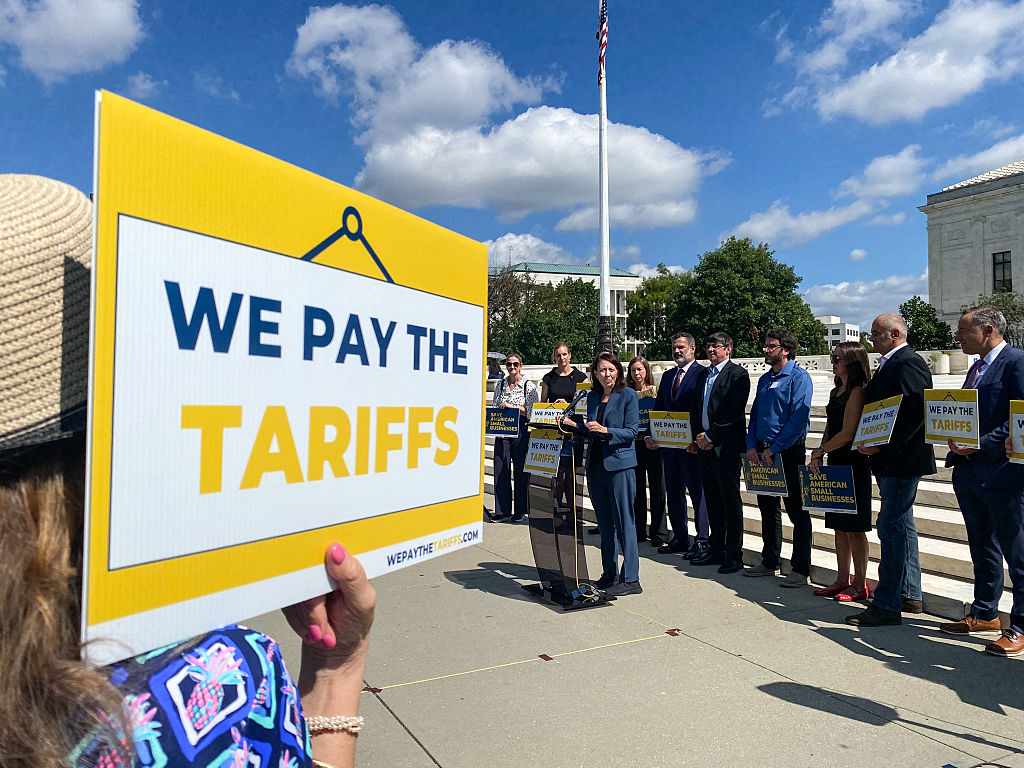
Both Wells and Powell are members of the group We Pay the Tariffs, which is comprised of over 1,000 small businesses that opposed Trump’s tariffs.
Who is eligible for the refund?
Tariff refunds are not automatic for businesses that were impacted in the last year. Instead, businesses and importers will need to submit a claim request through the portal for processing.
Powell says the process was extremely easy, and all he needed to upload was a simple spreadsheet with one column, containing the import entry numbers that had an IEEPA tariff applied.
The refund system will initially focus on the first phase of payouts, which will be limited to “certain unliquidated entries and certain entries within 80 days of liquidation,” according to federal guidance. Once refund requests are approved, it could take 60 to 90 days to return the money to the importer.
According to court filings last week, the system can handle about 63% of affected import filings. Eventually, the new refund system, called Consolidated Administration and Processing of Entries (CAPE), will be able to refund older, finalized tariff payments.
Refunds will be issued electronically, which has been the CBP’s policy since early February.
Will consumers receive refunds?
In addition to American importers, U.S. consumers have been heavily affected by higher prices and supply chain issues brought on by Trump’s tariffs.
One study published in January this year by the Kiel Institute, an independent economic research institute based in Germany, found that 96% of the tariff burden is passed through to U.S. buyers.
“Whether through higher prices on imported goods, higher prices on domestically produced goods that use imported inputs, or reduced availability and variety of products, American households pay for the tariffs,” the study found.
According to the Congressional Joint Economic Committee, American families have paid more than $1,700 in tariff costs each.
Yet it is unlikely that consumers will see compensation for price increases over the last year.
Consumers cannot apply for refunds. Some businesses, like shipping giant FedEx, say they will try to pass their refunds to customers who originally bore those charges. Other businesses, meanwhile, have said they will lower prices for consumers instead.
“As we've done in the past when legal challenges have recovered, charges passed on in some form to our members, our commitment will be to find the best way to return this value to our members through lower prices and better values,” Ron Vachris, CEO and President of Costco, said during a March earnings call.
Hence then, the article about trump administration begins refunding tariffs what you need to know was published today ( ) and is available on Time ( Middle East ) The editorial team at PressBee has edited and verified it, and it may have been modified, fully republished, or quoted. You can read and follow the updates of this news or article from its original source.
Read More Details
Finally We wish PressBee provided you with enough information of ( Trump Administration Begins Refunding Tariffs. What You Need to Know )


Also on site :
- The Least Worried Man in AI Has a Plan to Rein in Rogue Agents
- AMD acquires startup cofounded by ‘godmother of AI’ Fei-Fei Li for $8.2 billion
- Fans Spot a Major Change to Taylor Swift’s ‘The Man’ Music Video During VMA Presentation — Easter Egg or Editing Error?