
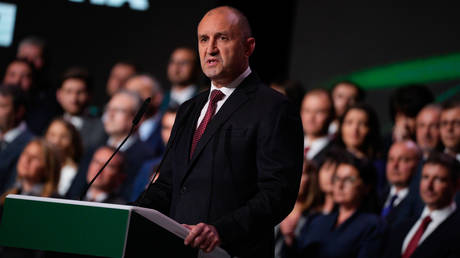
Brussels just can’t kick its irrational Russophobia, as Rumen Radev’s supposed friendliness towards Moscow has many up in arms
After eight snap elections in five years, Bulgaria’s Rumen Radev, a 62-year-old reform-minded pragmatist with much political (he’s a former president) and military (he's also a former general) experience has just managed to gain an absolute majority of seats in the national parliament. It is, according to Bloomberg “a landslide” and, for German mainstream flagship Spiegel, an “exorbitant victory.”
With this breakthrough, Radev’s party Progressive Bulgaria has also broken a long trend of inconclusive elections and now has very good chances of establishing a stable, lasting government after years of instability and scandals, climaxing in a full government collapse late last year.
Election participation was higher than usual, which is another signal of genuine popular support for Radev’s message and reinforces his mandate. Bulgaria has been suffering from prolonged gridlock and a massive crisis of public trust. No one can predict the future, but Radev promises a fresh beginning, and this election result at least provides a chance to make one. Moreover, Progressive Bulgaria’s voter appeal, polls show, has not only been deep but also wide: Gen-Z, older citizens, pro-EU voters and those often, in Western mainstream media, disparaged as “pro-Russian,” and, last but not least, Bulgaria’s expat voters – they are all in the mix.
While Progressive Bulgaria will not have the two-thirds majority to make constitutional changes without help from other parties, Radev will have enough seats to rule without a coalition partner. In a country where coalition building has become associated with sleaze and inefficiency that is an advantage. Especially if Radev makes good on one of his key campaign promises to fight corruption and the influence of what Bulgarians call the “oligarchy.”
In sum, Radev’s election victory should be grounds for if not celebration than at least optimism. All the more so since he is also ready to apply constructive pragmatism to Bulgaria’s relationship with the EU as well. In his own words, “what Europe needs right now is critical thinking, pragmatic action and results, especially building a new security architecture and recovering its industrial power and competitiveness […] That will be the main contribution of Bulgaria to its European mission.”
Read more Dialogue with Russia ‘must be restored’ – Bulgarian election winnerWhat’s not to love?
Plenty, it turns out, at least for some Western and especially EU observers struggling with their own biases and, really, phobias. Because, you see, there is a thing that Radev does not have: He does not hate Russia. Indeed, according to Spiegel, always EU-aligned to the point of obsequiousness, there is “disquiet in Brussels,” because Radev has “the reputation of being inclined toward Moscow.” What a delicate way of shouting “Russians under the Bulgarian bed!”
But it’s all the same anyhow: Radev stands accused of one of the worst heresies against Western and, in particular, EU doctrine. Being soft on and even Russia-friendly, as Bloomberg, for instance has put it. The catalogue of his alleged sins is short but impressive: he has objected to delivering ever more weapons to fuel the West’s proxy war against Russia in and via Ukraine; called Crimea Russian, does not believe in sanctions against Russia, and, in general, dares criticize EU foreign policy.
Radev, to be sure, has made no radical statements regarding Bulgaria’s membership in the EU or NATO, and observers generally agree that he is very unlikely to challenge either. It even remains to be seen whether now that he has power, he will repeat his attacks on Bulgaria’s mistake of adopting the euro. Yet all that moderation and pragmatism may not be enough for the true believers now dominating the EU. For them, the mere fact that Radev openly displays his lack of belief in the Ukraine war project and – correctly – hints that Europe’s future depends on inexpensive, that is, Russian, energy may well be enough to initiate a slide into ostracism.
For now, the message seems to be that the EU establishment does not expect Radev to become a second Victor Orban, the long-time leader of Hungary, that the EU has just removed by massive interference in Hungary’s domestic politics. But the essence of that conditional offer to try cooperating is, of course, really a warning or, to be more precise, a threat: Do not be Orban or else!
The irony of this uneasy relationship is palpable but worth restating: The issue is not that Radev is “Russia-friendly.” He is simply reasonable and pragmatic and that sets him at odds with the extremely irrational Russophobia that is maintaining a tight grip on the EU. While Western mainstream commentators are stuck on pondering whether Radev’s purported sympathy for Russia is a big or maybe just a small problem, they are, as so often, caught up in the wrong question. The problem isn’t “Radev and Russia” at all. It is that for so many in the EU, the only good relationship with Russia is a bad one, a very, very bad one, please.
Hence then, the article about bulgaria is not going pro russia the eu is just paranoid was published today ( ) and is available on Russia Today ( News ) The editorial team at PressBee has edited and verified it, and it may have been modified, fully republished, or quoted. You can read and follow the updates of this news or article from its original source.
Read More Details
Finally We wish PressBee provided you with enough information of ( Bulgaria is not going ‘pro-Russia’ – the EU is just paranoid )


Also on site :
- ‘Avengers: Endgame’ retakes box office crown; Robert Pattinson drives sales for ‘Primetime’
- 1977 Fleetwood Mac Hit Was Recorded in the Wrong Key After a Day of Perfecting Its Iconic Guitar Sound
- The 1994 Film That Made This 1 Nail Color a Cultural Phenomenon—and Why It’s Back, Manicurists Explain