
This article is part of The D.C. Brief, TIME’s politics newsletter. Sign up here to get stories like this sent to your inbox.
Need proof the political map is turning against Republicans? Just spy the $79 million that the Senate GOP’s super PAC set aside this month for Ohio, a state President Donald Trump carried all three times and where Democrats last won a statewide election in 2018. Or the fact that that eye-popping sum wasn’t enough to keep D.C.’s gospel of political handicapping from shifting the race’s status from “Lean Republican” to “Toss Up.” Or the fact that the Republican incumbent in that seat just keeps giving the digital Democratic trolls fodder to make his campaign more difficult.
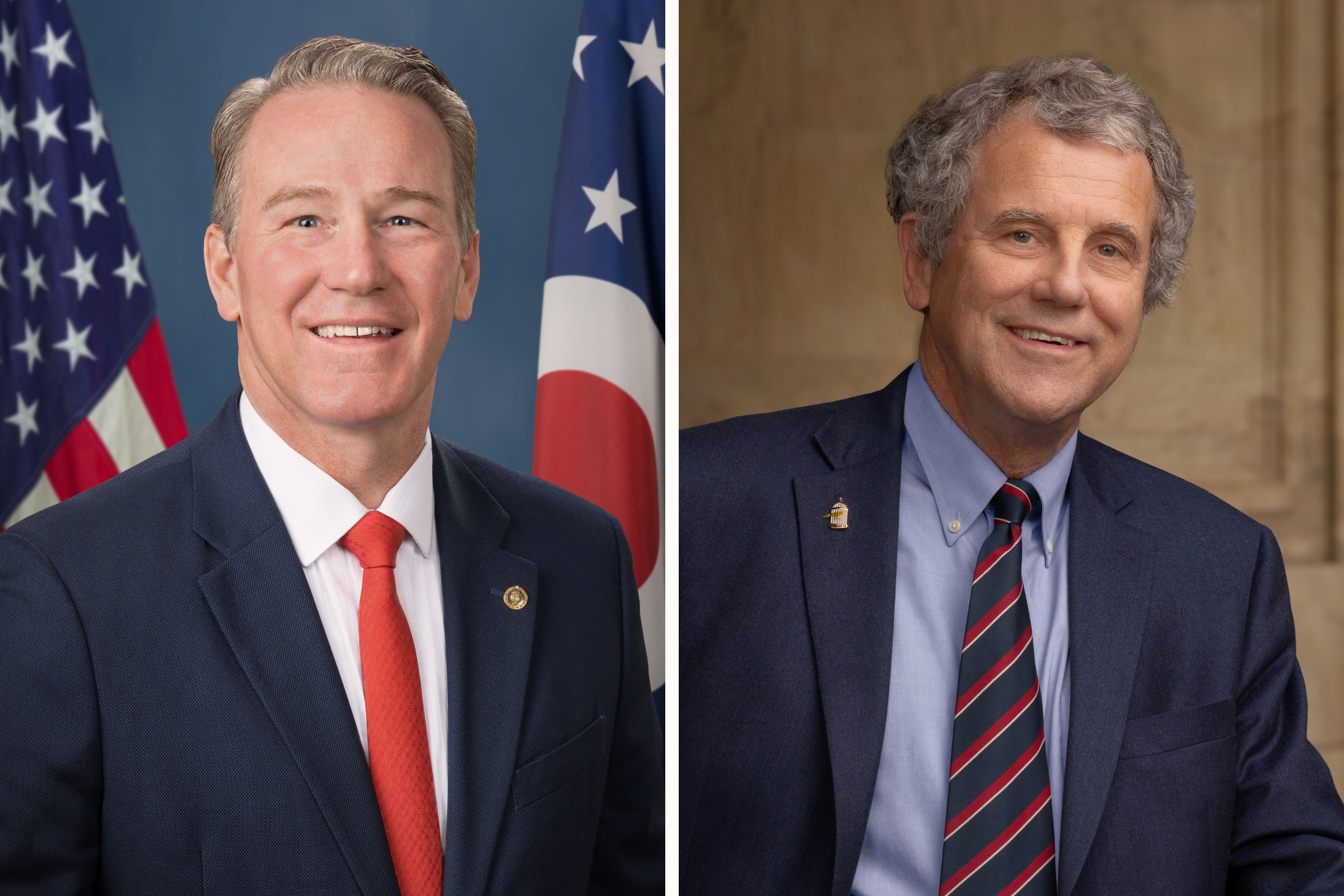
None of this was on the radar when Trump returned to office a little more than a year ago. The thinking around Washington was that Jon Husted, who was put in his seat after J.D. Vance left it to become Trump’s right-hand hatchet man, would be a responsible custodian who could coast through this November’s special election to finish out the balance of Vance’s term. After all, Husted had done just about every job in state politics and had been around long enough to get the game.
But then Democrats persuaded Sherrod Brown back onto the field. Brown, a progressive who can credibly slide into Trump’s populist register, was the runner-up to become Hillary Clinton’s running mate in 2016 and he eyed his own race for the top billing in 2020 before deciding against it. A union hall hero and disheveled everyman, Brown had been the rare Ohio Democrat who would win statewide—at least until an unexpected defeat in 2024 that was driven by the national mood more than anything. (Despite it being the most expensive Senate race that year, Brown still ran eight points ahead of Kamala Harris’ White House campaign.)
Even with Brown on the ballot, Republicans were still feeling confident as recently as December that Ohio wouldn’t be a trouble spot on the Senate map. Ohio, like Florida, the other ultimate swing state, no longer offered much swing in its election results. Republicans had been running the table in Ohio for years now.
Nonetheless, Republicans are now panicking about Ohio. The clearest sign came earlier this month when the Senate Leadership Fund, the outside political operation with close ties to Senate Majority Leader John Thune, released its spending plan. Of a massive $342 million the group plans to spend to keep Thune in that role in 2027, the biggest amount—$79 million—is going to Ohio.
"Senate Leadership Fund is deploying the resources necessary to ensure Sen. Husted is elected in November and Ohioans are rid of Sherrod Brown once and for all,” said the head of that outside group, Alex Latcham.
Democrats, meanwhile, crowed about the fact their GOP rivals spotted the trouble. “This announcement is a sign Republicans are nervous, plain and simple. Their battleground map has increased substantially, and we're seeing the tell-tale signs of weakness with bad candidates, uninspiring messaging, and an approval rating in the pits,” Senate Democrats’ super PAC spokesperson Lauren French said. She did not address how much cash the Senate Majority PAC was ready to invest in the race.
Despite the Brink’s truck of cash backed up to the Husted campaign’s loading dock, the nonpartisan Cook Political Report shifted the race away from the “Lean Republican” status and into a true “Toss Up” category last week. (At the same time, Cook moved North Carolina and Georgia to “Lean Democrat” from “Toss Up,” and Nebraska slid from “Solid Republican” to “Likely Republican.” All signal trouble for GOP candidates.)
Republicans’ main task at this point is to play defense, and no race illustrates that better than Husted, who got that job a little more than a year ago, taking over for Vance.
Husted, a fixture of Ohio politics dating back to his first campaign in 2000, is known in Ohio—as well as anyone who served in the state legislature, state Secretary of State, or Lieutenant Governor can be, that is. Most polls show him with the advantage, but it’s a darned narrow one.
Husted’s may be a veteran of the campaign trail, but he’s making the mistakes of a rookie, serving a string of comments ready-made for attack ads, like saying the solution to high prices is to “earn more” and claiming Ohioans’ “work ethic is broken” and that they are “not very experienced at navigating the real world.”
Then he had to take the stand last month in a public corruption case that accused former energy executives of bribing a utility regulator in the state that resulted in passed-on energy costs to households. That Husted attended a dinner where the execs lobbied state officials made for bad headlines but, to be clear, Husted had not been accused of any wrongdoing. The trial ended last month with a hung jury.
Democrats have also been hammering Husted for taking more than $115,000 in campaign cash from an associate of disgraced financier and convicted sex offender Jeffrety Epstein. Husted says he is donating the money he received from Les Wexner out of politics.
That’s not to say Brown is without his baked-in dings. Before leaving the Senate last year, he had been in politics dating back to his first campaign that began while he was still a student at Yale, way back in 1974. He’s a close ally of Sen. Bernie Sanders, a foe of Wall Street like Sen. Elizabeth Warren, and an unapologetic liberal on domestic priorities like a social safety net and workers’ rights. In his last campaign, a brutal $34 million in attack ads targeted Brown for his support of transgender rights. Despite decades excoriating NAFTA and offshoring of jobs, Republicans still see opportunities to cast Brown as just another elitist globalist who also happens to be a career politician.
Most polls indicate a slight advantage for Husted but Brown is crushing the fundraising race. He raised $10.1 million in the first three months of the year; Husten raised $2.9 million. Brown has $16.5 million banked while Husted has $8.2 million.
Cash in Ohio, however, is hardly predictive; the last time Brown was on the ballot, he spent $101 million and his allies dumped another $112, while GOP rival Bernie Moreno spent $26 million and his allies added $184 million. Brown lost by almost 4 points.
That’s why strategists in both parties are keeping close watch of Ohio: it has proven a tough prize for Democrats for years but the national mood is one that has Republicans rightly skittish. The fact that a thrice-Trump state is even on the map in 2026 speaks volumes.
Make sense of what matters in Washington. Sign up for the D.C. Brief newsletter.
Hence then, the article about when no one was looking ohio became a swing state again was published today ( ) and is available on Time ( Middle East ) The editorial team at PressBee has edited and verified it, and it may have been modified, fully republished, or quoted. You can read and follow the updates of this news or article from its original source.
Read More Details
Finally We wish PressBee provided you with enough information of ( When No One Was Looking, Ohio Became a Swing State Again )


Also on site :
- Zelensky’s endgame, Houthi dominance, German decline: RT stories that shaped the week
- Americans Affected by 2024 Data Breach Could Claim Up to $5,000 From Settlement — How to Check If You Qualify and What You Need to Submit
- Centron und Tsinghua University unterzeichnen eine Vereinbarung über die Zusammenarbeit bei Forschung und Entwicklung