
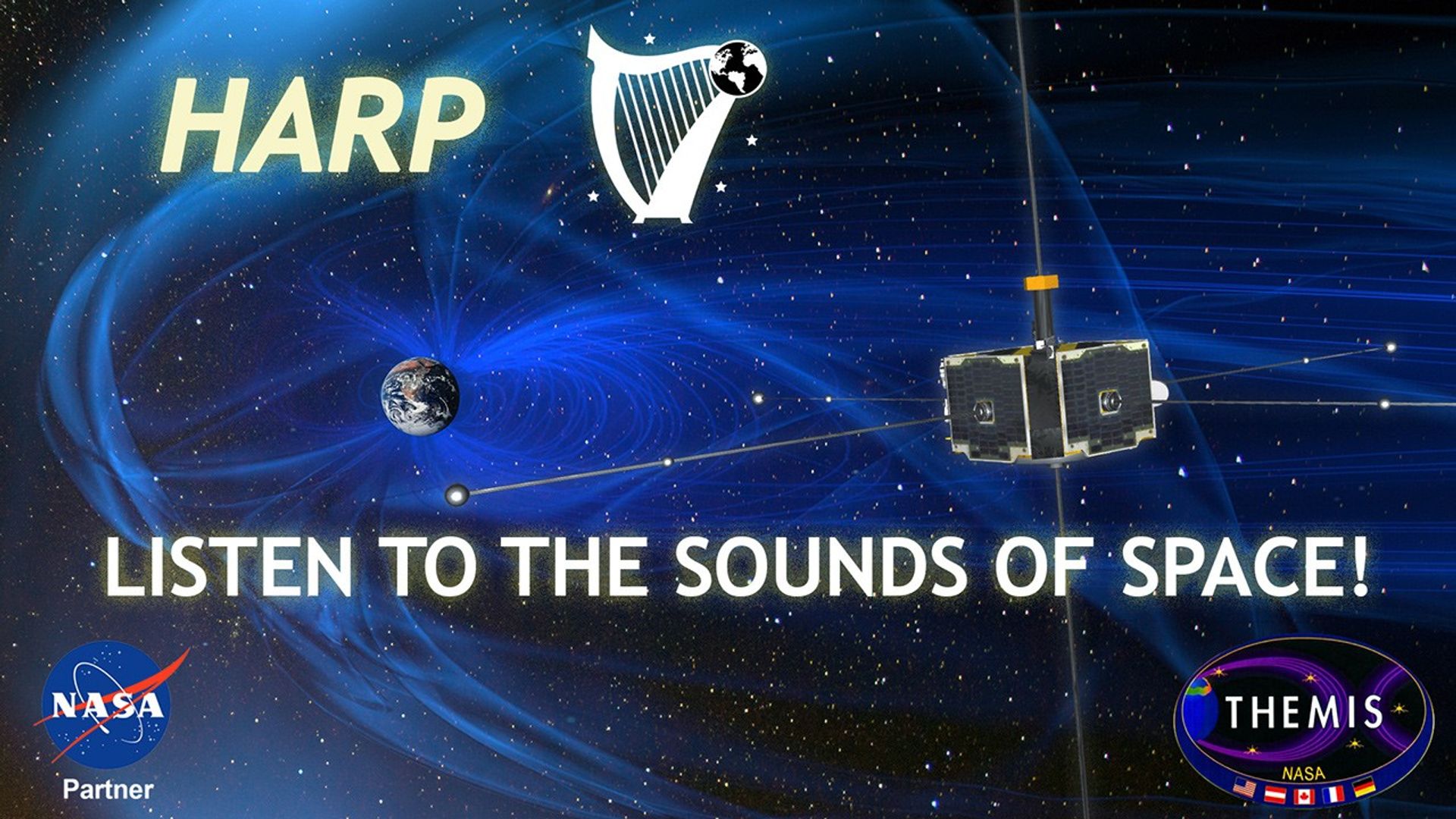
Our planet rests inside a magnetic cocoon filled with plasma – but it’s not always peaceful and quiet. Activity from the Sun can send waves through this space, and some of those disturbances can even reach Earth, affecting our power grid.
Scientists are working to understand exactly how these waves behave, and the team behind NASA’s Heliophysics Audified: Resonances in Plasmas (HARP) citizen science project approaches this in a unique way: they compare the Earth’s magnetic field to a giant harp in space. The HARP team translated magnetic field measurements into sound. This translation allowed HARP project volunteers to use their ears to study a particular type of plasma wave that plays a role in space weather. What they heard surprised everyone.
The science team expected lower pitches farther from Earth and higher pitches closer to it. But when they played back data from NASA’s THEMIS (Time History of Events and Macroscale Interactions during Substorms) mission, volunteers noticed something unexpected. Some plasma waves revealed the opposite pattern – lower pitches close to Earth and higher pitches farther away.
The HARP volunteers were thrilled to help discover this anomaly, which will help scientists better understand geomagnetic storms. One volunteer said of the HARP project, “I only signed up for this group because my friend was participating, but now I think I’m going to change my major to physics – this was just too cool.” These findings now appear in a new article in Frontiers in Astronomy and Space Sciences.
Thank you to all the HARP volunteers who helped develop the project’s audio analysis protocol, beta tested the graphical user interface, and identified and labeled the myriad plasma waves that the team will be studying for years to come.
The HARP project was sponsored by NASA and continues to be sponsored by the National Science Foundation. The project is no longer actively seeking volunteers.
HARP volunteers uncovered unexpected patterns in plasma wave activity near Earth using data from the NASA THEMIS mission. Image credit: Emmanuel Masongsong and the HARP team Credit: Emmanuel Masongsong and the HARP team Facebook logo @nasascience_ @nasascience_ Instagram logo @nasascience_ Linkedin logo @nasascience_Share
Details
Last Updated Apr 17, 2026Related Terms
Citizen Science Heliophysics Heliophysics DivisionExplore More
4 min readNASA Data Hackathon Inspires Community Action
Article 4 weeks ago2 min read
Hail Yeah! NASA Researchers Use Volunteer Observations for Hail Estimates
The bigger the hailstone, the more damage it can cause. But scientists find that predicting…
Article 1 month ago7 min read
To Protect Artemis II Astronauts, NASA Experts Keep Eyes on Sun
Article 1 month ago
Hence then, the article about volunteers discover rare space weather events using their ears was published today ( ) and is available on NASA ( Middle East ) The editorial team at PressBee has edited and verified it, and it may have been modified, fully republished, or quoted. You can read and follow the updates of this news or article from its original source.
Read More Details
Finally We wish PressBee provided you with enough information of ( Volunteers Discover Rare Space Weather Events Using Their Ears )


Also on site :
- Rush-Henrietta Senior High School went into lockdown due to fight, superintendent says
- After a decade of failed bills and three years of resignations, Washington finally discovers it cares about AI safety
- More Than 1 Million Americans Are Taking Ozempic and Other GLP-1s Without an Approved Reason. Is That Actually a Problem?