
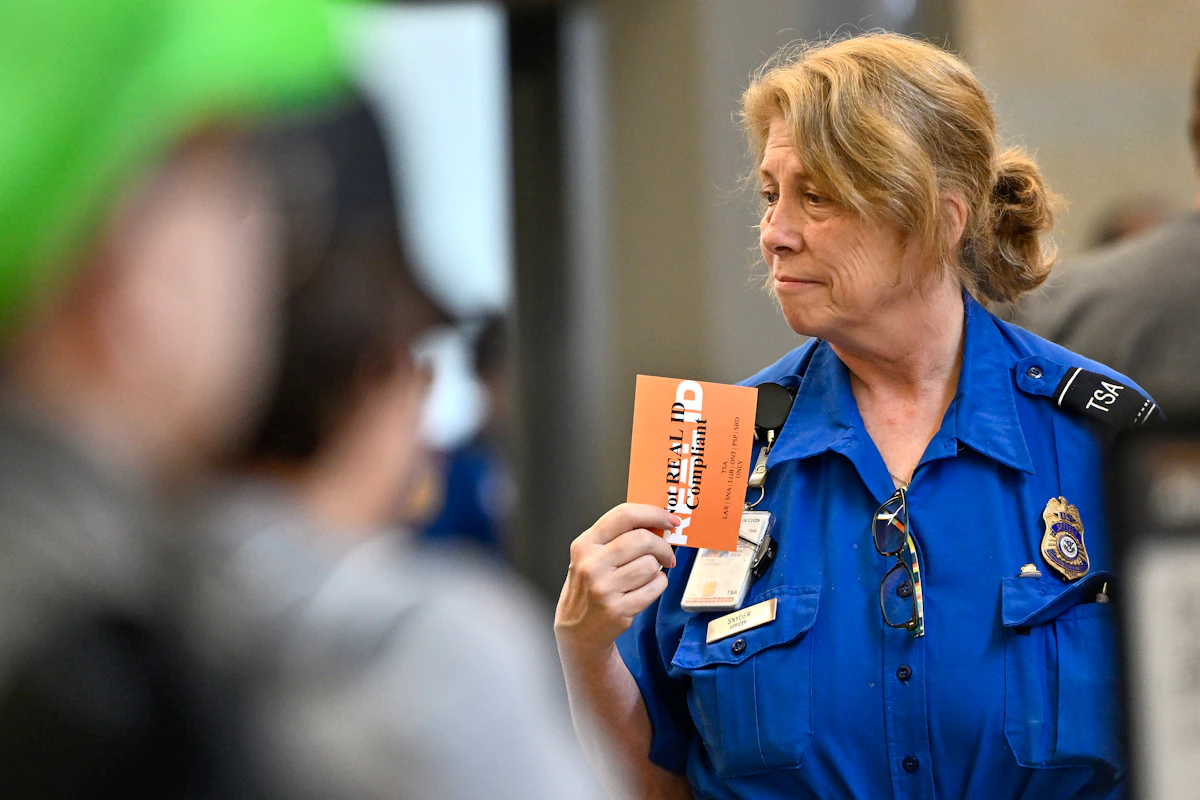
President Donald Trump and the conservative think tanks that inspire his policies want to privatize the Transportation Security Administration screeners who check your bags and bodies before you fly. It’s been a goal of theirs since Trump’s first term—the Heritage Foundation has been banging on about it since at least 2017—but they’ve re-upped the call amid Congress’s stalemate over Department of Homeland Security funding, which is now in its ninth week. “Shutdown woes show why it’s time to privatize the TSA,” the libertarian Competitive Enterprise Institute declared in March. And Trump’s budget request to Congress earlier this month called for privatizing the TSA, as it did last year.
So the answer to long airport lines isn’t, apparently, for Republicans to reach a deal with Democrats that funds DHS while also implementing ICE reforms. It’s simply to hand over airport security to the private market.
These proponents make claims that echo other arguments in favor of the private market—that it improves quality and efficiency—and note that the U.S. airports that employ private security screeners have run smoothly amid the shutdown. But there isn’t a lot of evidence that privatizing the TSA would indeed make airport security smoother and cheaper. It would, however, reduce the federal government’s workforce and possibly save on employee salaries and benefit costs, since TSA workers are unionized and private screeners usually are not. And that, perhaps, is why Trump and his ilk are so keen on it.
We don’t really know what fully privatizing the TSA would accomplish because there hasn’t been a ton of good data collected and analyzed about the private airport security that exists now. The TSA was created in the immediate wake of 9/11, replacing passenger screening that had been handled by airlines, which often contracted with private companies. But in 2004, Congress passed a law creating a TSA pilot program that allowed airports to apply to hire private companies to perform security screenings overseen by the agency. The Screening Partnership Program became permanent after the pilot ended, and 20 airports use it today. Most of them are small, but participants include San Francisco’s and Kansas City’s international airports. In a sense, using private companies to screen passengers goes back to pre-TSA days, but today they have to follow the same stricter rules and procedures that TSA screeners do, and they have to qualify to be a TSA vendor. There are 27 companies eligible to provide airport screening, and many also provide security for other government agencies and buildings.
The Government Accountability Office evaluated the program several times from 2009 to 2015, and Tina Sherman, who leads the GAO’s Homeland Security and Justice Team, told me the evaluations suffered from imperfect data. “While it will save tax dollars if they take money off the books to pay private screeners and no longer pay the federal workforce … there are a lot of questions about just costs in general,” she said.
Early reporting from the program failed to account for the costs of things like employee benefits, and didn’t fully compare private company performance metrics to the federal government’s performance metrics. The GAO recommended in 2012 that the TSA regularly report that data to Congress, but there hasn’t been a comprehensive evaluation since then. So it’s hard to say whether the program is more cost-effective.
The law creating the program also required that private security operators prove they’re meeting or exceeding the safety standards set by the TSA, but they can’t exceed what it would cost the federal government to screen at that airport. One way those companies might save money is by cutting worker pay. The federal workforce is heavily unionized compared to the private workforce, and the TSA screeners’ union argues that privatization is just a way to cut pay and benefits. Nothing prevents private security screeners from being unionized, but it’s also not guaranteed, and rates of unionization in the private sector remain much lower than in the federal government. That usually does translate to lower pay and fewer benefits.
Sherman said one thing privatization wouldn’t change is the stressful and demanding nature of the job. She pointed to a 2023 GAO study on morale of TSA screening officers and found that they had low job satisfaction, despite a small improvement in morale from a recent raise. It’s hard for them to call out sick, take breaks, or find opportunities for advancement because of the demands of the job, leading to a lack of work-life balance and complaints about management practices. “This is a difficult job,” she said. Private-sector contractors face the same demands in the same environment. “Being at the airport, how the shifts run, the kind of customer interactions because everybody wants to just get on their flight, because all of the technologies and procedures for screening are exactly the same, even though the individual is being paid by someone else, those pressures remain,” she said.
Even if airport screening were fully privatized, the federal government would continue to oversee airport security and thus would still have to ensure that private companies are meeting the necessary standards—so there would still be federal workers involved and costs associated with privatization. And it’s not clear that there would be other benefits to privatization. Because airport screeners provide an essential service—public safety—it’s not easy to compare their privatization to other such efforts. But when other countries have privatized mail services, for example, the service level hasn’t measurably improved, and while some generate profits they also struggle in hard times, like many industries do. While screeners working for private companies aren’t subject to the current shutdown, they’re still vulnerable to the kinds of layoffs and downturns that affect private companies everywhere.
Republicans have been calling to privatize chunks of the federal workforce since the Reagan era, and the results have been mixed. Elliott Sclar, an urban planning professor at Columbia University, wrote in a 2001 book that it is too complex and inefficient to transfer some public services to the private domain. And he argues that Americans are so suspicious of the government that anything that could have been privatized likely has been by now. “The reason we have so little privatization despite two decades of an ideological full-court press to change that is because Americans are also pragmatists,” he wrote.
It’s worth considering that airports haven’t rushed to sign up for the program since the GAO last evaluated it in 2015, either. “They’re all essentially the same as the ones that had been operating a decade or more ago,” Sherman said. “This [program] has been available, but it’s not something that airports have necessarily taken advantage of.… I can’t opine at all as to why.”
It’s clear that the Trump administration has an ideological interest in dismantling the federal workforce, whether it’s good for the U.S. or not. This is the second time in Trump’s second term that a fight over funding has shut down at least some federal agencies, and voters increasingly disapprove of his leadership and that of the Republican Party. The administration likely doesn’t have enough goodwill from voters to make a big change like privatizing all airport security operations. The last thing Americans want at this point is for more disruptions when they travel.
Hence then, the article about the real reason republicans want to privatize the tsa was published today ( ) and is available on The New Republic ( Middle East ) The editorial team at PressBee has edited and verified it, and it may have been modified, fully republished, or quoted. You can read and follow the updates of this news or article from its original source.
Read More Details
Finally We wish PressBee provided you with enough information of ( The Real Reason Republicans Want to Privatize the TSA )


Also on site :
- Jordan Peele’s Monkeypaw Productions and Universal Film Team With American Cinematheque and Beyond Fest for ‘No Drama’ Initiative (EXCLUSIVE)
- VMAs Producer Van Toffler on Nirvana & George Michael Tributes at 2026 Awards and Why the VMAs Are Best at Their Most ‘Age, Genre & Color Blind’
- ‘America’s Got Talent’ 2026 Finale Moves to New Time Slot Tonight: Here’s How to Watch