
Often attributed to Mark Twain — perhaps mistakenly, since no historical source shows he actually made the statement — “History doesn’t repeat itself, but it often rhymes” is a common and apt refrain when discussing the connection between historical perspectives and current events. By drawing on knowledge of what happened in the past, and why, we are better able to understand the flow and direction of the history collectively created in each new day.
“Past Rhymes With Present Times” is a series by Lloyd S. Kramer exploring historical context and frameworks, and how the foundations of the past affect the building of the future.
All great empires and dominant national states have eventually confronted the limits of their power and struggled to manage their declining influence in global affairs.
This familiar pattern of world history is now shaping political transitions and fears in the United States, but our MAGA president and his political allies are demolishing the structures of America’s global power with an ahistorical efficiency that few declining “great powers” have ever matched.
Why Great Powers Lose their Dominance
Wars and successful military campaigns have helped every great power widen its international influence, broaden its economic advantages, and expand the territories it controls. Historical expansions reshaped nations such as China, Spain, Britain, France, and Germany (not to mention the ancient Athenian and Roman empires), and a similar historical trajectory transformed the United States into the outstanding modern example of global power after the Second World War.
An impressive combination of military victories, economic productivity, and global trade gave Americans an unrivaled international influence for almost a century, though this expanding global role also led the United States into huge military expenditures, numerous wars, and growing vulnerability to the endless evolution of global economic power.
Great powers typically lose their international dominance when they become bogged down in imperial overreach and expensive wars that weaken their economic and military position (relative to the rising power of other nations).
Historians have described such declines in every great imperial power from ancient Rome to modern Britain, but one of the best descriptions of “overextension” appears in Paul Kennedy’s classic book, The Rise and Fall of the Great Powers (1987). Kennedy examined diverse examples of national expansion and decline before the United States plunged into the labyrinth of its multiplying Middle Eastern Wars (ranging from Iraq in 1990 and 2003 to Iran in 2026), but his analysis of national crises discussed early legacies of America’s military defeat in Vietnam.
Americans might have drawn valuable lessons from this painful failure, yet our twenty-first-century wars have extended the national vulnerabilities that first appeared in Vietnam and continue to facilitate the ascendance of China and other geo-political states.
Great nations cannot fight or spend their way beyond the “overreach” and limits of their military power, but President Trump is now intensifying the historical trends of national decline by shattering American alliances, promoting self-destructive tariffs, and launching a war against Iran that has required escalating military expenditures.
According to its most recent budget proposal, the Trump administration wants to increase the military budget to $1.5 trillion in the coming fiscal year (a 44% increase) and to reduce the government’s support for environmental protection, agriculture, health care, education, and renewable energy by at least $73 billion.
This Trumpian budget therefore offers excellent examples of what Paul Kennedy describes as the historical crisis that emerges when “too large a proportion of the state’s resources is diverted from wealth creation and allocated instead to military purposes” and when a state “overextends itself” through the “waging of costly wars.”
International systems thus evolve because (to quote Kennedy again) “economic strength and military strength are always relative” and because the “inexorable tendency” toward change assures that “international balances” never stand still.
These are the kinds of structural problems that Donald Trump and Pete Hegseth have ignored while pursuing a costly, vaguely defined war in Iran and while China has watched patiently from the sidelines—without firing a missile, expending a single high-tech weapon, or expanding a national debt in faraway wars.
The Costs of Warfare and The Failures of Air Power
The United States was unquestionably the greatest global power after 1945. In addition to generating almost half of the world’s industrial production, it reorganized the global financial system and constructed alliances in Europe and Asia that reinforced its unassailable military and economic influence.
This dominance was bound to decline, but the Vietnam War (1964-1973) drained roughly $170 billion from American government budgets (or almost $1 trillion in current dollars), diverted funds from public plans to reduce poverty, and shattered the “New Deal coalition” that had advanced social reforms and human rights through complex political collaborations.
Equally important for America’s enormous military power, the war in Vietnam showed that even the greatest air bombardment could not defeat a determined military-political opponent on the ground. Operation “Rolling Thunder” (1965-1968) and other air campaigns that continued to expand until the end of 1972 dropped more than 4.6 million tons of bombs on military and transportation systems and may have killed more than a million Vietnamese soldiers and civilians.
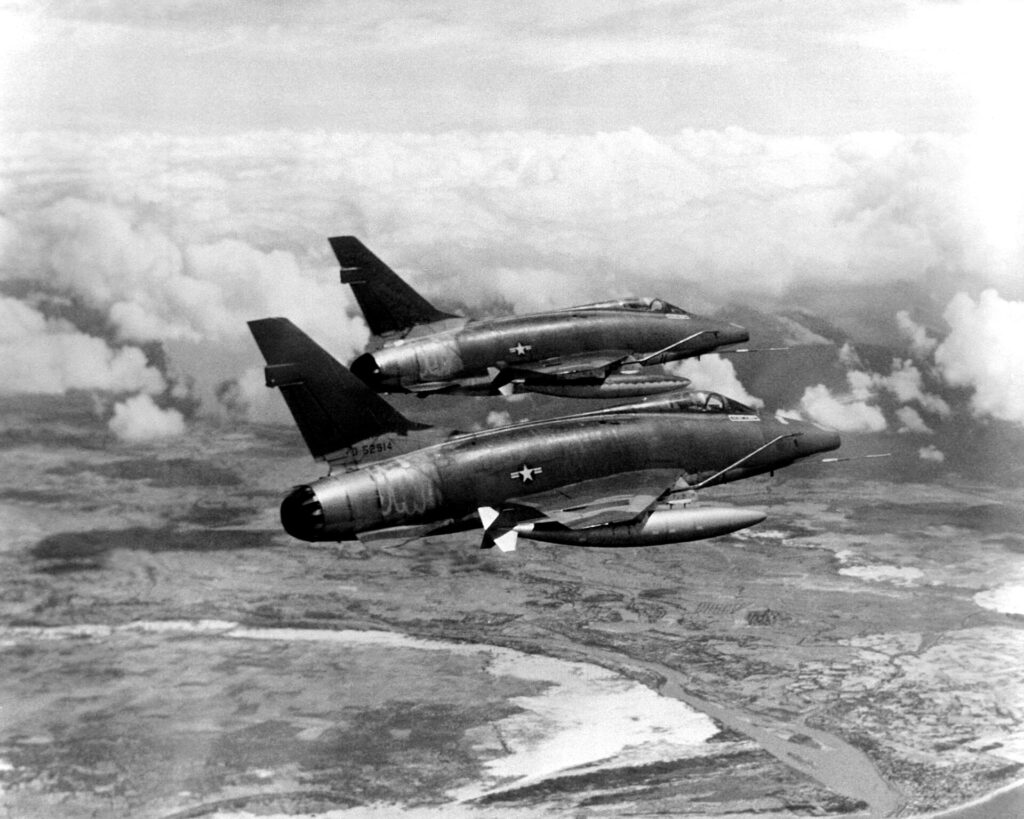
Two U.S. Air Force North American F-100D Super Sabre aircraft over South Vietnam in 1967. (photo via USAF / Wikimedia Commons)
Yet this massive air assault and the intervention of 500,000 American ground troops could not establish a stable government in Saigon or defeat the scattered North Vietnamese army.
The war in Iraq (2003-2011) also began with huge aerial bombardments that were designed to overwhelm Iraqi forces through “shock and awe,” but this costly campaign was also stymied by ground-level resistance and the violent turmoil that followed both the initial assaults and the collapse of Iraq’s previous governing system.
The huge loss of human life was incalculable, but later estimates of American expenditures placed the total direct and indirect costs of the nation’s Iraq-Afghanistan wars at more than $4 trillion (including weaponry and veterans’ health care that will continue for decades).
Now the Trump administration has launched another expensive war, which consumed more than $11 billion over the first six days, generated proposals for a $200 billion supplement in the current Pentagon budget and led to the new $1.5 trillion plan for military expenditures.
These funds must come from an American economy that now produces roughly 17% of global manufacturing output (compared to America’s 45% in the early 1950s and China’s 27% in 2025); and such expenditures will quickly expand an American national debt that is already exceeding 39 trillion dollars and restructuring the global balance of financial power.
The military and economic history of declining “great powers” is therefore reappearing in Trumpism’s domestic and global policies. In most general terms, such policies contradict all claims that President Trump is making “America Great Again” and hasten the global displacement of America’s once exceptional economic, political, and military power.
A solo US Air Force (USAF) B-52 Stratofortress Bomber from the 40th Expeditionary Bomb Squadron (EBS) flies back to its home station after striking multiple targets deep in Iraqi territory, in support of Operation IRAQI FREEDOM. (photo via Department of Defense / Wikimedia Commons)
Great Power Transitions and the “Thucydides Trap”
I still remember the annual “Thomas Lambeth Distinguished Lecture” in 2017 at UNC, Chapel Hill, where the native North Carolinian (and Harvard professor) Graham Allison discussed an idea he found in the ancient Greek historian Thucydides (c. 460-400 BCE).
Allision called this concept the “Thucydides trap” and noted how it referred to the “dangerous dynamic that occurs when a rising power threatens to displace a ruling power.” As Thucydides explained in his historical account of the Peloponnesian War, the leaders of Sparta wanted to counter the dominant Athenians whose imperial system blocked the rising power of other Greek states. Athens had continually expanded its military ambitions after great victories in earlier wars, but it was “the fear that this [expansion] instilled in Sparta that made war inevitable.”
This specific Spartan fear led to catastrophic Athenian defeats in the Peloponnesian War after 431 BCE, yet Allison argued more broadly in his lecture and in a longer book (Destined for War: Can America and China Escape Thucydides’s Trap [2017]) that similar transformational conflicts have emerged in numerous other historical eras.
A rising power believes “I’m stronger, I deserve more say,” so it seeks to displace a dominant power that believes the upstart nation “should be grateful” for the international “order that we designed and oversee.”
Allison’s account of this recurring historical rivalry implicitly endorses Paul Kennedy’s argument that previously dominant empires or states lose power as they spend more money on military campaigns and less on productive internal investments. It is thus significant (in Allison’s view) that China built some 16,000 miles of high-speed rail transportation during the decade before 2017, while the United States could not complete even one 500-mile high-speed rail project in California.
Meanwhile, the Chinese government rapidly expanded its economic and military power during the years that Americans spent trillions of dollars in Middle Eastern wars, exploded vast quantities of expensive weaponry, and lost commerce to Chinese traders throughout the global economy.
Allison’s longer book on “Thucydides’s Trap” interprets this recent history of contrasting global action with a quotation from the ancient Chinese military writer Sun Tzu (c. 544-496 BCE), who argued that “Ultimate excellence lies not in winning every battle, but in defeating the enemy without ever fighting.”
Most American leaders seem to ignore this strategic insight, but Allison notes how his former teacher at Harvard, Henry Kissinger, recognized in 2012 that Chinese theorists had long believed they could best defeat an enemy by “maneuvering him into an unfavorable position from which escape is impossible.”
Kissinger’s latter-day summary of Chinese strategic thinking may have come (ironically) from a retrospective personal understanding of the American government’s “unfavorable position” at the end of the Vietnam War, but we can still find helpful perspectives on the current Iranian crisis and America’s global decline in the themes that Kennedy, Allison, and Kissinger developed in their historical narratives.
The impulsive, authoritarian instincts of Donald Trump and his sycophantic advisors have carried the United States into an economic and military disaster from which an easy escape is “impossible.”
Although Great Powers have constantly risen and declined during all the centuries of world history, America’s current leaders are showing how these historical cycles can be accelerated when a self-destructive government completely ignores why great nations gain and retain their influence in global affairs.
Photo via Lindsay Metivier
Lloyd Kramer is a professor emeritus of History at UNC, Chapel Hill, who believes the humanities provide essential knowledge for both personal and public lives. His most recent book is titled “Traveling to Unknown Places: Nineteenth-Century Journeys Toward French and American Selfhood,” but his historical interest in cross-cultural exchanges also shaped earlier books such as “Nationalism In Europe and America: Politics, Cultures, and Identities Since 1775” and “Lafayette in Two Worlds: Public Cultures and Personal Identities in an Age of Revolutions.”
Past Rhymes With Present Times: Wars, Economics, and the Global Decline of American Power Chapelboro.com.
Hence then, the article about past rhymes with present times wars economics and the global decline of american power was published today ( ) and is available on chapelboro ( Middle East ) The editorial team at PressBee has edited and verified it, and it may have been modified, fully republished, or quoted. You can read and follow the updates of this news or article from its original source.
Read More Details
Finally We wish PressBee provided you with enough information of ( Past Rhymes With Present Times: Wars, Economics, and the Global Decline of American Power )


Also on site :
- Quote Of The Day By Helen Mirren: 'I Don't Think It's Good To Try To Change Anyone. Learn To Live With The Bits You Don't Like...'
- The Gates Foundation is spending $400 million on AI in schools. Teachers warn it could ‘end up widening’ the divide it’s meant to close
- ’60s Music Legend, Whose Hits Were Made Famous in ‘Top Gun’ and ‘Dirty Dancing,’ Turns 86 After More Than 60 Years in Music