
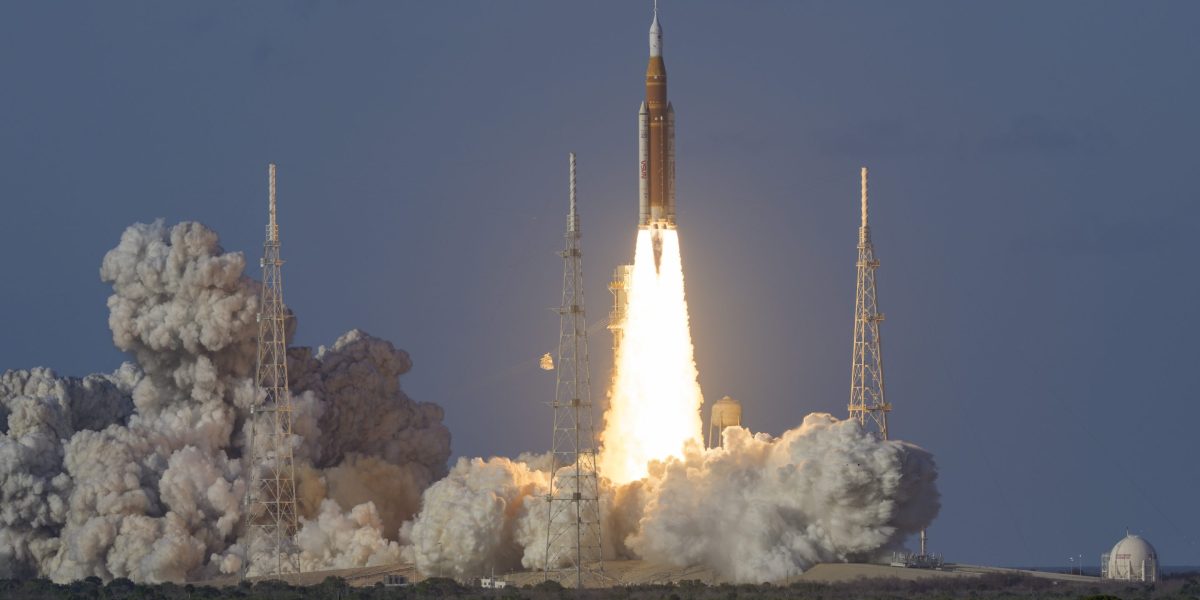
NASA’s Boeing Co. rocket just propelled astronauts farther into space than ever before. The Trump administration is already looking to competitors for a replacement.
About a week before the $24 billion Space Launch System pushed the four crew members of the Artemis II mission around the moon, NASA asked rivals what options they could offer for its ambitious plan of future lunar trips. That call, echoed almost immediately in the White House’s budget request, put a big question mark on the future of Boeing’s beleaguered rocket after roughly a decade of development.
The fate of the program — worth tens of billions of dollars over the next few years — has become a key test for Jared Isaacman, the billionaire fintech entrepreneur who President Donald Trump named to run NASA last year, in his efforts to make the space agency faster and more efficient. He’s counting on new commercial companies like SpaceX to provide cheaper alternatives to the costly systems like SLS developed by legacy players like Boeing and Lockheed Martin Corp.
“Because that program draws on such history, has contractors, hundreds of subcontractors, tens of thousands of people, it’s expensive,” Isaacman said in February. “It’s not the vehicle that you are going to take to and from the moon a couple of times a year as you build out a moon base the way the president wants.”
That network of support — Artemis counts suppliers in all 50 states — has helped the program survive efforts to kill it over years of delays and cost overruns. The administration’s attempt to phase out the SLS and the Lockheed-made Orion crew capsule in its budget request last year ran into fierce opposition on Capitol Hill, where lawmakers ultimately succeeded in blocking the cuts. Last week, the White House signaled that it will try again to find commercial replacements.
With a 2028 deadline looming to land astronauts on the moon before Trump leaves office and China planning its own mission by the end of the decade, Isaacman is under pressure to deliver. Although legacy providers like Boeing have struggled to meet deadlines in the past, their technologies are proven. New rivals like SpaceX and Blue Origin have yet to show their rockets can get to the moon.
Read More: Why the US, China and Others Are Racing to the Moon: Explainer
Isaacman has been turning up the heat.
In February, he announced that NASA would be canceling Boeing’s multi-billion dollar contract for a more powerful upper stage for the SLS rocket despite years of development. In March, he announced a pause on Gateway, a planned space station in lunar orbit, leaving international partners and companies involved scrambling to adjust. In its place, he outlined plans for a base on the moon’s surface and an accelerated slate of missions to build it.
“He is really trying to rely heavily on commercial space and competition,” said Dave Cavossa, president of the Commercial Space Federation, which represents companies like SpaceX and Blue Origin. “I think it’s the most pro-commercial administration, the most pro-change administration leadership we’ve ever seen.”
Artemis was created in the first Trump administration out of the remnants of a NASA program that had been cancelled by his predecessor but managed to limp along thanks to continued funding from Congress. By the time Trump returned to the White House last year, the holdups and price tag had grown.
A focus of the criticism is the SLS rocket, which has carried the Artemis missions into orbit at a cost of about $4 billion per trip — four times initial estimates and years behind schedule.
“We are not going to sit idly by when schedules slip or budgets are exceeded,” Isaacman said on Mar. 24. “Expect uncomfortable action if that is what it takes, because the public has invested over 100 billion dollars and has been very patient with respect to America’s return to the moon.”
A Boeing spokesperson said that the company is a proud partner in the Artemis mission. Tony Byers, Director of Orion Exploration Services and Transformation at Lockheed Martin, said that the Orion spacecraft is the only flight-proven deep space crew vehicle and that the company would continue to evolve the capsule to meet NASA’s planned increased flight cadence. NASA didn’t immediately respond to a request for comment.
When the White House proposed winding down SLS and the Orion spacecraft after just three flights in its budget request to Congress last May, lobbyists from contractors like Boeing and Lockheed Martin flooded Capitol Hill. They targeted Texas Senator Ted Cruz and Representative Brian Babin, whose districts rely heavily on the programs for jobs.
By July, Cruz led a push to reinstate about $6.7 billion to keep the program funded even as Republicans were lining up behind most of Trump’s other priorities.
“It speaks to the strength of the program to some key members of Congress and then those key members really acting to show that strength,” said Mike French, founder of the consulting firm Space Policy Group.
This year, the administration’s budget proposal doesn’t include a hard deadline for phasing out SLS and Orion, just the vaguer request to look for commercial alternatives. NASA also said it’s assessing other options for Artemis missions set to launch after 2028.
For the moment, SLS is the only rocket on the market that can do what NASA needs.
The lack of other options has allowed lawmakers to walk a tightrope between embracing a commercial alternative and defending the legacy architecture for now.
“I think we need to use what we have,” Babin said, pointing at the SLS rocket standing behind him at Kennedy Space Center on Apr. 1 shortly before the launch of Artemis II. “When we have an alternative, I think that would be great to have a commercial rocket or a government-owned rocket, whatever it takes.”
This story was originally featured on Fortune.com
Hence then, the article about boeing s moon rocket faces uncertain future under trump s nasa was published today ( ) and is available on Fortune ( Middle East ) The editorial team at PressBee has edited and verified it, and it may have been modified, fully republished, or quoted. You can read and follow the updates of this news or article from its original source.
Read More Details
Finally We wish PressBee provided you with enough information of ( Boeing’s moon rocket faces uncertain future under Trump’s NASA )


Also on site :
- Pulitzer-Winning Author’s Novel, Written in a Home Basement, Ranked ‘Greatest Book of the Last 20 Years’
- Anthropologie’s Multicolored Glass and Stone Hoops Add Vintage-Style Elegance to Any Look for Just $30
- Walmart’s ‘Whimsical’ Boucle Mushroom Storage Ottoman Looks ‘Trendy’ and ‘High-End,’ But It’s Now Under $30