
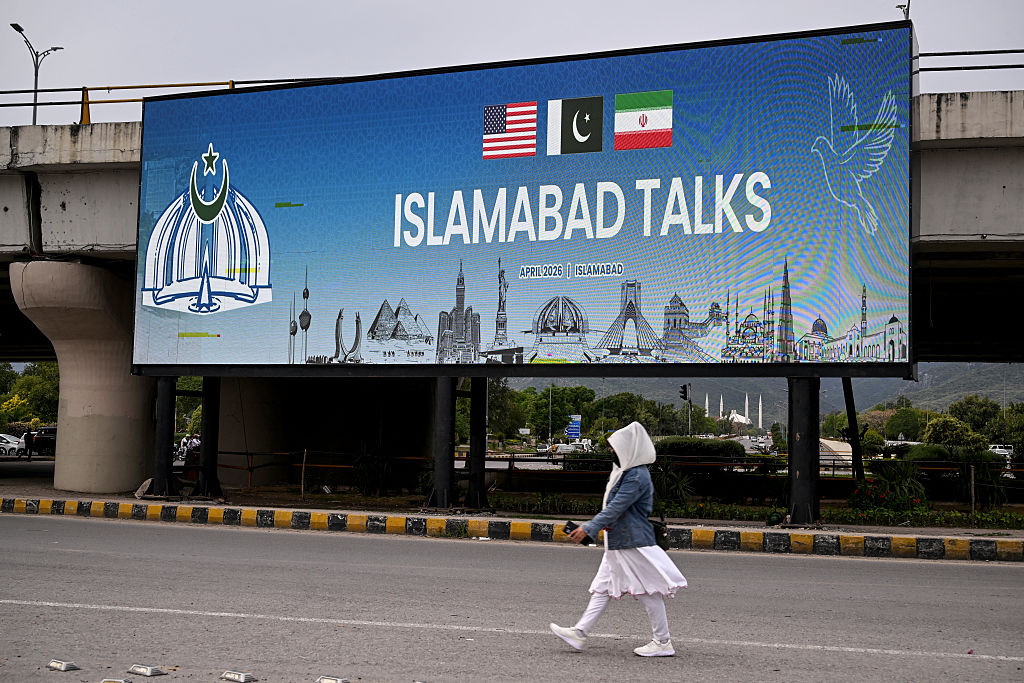
On Saturday, a delegation led by Vice President JD Vance is expected to meet with Iranian counterparts in Islamabad, Pakistan’s capital, to explore a diplomatic path out of the war between the United States, Israel, and Iran. The talks, facilitated by Pakistan, follow the Tuesday ceasefire that offered Iranians a moment of reprieve after days of dread, uncertainty, and threats, among them President Donald Trump’s rhetoric about the obliteration of Iranian civilization.
The ceasefire is brittle. Israel’s military strikes on Lebanon—which killed more than 300 people and wounded more than 1,150 on Wednesday alone—underscore the fragility of the ceasefire and threaten to derail the talks aimed at ending the war. Confusion over whether Lebanon was covered by the ceasefire, disputes over its terms, and Israeli Prime Minister Benjamin Netanyahu’s insistence on continuing military strikes on Lebanon all point to the same reality: the ceasefire is barely a tactical pause between actors whose core objectives remain fundamentally unchanged.
The ceasefire may never have been a ceasefire at all. It does not appear to be the product of a negotiated agreement with clear terms, enforcement mechanisms, and mutual concessions. Rather, it seems closer to an improvised halt in hostilities, possibly driven in part by President Trump’s desire to avoid carrying out the consequences of his own maximalist threat to “end a civilization.” That distinction matters. A war paused without a political framework is not a conflict resolved. It is a conflict deferred.
The underlying drivers of confrontation remain intact for each of the key participants. For Israel, especially under Netanyahu, the strategic logic of confrontation with Iran has become inseparable from domestic political survival. For years, Netanyahu has framed the Iranian threat as the defining issue of his political career. From his perspective, stopping now risks leaving Iran more resilient than before. Despite the damage inflicted during the war—including the loss of senior commanders and military infrastructure—the Iranian state remains intact, and so does its core capacity for deterrence.
The war has demonstrated that Iran’s military advantage lies not in conventional strength but in a broader architecture of asymmetric leverage: hardened missile infrastructure, distributed command networks, maritime disruption capabilities, and a web of regional proxy relationships. Iran absorbed severe losses, but it has not been strategically neutralized. Should sanctions be eased following renewed talks with Washington, or should Tehran find ways to use its leverage over regional shipping routes and energy flows to ease economic pressure, Iran could emerge over time in a stronger position than its adversaries had anticipated. For many within Israeli foreign policy circles, that prospect would be unsettling. For Netanyahu, it would be intolerable.
For the U.S.—and for Trump in particular—the ceasefire may offer an exit from immediate escalation, but it does nothing to resolve the central contradiction in American policy toward Iran. For decades, under both Republican and Democratic administrations, the core U.S. foreign policy objective has been to prevent Iran from emerging as a nuclear power dominating the Middle East, threatening American partners, and controlling critical energy routes. Trump’s first-term policies reflected a particularly hardline approach to that broader objective: withdrawal from the nuclear deal, “maximum pressure” through punishing sanctions, and support for regional realignment through the Abraham Accords.
A long-term arrangement that leaves Iran with significant leverage over the Strait of Hormuz, preserves its missile capabilities, and allows the regime to recover economically would be politically untenable not only in Washington, but also in Israel and among key Gulf allies. That tension helps explain why Senator Lindsey Graham, a Trump loyalist with hawkish views on Iran, has insisted that Congress must have a role in approving the terms of any peace agreement with Iran.
For Iran, the situation is considerably more complicated, and the complications illustrate the fragility of the ceasefire. The war has also validated the view of Iran’s hardliners that the U.S. cannot be trusted in diplomacy. The war began as a surprise attack launched while the U.S. and Iran were in the midst of negotiations over the future of Iran’s nuclear program—talks that carried particular historical weight given that Iran had already signed one such agreement, the Joint Comprehensive Plan of Action in 2015, only to watch the first Trump Administration abandon it.
Why, the hardliners now ask with some justification, should Iran stake its security on a new accord with the same administration? From their perspective, the war validated Iran’s military investments and doctrine. Despite heavy losses, the country’s missile systems, dispersed defense infrastructure, and regional networks imposed enough costs to force Washington to seek de-escalation. For these factions, the ceasefire is not a vindication of compromise; it is evidence of the dangers of compromise.
But the durability of hardline influence over Iranian foreign policy remains an open question. The war also exposed deep internal fractures within the Islamic Republic. The deaths of senior figures and the weakening of long-standing power structures have accelerated a struggle over the country’s political direction. Pragmatists and institutional moderates argue that Iran cannot endure indefinite isolation. They see sanctions relief, controlled reform, and reintegration into the international order as essential to preserving the stability of the state. Signals from figures such as former Foreign Minister Mohammad Javad Zarif have been interpreted by some analysts as efforts to reopen channels with the West and reframe Iran’s posture on the global stage.
The choice Iran faces
If Iran’s leadership uses this moment only to consolidate power, intensify repression, and sell military endurance as victory, the ceasefire will merely delay the next internal and external crisis. But if those now ascending within the Islamic Republic recognize that national resilience requires political legitimacy, this pause in the fighting could mark the beginning of a different path.
That is what makes this ceasefire so fragile. It is not simply suspended between Tehran, Washington, and Jerusalem. It is suspended between Iran’s past and its possible future. Western policymakers tend to focus narrowly on missiles, sanctions, and deterrence. But the long-term stability of Iran and the broader region will depend just as much on whether the Iranian state proves willing to renegotiate its relationship with its own citizens.
Ordinary Iranians have borne the heaviest burden of this conflict. They have endured bombardment, internet shutdowns, business losses, and an economy pushed closer to outright collapse. Protesters and civil society actors, many of whom have already faced brutal repression, now find themselves caught between a militarized state and external aggression. They want an end to the fighting and the beginning of a genuine normalization with the West. That, unfortunately, may be the most fragile hope of all—even more unlikely than the ceasefire holding.
Hence then, the article about why the u s iran ceasefire won t last was published today ( ) and is available on Time ( Middle East ) The editorial team at PressBee has edited and verified it, and it may have been modified, fully republished, or quoted. You can read and follow the updates of this news or article from its original source.
Read More Details
Finally We wish PressBee provided you with enough information of ( Why the U.S.-Iran Ceasefire Won’t Last )


Also on site :
- APOD: 2026 September 23 – A New Lunar Crater: McGetchin
- A Fat, Nude Woman Became a 1970s Merchandise Sensation. Who Was “Bridget in the Buff”?
- 1968 No. 1 Hit, Ranked Among ‘Greatest Songs of All Time,’ Became an 11-Minute Creedence Clearwater Classic