
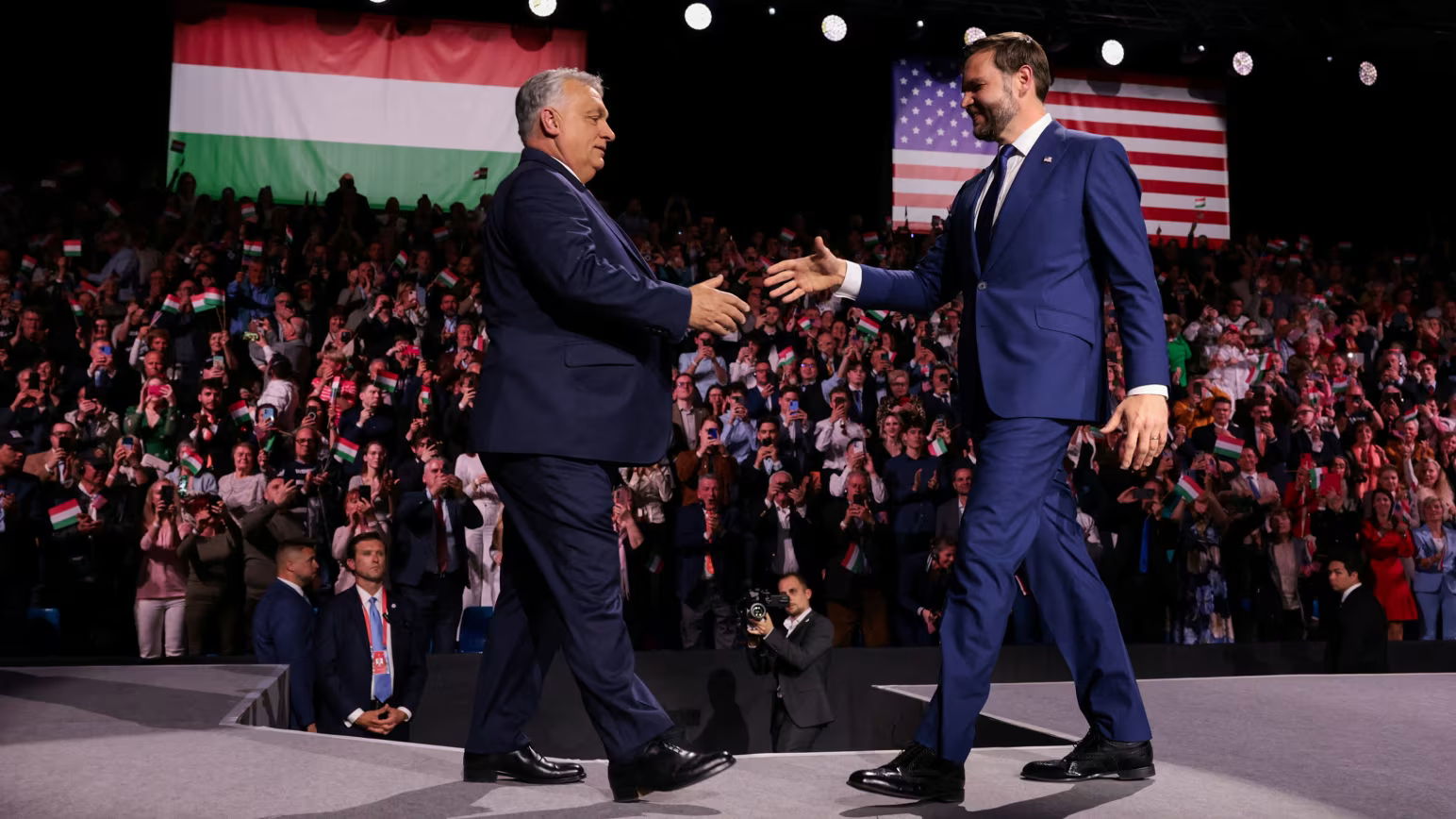
When Vice President JD Vance held his phone to the mic, it seemed for a moment as though his boss might not pick up. But at the second attempt, and after a few rings, he got through to Donald Trump. In the president’s defense, he had plenty on his mind, having threatened hours earlier to destroy “a whole civilization” in Iran.
That crisis felt a world away from the MTK Sportpark in Budapest, where a few thousand Hungarians had gathered to celebrate “The Day of Hungarian-American Friendship.”
Billed as the celebration of friendship between the two nations, the day was really about friendship between Trump and Victor Orbán, Hungary’s populist prime minister – a darling of the MAGA movement who is trailing in the polls ahead of parliamentary elections this weekend.
“I’m a big fan of Viktor. I’m with him all the way. The United States is with him all the way,” Trump told the crowd. Vance said he was in Budapest to help Orbán “as much as I possibly can.” In a visit to Budapest in February, Secretary of State Marco Rubio stressed that “Hungary’s success is our success.”
Vance holds his phone to the mic so that President Donald Trump could address the crowd at MTK Sportpark.Jonathan Ernst/Pool/Reuters
At first glance, it is not clear why the “success” of Orbán’s Hungary – considered the most corrupt, the least free, and among the poorer countries in the European Union – should have any bearing on the “success” of the United States.
But to Ivan Krastev, a Bulgarian political scientist who has known Orbán since the 1990s, the situation is not so strange. Over his 16 years in office, Orbán has fashioned Hungary into the “intellectual, institutional, and financial hub” of the European right, Krastev said. The Trump administration views Orbán and the ideological infrastructure he has built as central to its push for a more “like-minded” Europe – that is, anti-woke, anti-green, anti-immigrant.
“This American administration believes that there is a Trumpian revolution, and that this Trumpian revolution is coming to Europe, and that Europe is just one electoral cycle behind the United States,” Krastev, chair of the Centre for Liberal Strategies in Sofia, Bulgaria, told CNN.
Sunday’s election will test that belief. The opposition Tisza party, led by Péter Magyar, has held a double-digit lead over Orban’s Fidesz party in most polls for more than a year. Magyar, an Orban loyalist-turned-nemesis, has stayed clear of the prime minister’s favored terrain of foreign policy and focused instead on kitchen-table issues like corruption, health care and people’s wallets.
For Hungarians, the election may offer a chance to see what a future without Orbán might look like. But its effects could be felt much farther away. “If Orbán loses – the man who is the symbol of the strength of the far right – this is going to have an incredible psychological impact,” said Krastev.
Supporters of Péter Magyar’s Tisza party hold a rally in Budapest last month ahead of Sunday’s vote.Akos Stiller/Bloomberg/Getty Images
The Hungarian ‘model’
Political scientists have had a hard time defining the “model” Orbán has built. Some call it a “hybrid regime” – not an autocracy, but not fully democratic, either. Some go for “competitive authoritarianism,” because the government, though somewhat authoritarian, still faces competitive elections. Or, to use Orbán’s own phrase, Hungary is an “illiberal democracy” – a system where everyone gets a vote, but where there is less tolerance of opposing views.
Péter Krekó, a political scientist who runs a think-tank in Budapest, prefers “informational autocracy.” Unlike the autocracies of the 20th century, there is next to no threat of physical violence in Orbán’s Hungary, he said. Instead, damage is done in the world of words and ideas.
“If you criticize the system, they don’t want to immediately censor, suppress and silence you,” Krekó told CNN. “It’s much more smear campaigns, disinformation campaigns against you. Character assassination.”
For the system to work, it needs a steady supply of enemies, said István Hegedűs, who served alongside Orbán in Hungary’s first freely elected parliament in 1990. Although Orbán has come a long way since his younger days as a liberal anti-communist, “his way of thinking was always black and white, friends and enemies, us and them – as it is now,” Hegedűs told CNN.
Over 16 years, Orbánism has found enough enemies to sustain itself. “The system started to behave in a much rougher, more brutal way with its campaigns against NGOs,” Hegedűs said. Then came the “campaign against liberal philosophers, then free media, journalists,” and the Central European University (CEU).
Orbán, pictured at the “Day of Friendship” event on Tuesday, has created what analysts describe as a “model” for right-wing populists.Jonathan Ernst/Pool/Reuters
Once one of the best-funded liberal arts universities in the post-Soviet world, Orbán picked a fight with it because he had branded the man who funded it – George Soros, the liberal philanthropist – as an enemy of Hungary. Facing unrelenting pressure from the Orbán government, it moved its academic operations to Vienna, Austria, in 2018.
Today, the CEU maintains something of a ghostly presence in Budapest. Its campus still stands, and researchers – Krekó among them – still use it as office space. Just as there is no need for physical violence against the population, there was no need to physically shutter the campus; sustained pressure was enough for Orbán to get his way.
The American outreach
Once the CEU was ousted, another college took its place as Budapest’s premier educational institution. The Mathias Corvinus Collegium (MCC) – funded in recent years by a generous government grant of a 10% stake in Hungary’s largest oil and gas company – now functions as something of a training ground for national conservatives across Europe.
Vance paid the MCC a visit Wednesday morning. If the crowd at MTK Sportpark was past its prime – a few MAGA hats, far outnumbered by graying, balding heads – the audience at the MCC was mostly 20-something men, with slicked-back hair and tight-fitting suits.
A young, Trump-friendly audience at the Mathias Corvinus Collegium in Budapest listen to Vance’s remarks.Jonathan Ernst/Pool/AFP/Getty Images
“The MCC is not just an institution. It is a mission,” said Balázs Orbán, the prime minister’s political director (no relation), introducing the vice president. Before Vance spoke, the audience listened to a panel that included Gladden Pappin – a US-born, Harvard-educated adviser to the prime minister, who once reportedly predicted that Trump would dissolve Congress, paving the way for the pope to anoint Melania Trump to rule the US as queen.
Vance’s address to the MCC was not so far-fetched. “Resist the temptation to think that victory is immediate, or that we’re going to win back our civilization through instant gratification,” he told the potential next generation of culture warriors. “Our civilization was not built overnight. It’s not going to be saved overnight.”
The MCC is just one piece of Orbán’s ideological infrastructure. There are well-funded conservative think-tanks, like the Danube Institute and the Hungarian Institute of International Affairs. There are glossy publications, like The European Conservative, and online sites like Remix News, which details alleged crimes committed by migrants in Europe. It is through this architecture of soft power, Krastev said, that Orbán has made himself “for the western far right what Fidel Castro was for the left in the 1970s.”
It took some years, but America started to notice. Steve Bannon, the architect of Trump’s first presidential campaign, was among the initial cheerleaders. Speaking from Hungary in 2018, Bannon called Orbán “Trump before Trump.”
Within a few years, the Conservative Political Action Conference, long a cornerstone of the American right, had established a recurring presence in Hungary. While still at Fox News, Tucker Carlson broadcast his popular prime time show from Hungary, and interviewed Orbán. Kevin Roberts, president of the Heritage Foundation – the conservative US think-tank that authored Project 2025 – has described Hungary “not just as a model for modern statecraft, but the model.”
Having established Budapest as MAGA’s European headquarters, Orbán has begun to reap rewards from the relationship.
Orbán was panicked last fall after the Trump administration announced sanctions on the purchase of Russian oil. Because Hungary is almost entirely dependent on energy imports from Russia, Orbán had warned that such measures would bring Hungary’s economy “to its knees.”
Russia accounted for more than 90% of Hungary’s crude oil imports last year. Much of the oil transits through the Druzhba pipeline between Hungary and Russia.Bernadett Szabo/Reuters/File
Thankfully for the prime minister, Trump granted Hungary a one-year exemption from the US sanctions, even though he had long berated EU countries for continuing to buy Russian oil, which he said helps fuel the Kremlin’s war machine and prolong the war in Ukraine. On Tuesday, Vance even praised Orbán’s energy policy, claiming the rest of Europe “should have been following” his policies.
Orbánism without Orbán?
It is not yet clear whether Vance’s visit will help or hinder Orbán’s Fidesz party in Sunday’s parliamentary ballot. The leader has decried alleged foreign interference in Hungary’s elections yet seemed happy to accept endorsements from his backers in Washington. Vance told the crowd at MTK Sportpark “go to the polls” and “stand with Viktor Orbán, because he stands with you.”
In a terse statement about Vance’s visit, Magyar, head of the opposition Tisza party, said: “No foreign country may interfere in Hungarian elections… Hungarian history is not written in Washington, Moscow, or Brussels – it is written in Hungary’s streets and squares.”
Magyar, pictured at a campaign event in Budapest in February, appeared to criticize Vance’s visit.Bernadett Szabo/Reuters
It is notable, said Krastev, that after so long governing as a “nationalist,” Orbán is calling for international support to bolster his campaign. “The irony is that if he’s going to lose, he’s going to lose like a globalist,” he said.
If Orbán loses, the ideological architecture he has built will not collapse. Right-wing intellectuals will still find a home in Budapest, conservative publications will continue to print, and the MCC will not shutter. Although perhaps in time, like the CEU, it might cast a ghostlier presence in the city.
But an Orbán loss would sap the confidence of the European nationalist movements that he – and more recently the Trump administration – are trying to internationalize.
Meanwhile, for the Russians and Americans – who find themselves backing the same candidate – Orban’s loss “would not just be a defeat, it would be humiliation,” Krastev said.
“You have these two superpowers who are pretending they can divide Europe. Suddenly, their candidate is losing after they have done everything possible for him to win. This is going to give a lot of strength to the sense of European resilience.”
CNN’s Steve Contorno contributed reporting.
Trump could soon lose his best friend in Europe Egypt Independent.
Hence then, the article about trump could soon lose his best friend in europe was published today ( ) and is available on EGYPT INDEPENDENT ( Egypt ) The editorial team at PressBee has edited and verified it, and it may have been modified, fully republished, or quoted. You can read and follow the updates of this news or article from its original source.
Read More Details
Finally We wish PressBee provided you with enough information of ( Trump could soon lose his best friend in Europe )


Also on site :
- Walmart’s ‘Pretty’ $24 Scalloped Stoneware Pie Dish and Ramekin Set With Gold Trim Makes Fall Baking Even Sweeter
- ‘The Early Spring’ Finale Delivers the Moment Flora and Luke Fans Have Been Waiting For—Here’s What the Ending Means
- Quote of the Day: 51 Years Ago, Philosopher Stanisław Lem Explained Why Getting It Wrong Is Essential to Finding the Truth—and It Still Rings True Today