
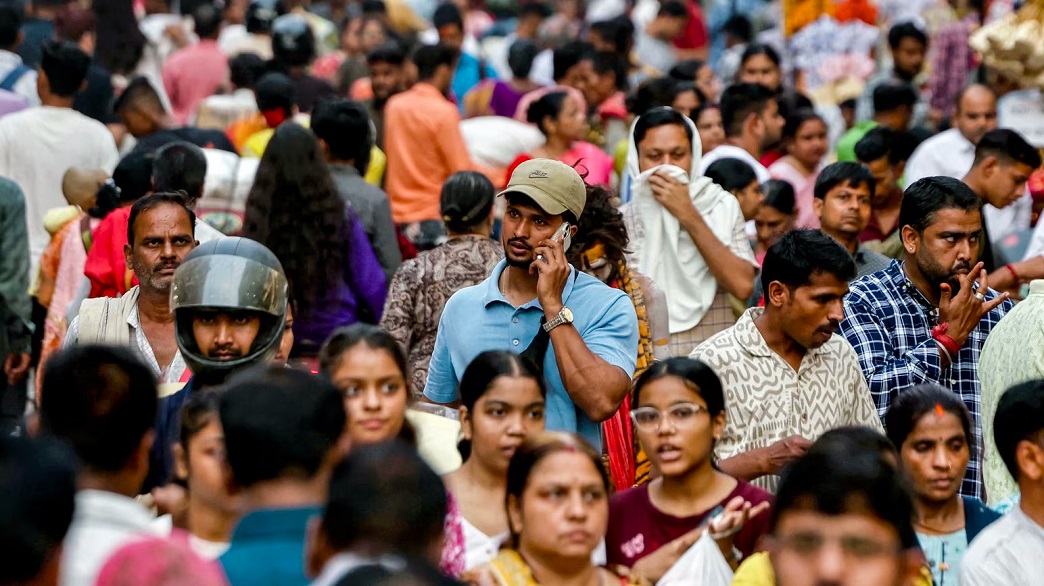
India has kicked off a mammoth exercise to count its entire population – all 1.4 billion of them, give or take a few, in a census initially delayed by the pandemic then administrative issues.
Over the next year, more than three million people will go door-to-door, traveling through megacities and remote villages, to tally up every household and resident of India – and collect data on their social and economic characteristics.
For the first time in almost 100 years, the survey will include caste – a controversial decision that some say could further entrench divisions.
The final count will not be known until next year, underscoring the vast scale of an exercise that seeks to capture the contours of one of the world’s most diverse and complex societies.
Here’s what to know.
How often does India hold a census?
India is meant to count its population once every decade, but this will be the first in 16 years after a delay in 2021 due to Covid-19 and other administrative setbacks.
During the last official census in 2011, India counted just over 1.2 billion people. The United Nations Department of Economic and Social Affairs now estimates it’s overtaken China to become the world’s most populous nation with 1.4 billion people.
Its demographics have also undergone an epochal shift. Currently, more than 40% of India’s residents are under the age of 25, and UN data placed the country’s estimated median age in 2023 at just 28, nearly a decade younger than China’s.
This represents what economists call a “demographic dividend” – the potential for accelerated economic growth resulting from a favorable shift in a population’s age structure.
How will India count its residents?
The census will be held in two phases and cover all of India’s 26 states and federally administered territories.
First, officials will gather details on the condition of households across India, the amenities in each one, and all the assets available to them.
A census official marks a house after collecting details from a village resident during first phase of the census at Hatkhuwapara Village, near the northeastern Indian city of Guwahati, India, on April 1, 2010.Utpal Baruah/Reuters
The second phase, scheduled for February 2027, will collect data on demographics, salary, education, migration, and fertility.
Workers will travel to nearly 640,000 villages and 10,000 towns, according to a government statement.
Both phases will require workers – mostly schoolteachers and government officials – to go door-to-door to collect information. Officials will, for the first time ever, submit this data electronically via a mobile app.
What do they ask?
While it is rapidly ascending the global economic ranks – boasting a nearly $3.5 trillion economy that is the world’s fifth largest and among the fastest-growing – India’s prosperity is highly concentrated and poverty remains widespread.
Against this backdrop, the upcoming census will provide crucial insights into the daily lives of the population.
When the British colonial apparatus first attempted to count India’s population in 1872, the survey asked was a list of 17 questions covering basic markers like age, religion and occupation. This year, people will be asked 33 questions in the first phase alone.
Authorities plan to assess basic living conditions by gathering data on housing materials, homeownership status, and access to essential amenities like clean drinking water, sanitation and cooking fuel.
They also want to know whether these households have an internet connection, a television, a radio, a smartphone, and what type of vehicle they own.
The issue of caste
For the first time since 1931, India will count caste in its census – a 1,000 year-old social hierarchy system.
Its inclusion is controversial and has led to debate about whether counting it will uplift disadvantaged groups or further entrench divisions.
The caste system has roots in Hindu scriptures and historically sorted the population into a hierarchy at birth that determined their occupation, where they could live and who they could marry. Today, many non-Hindus in India, including Muslims, Christians, Jains and Buddhists, also identify with certain castes.
India has quotas that reserve government jobs and school admissions for people from lower castes, and counting these groups is seen by some as crucial to ensure political representation and the welfare of these groups.
But not all are in favor, with critics arguing that the nation should be trying to move away from these labels instead of formalizing them.
How India plans to count 1.4 billion people Egypt Independent.
Hence then, the article about how india plans to count 1 4 billion people was published today ( ) and is available on EGYPT INDEPENDENT ( Egypt ) The editorial team at PressBee has edited and verified it, and it may have been modified, fully republished, or quoted. You can read and follow the updates of this news or article from its original source.
Read More Details
Finally We wish PressBee provided you with enough information of ( How India plans to count 1.4 billion people )


Also on site :
- Danielle Deadwyler, Ella Beatty, Ike Barinholtz, Connor Storrie & More Confirmed For Focus Features’ ‘The Bell Jar’ As Production Wraps
- 9 Years Ago, a Stephen King Adaptation Became the Highest-Grossing Horror Movie Ever — And Still Holds the Title
- Starbucks’ New High-Protein Snack Pack Is Made for the Midday Slump