
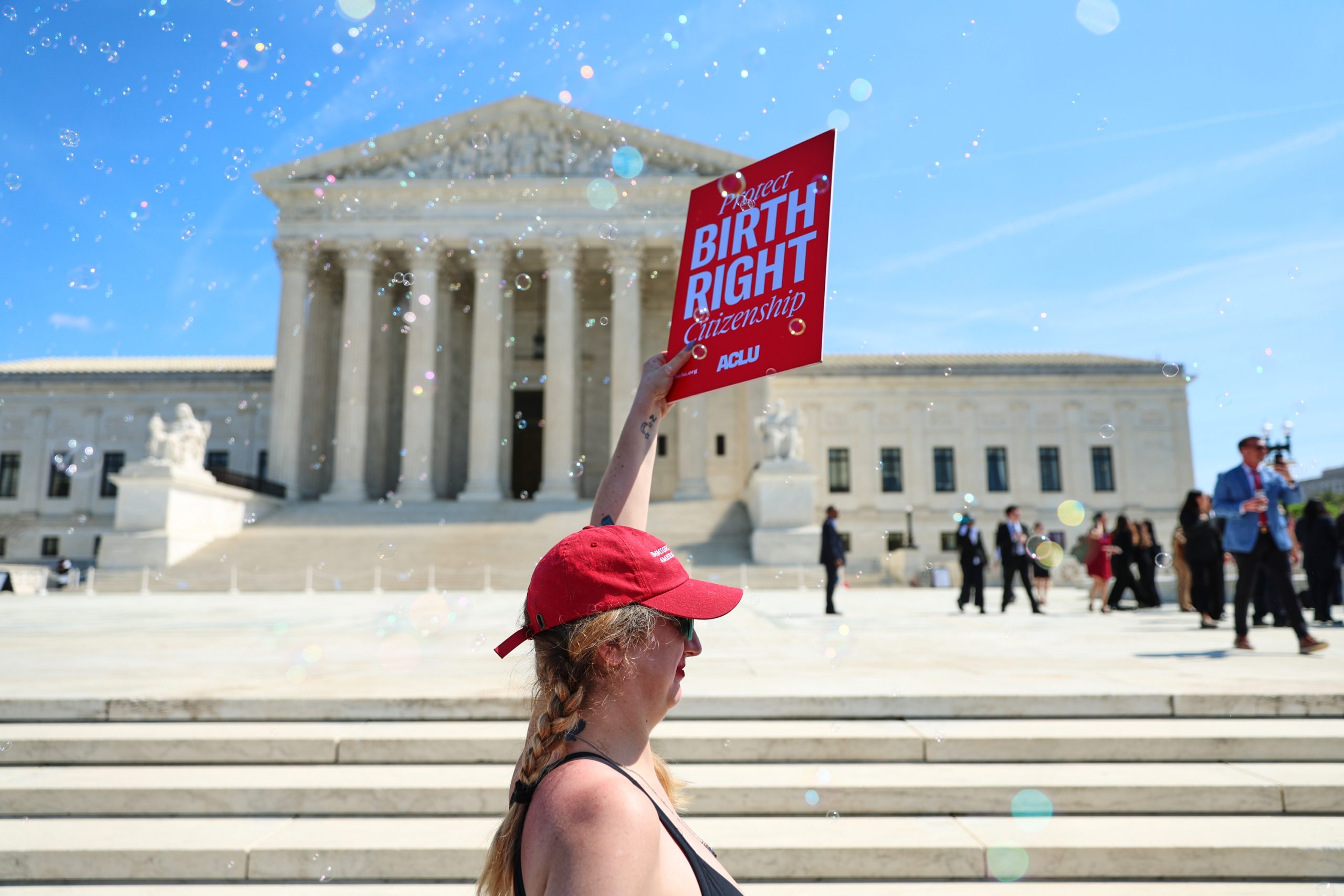
Supreme Court justices on Wednesday showed little appetite to greenlight President Donald Trump’s unilateral attempt to limit birthright citizenship, with nearly every member of the court expressing skepticism of the administration’s revisionist version of a long-established and core American principle.
The Trump administration is seeking to cement a longtime dream of restrictionists by ending the 14th Amendment right of all babies born on U.S. soil to gain automatic citizenship, a move that would render some unborn children stateless.
Trump attended the oral arguments in person — a highly unusual move from a president who has repeatedly suggested the majority-conservative court should rule in his favor. But in court, even the conservative judges made their position clear.
Chief Justice John Roberts, asking about the government’s arguments over what it derides as “birth tourism,” asked, “Would you agree that has no impact on the legal analysis before us?”
“It’s a new world,” Solicitor General D. John Sauer responded.
“Well, it’s a new world, but it’s the same Constitution,” the chief justice shot back, drawing laughter from the audience.
Trump’s visit comes just over a month after he insulted the justices as “unpatriotic and disloyal” and even “an embarrassment to their families” after they knocked down his tariffs. Justice Samuel Alito, who has sided with the president on multiple questions of executive authority, appeared to stare at him on his way into the large hall at 10 a.m., with Trump sitting in the middle of the courtroom in the front row of the section reserved for the general public. He sat near White House counsel David Warrington and Commerce Secretary Howard Lutnick.
The president did not stay for the entire proceeding. He walked out five minutes into the opposing side’s argument at 11:21 a.m. — about an hour and a half after arriving — and quietly shuffled past the heavy brass gates and marble columns on the sunlit east side of the courtroom. But he was present to watch several justices combat his administration’s attempt to reinterpret the Constitution.
Alito took stabs at the government’s attempts to insert a legal residence as a prerequisite to the 14th Amendment, which says, “All persons born or naturalized in the United States, and subject to the jurisdiction thereof, are citizens of the United States and of the State wherein they reside.”
Alito cited what he called the government’s “inefficient” or “unenthusiastic” enforcement of immigration laws to make the point that, even immigrants here illegally “have in their minds made a permanent home here.”
Most legal experts have said this should be an open-and-shut case. The Supreme Court already addressed the meaning of that language in its 1898 decision concerning Wong Kim Ark, who was born to Chinese parents who were permanent residents, and found that children born in the United States to noncitizens are U.S. citizens by birth.
“You’re asking us to overrule Wong Kim Ark,” Justice Sonia Sotomayor affirmed, despite Sauer’s protests to the contrary.
“Even your brief concedes that the position you’re taking now is a revisionist one,” Justice Elena Kagan told the government.
Nearly all justices seemed skeptical of the government’s arguments.
“Are children of Native Americans birthright citizens?” Justice Neil Gorsuch asked.
Sauer eventually replied, “I think so.”
“I’ll take a yes,” Gorsuch said matter-of-factly, eliciting laughs in the courtroom.
Wednesday marks the second time the nation’s high court has heard arguments about birthright citizenship, although truly only the first time it has in earnest. In May 2025, the court considered whether judges could issue so-called “universal injunctions” to block the order nationwide.
At the time, justices appeared skeptical of Trump’s unilateral attack on such a core constitutional right and were open to concerns about the chaos that would ensue. Still, the court’s conservative majority severely limited universal injunctions a month later, on June 27.
That same day, the American Civil Liberties Union and several other advocacy groups filed a lawsuit on behalf of “ Barbara” — a Honduran woman living in New Hampshire with three kids and another on the way — “and all those similarly situated.”
U.S. District Judge Joseph Laplante, a George W. Bush appointee, ruled against the federal government while quoting his own previous decision finding that Trump’s executive order likely “contradicts the text of the Fourteenth Amendment and the century-old untouched precedent that interprets it.” This time around, the birthright issue is front and center.
At the Supreme Court on Wednesday, justices wrestled with the administration’s attempt to add new meaning to the 14th Amendment’s subclause, “subject to the jurisdiction thereof.”
The Trump administration claims undocumented immigrants and temporary visitors are still subject to a foreign power, and therefore do not hold an expected allegiance to the United States. But as Justice Ketanji Brown Jackson pointed out, that phrase has long been understood to mean exclusion of the children of diplomats. She also argued that any American would be subject to the jurisdiction of a foreign country while traveling there, naming Japan as an example.
Jackson noted that children born here have full loyalty to the place of their birth and their parents have temporary loyalty to American laws.
“To the extent you’re looking for allegiance, you have it,” Jackson said.
Justice Amy Coney Barrett, asking about how exactly the Trump administration purports to enforce such strict new citizenship tests that hinged on a parent’s intent to live here legally and permanently, questioned what would happen if an American woman living in Norway gave birth in the United States with plans to return to Norway.
“I can imagine it being messy,” Barrett said.
Jackson was more direct.
“Are we bringing pregnant women in for depositions? How do we figure this out?” she asked incredulously. Sauer said the government would likely issue Social Security numbers to every baby but then figure things out afterward.
The fight over birthright citizenship has become a core constitutional battle of Trump’s presidency — and one that cuts deeply into people’s sense of identity. Speaking to NOTUS late Tuesday night by phone, Connecticut Attorney General William Tong noted how his own father fled communist China and overstayed his tourist visa to work a restaurant job as a free man in the United States.
“I’m the first American in my immediate family. I’m an American citizen because the Fourteenth Amendment says I am,” he said. “I looked at Justice Gorsuch on the tariff case. He reminds us he’s a textualist. The words say what they say.”
California Attorney General Rob Bonta — who was born in the Philippines to Christian missionaries serving there at the time — made it a point to be in the courtroom on Wednesday. Earlier in the week, he told NOTUS that Trump “is a president who’s trying to define citizenship in his own image … a white image … that’s cruel, inhumane, xenophobic.”
“If they’re going to follow the plain and unambiguous language of the Constitution … then there’s only one outcome here. This really should be 9-0,” he said. “This is not up for policy debate. It’s not. This is a constitutional right.”
This story was produced as part of a partnership between NOTUS — a publication from the nonpartisan Allbritton Journalism Institute — and NEWSWELL, home of Times of San Diego, Santa Barbara News-Press and Stocktonia.
Hence then, the article about trump watches as supreme court pokes holes in his attack on birthright citizenship was published today ( ) and is available on Times of San Diego ( Middle East ) The editorial team at PressBee has edited and verified it, and it may have been modified, fully republished, or quoted. You can read and follow the updates of this news or article from its original source.
Read More Details
Finally We wish PressBee provided you with enough information of ( Trump watches as Supreme Court pokes holes in his attack on birthright citizenship )


Also on site :
- Sarah J. Maas Urges ‘ACOTAR’ Fans Not to Share Leaks Ahead of New Book: ‘Beyond Disheartening’
- Amex Travel Just Upgraded Its Cruise Program—Here’s How to Earn Double Points on Your Next Vacation
- Mark Wahlberg Stars as Notorious Hitman in 2026 Thriller The Guardian Called ‘Grimly Effective’ Now Out on Digital