
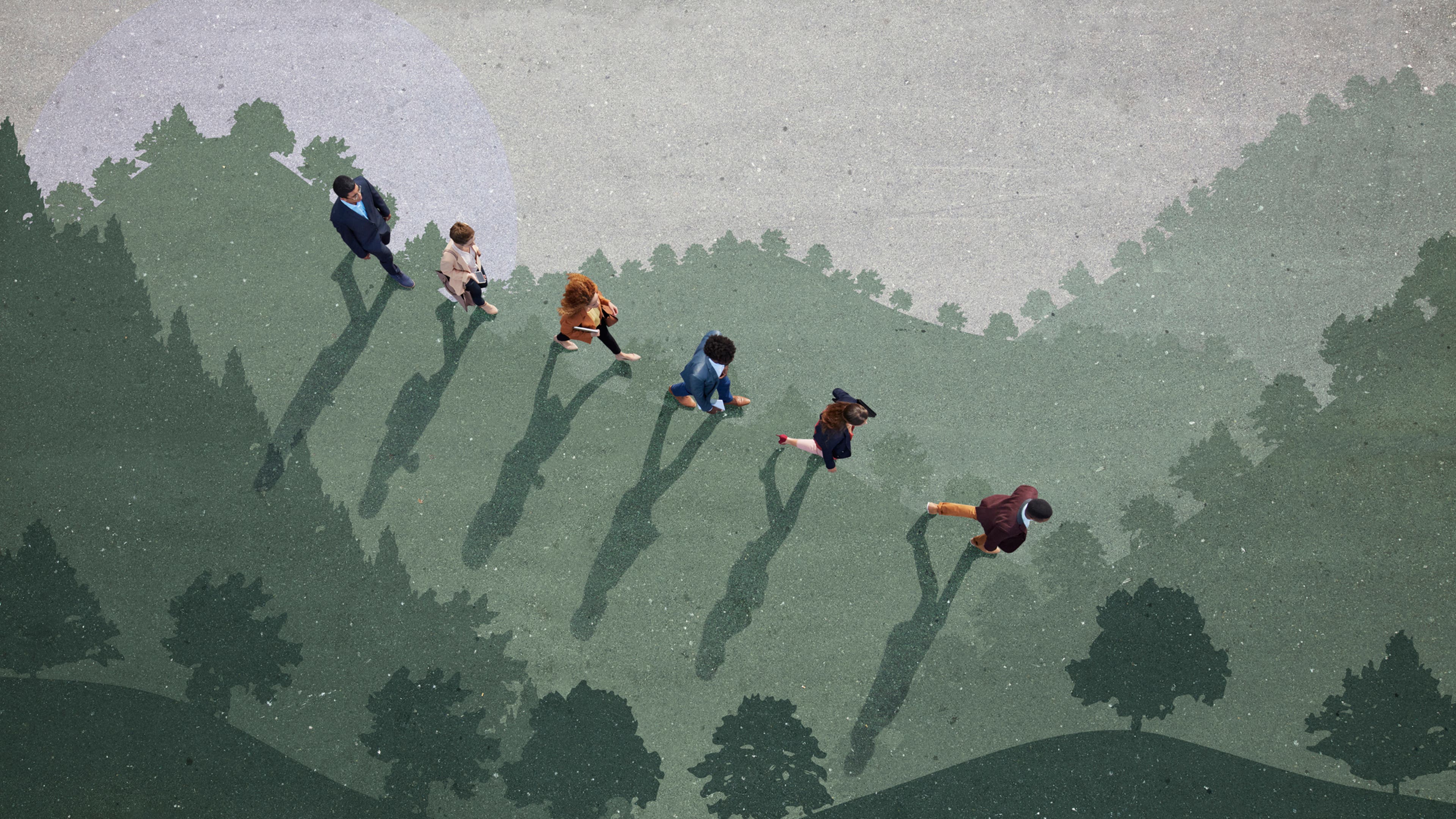
We cannot grow trees in dry soil. While seeds might be healthy and sunlight is abundant, without the conditions for roots to take hold, growth can never happen. The same goes for today’s economy. There is plenty of capital (seeds) and technology (sunlight), thus making it extraordinarily good at expanding systems; still, it is far less effective at strengthening the people: the soil that supports everything. Today, we may have more technology, capital efficiency, and “output.” Yet human development progress has been stalled. The simplest way to see this is to compare how the economy moves with people’s earning power improvement. In the U.S., GDP growth has fluctuated year to year, yet the minimum wage has been stuck at $7.25 per hour since July 24, 2009, demonstrating the weakening link between growth and livelihood.
Besides, the U.N. Development Programme notes that while human development is projected to reach record highs again, half of the poorest countries remain below their pre-crisis trajectory after the declines of 2020 and 2021. If the next era of growth is to be sustainable, it must be built around humans, and every human at that. The idea of a new economic paradigm that I call “sustainomy” aims to uplift people along with the system, argues that when economic output rises but the quality of life remains flat, growth is built at the cost of widening the gap between what the system can produce and what people can absorb.
Capitalism’s initial objective was productivity expansion. Adam Smith himself believed that when the economic pie grows, an improved quality of life would follow. Yet today, growth, modeled by GDP, often driven by manufacturing output, does not automatically translate into better living conditions, well-being, or happiness. Too often, it has, in fact, widened inequality and accelerated environmental degradation.
This is because according to the 2022 World Inequality Report, the lowest-earning half of the world holds merely 2% of global wealth, while wealth concentrates heavily at the top. In other words, the system is expanding while the median person experiences stagnation in living standards. While nominal wages in advanced economies have begun recovering after the inflation shock, real wages remain below early-2021 levels in around two-thirds of OECD countries analyzed by the organization. Simultaneously, we are running the planet at a loss. Global Footprint Network estimates that humanity is using nature roughly 1.7 to 1.8 times faster than ecosystems can regenerate, an ecological overdraft that shows up as earlier “overshoot days” each year.
Another thing that happens today is the rapid technological advancement. This is interesting because technology’s original promise was augmentation: to expand human capabilities, lift productivity, and unleash potential. Now, this very augmentation has gradually turned into substitution, and when substitution happens faster than human upgrading, the system becomes structurally unstable.
The World Economic Forum has projected that about 23% of jobs are expected to change by 2027, with major churn in roles created and displaced, and employers estimating 44% of workers’ skills will be disrupted over the same horizon. If we treat people as an afterthought in the innovation cycle, then the very technologies meant to lift society will instead widen the gap between a high-performing system and a struggling citizenry. Talking about a “high-performing system,” in the United States, the productivity–pay gap has widened dramatically since 1979; productivity rises, while typical worker compensation lags. A society cannot indefinitely rely on productivity gains while leaving the broad base of people underprepared, underpaid, or increasingly anxious about their place in the economy. This has made growth unequal and therefore brittle.
The solution starts with how humans learn
The “sustainomy” framework stresses that the most urgent reform is not merely more education, but a different architecture of learning that aligns with the demands of an information-saturated, collaboration-dependent economy:
Academic skillsThe foundational ability to distinguish what is relevant from what is noise. Today, misinformation spreads faster than facts, and AI can generate endless plausible-sounding text. Thus, the ability to think critically is non-negotiable.
Professional skillsPractical expertise is needed to make a living and transform personal value into economic value. Professional skills here refer to transferable skills, i.e., the applied capabilities that keep people employable through transitions.
People skillsThese are the abilities to understand others. With many colliding players, whether it be supply chains, climate risks, or social expectations, people skills are important in building comprehension and trust.
Collaborative skillsAsk “What can I contribute?” rather than only “What’s in it for me?”, for today’s defining challenges are not solvable by a single winner. None of us alone is smarter than all of us together.
How this works as an economic strategy is when human capability rises, societies absorb technological change without tearing. Workers shift roles faster. SMEs adapt faster. Communities sustain confidence through disruption. That is why “sustainomy” emphasizes an economy that simultaneously strengthens the triple capital: Prosperity, People, and Planet.
For policymakers, this means building infrastructure for lifelong learning: portable training accounts, modernized technical pathways, and incentives that make reskilling cheaper than long-term unemployment. For businesses, it means treating human development as a capital investment to fund continuous upskilling, redesigning jobs around augmentation, and measuring workforce resilience as seriously as quarterly performance.
Keeping technology as a tool, not the driver
While AI can be a remarkable engine of productivity, productivity is not the same as prosperity, and prosperity is not the same as a thriving society. If we focus solely on using AI to boost output, we risk devaluing human capital, and with that, labor becomes a cost to eliminate.
Sustainomy’s answer is “Authentic Intelligence:” the capacity to use technology to amplify our potential rather than letting it replace us. Authentic Intelligence is how to reap the benefits of technology while being pro-human; it insists that innovation should be judged by what it enables people to become. In practice, this requires three shifts:
Redesign for augmentationAdopt AI where it removes drudgery and expands capability, freeing people to do higher-value work, rather than using it as a shortcut to shrink opportunity.
2. Measure what matters
GDP can rise while minimum wages stagnate. Output can rise while nature is depleted faster than it regenerates. GDP can feed toward the issue of AI being used to replace human productivity. Sustainomy, therefore, proposes that “net positive impact” as a better compass: a way to evaluate growth by whether it strengthens prosperity, people, and the planet together.
3. Govern technology with human intent
With the estimation that 44% of skills would be disrupted in just a few years, the responsible way to respond is to combat it with good design: proactive reskilling, fair transition support, and institutional guardrails that keep innovation aligned with social well-being.
In today’s multifaceted world, growth must go beyond how much the economy grows to whether societies can remain stable, adaptive, and fair as technology accelerates. Transitioning toward “sustainomy” means rebalancing the economy around humans, equipping individuals with the skills, mindset, and “Authentic Intelligence” to thrive in a technologically advanced world. After all, what is an economy that outgrows its citizens but one akin to a proverbial tree planted in dry soil?
Scale, but strengthen the people, and the trees grow sustainably.
Hence then, the article about why the next era of growth must be built around humans was published today ( ) and is available on Time ( Middle East ) The editorial team at PressBee has edited and verified it, and it may have been modified, fully republished, or quoted. You can read and follow the updates of this news or article from its original source.
Read More Details
Finally We wish PressBee provided you with enough information of ( Why the Next Era of Growth Must Be Built Around Humans )


Also on site :
- Iran offers US deal to reopen Hormuz within a week
- Coalition intercepts two Houthi ballistic missiles, three drones
- Clive Barker Teases ‘Hellraiser: Revival’ Video Game Has Reignited “Many Ideas” For Film Franchise: “Planning To Keep My Fingers In That Pie”