
Sometimes it’s hard to know why a movie even exists. Perhaps in an effort to capture the attention of moviegoers who, it’s said, pay nearly as much attention to the tiny screens in their hands as to the bigger ones in front of them, plots have become sliced-and-diced affairs, shards of a story that are intended to somehow come together at the end, like a jagged puzzle. You can check out for a few minutes and not miss much. But by the end, you might find yourself wondering what a movie has left you with. I’m not talking about a lesson or even a satisfying conclusion. Really, all you need is a feeling, a sense that something has shifted inside you. It’s a simple but essential pleasure that emerging filmmakers increasingly fail to provide.
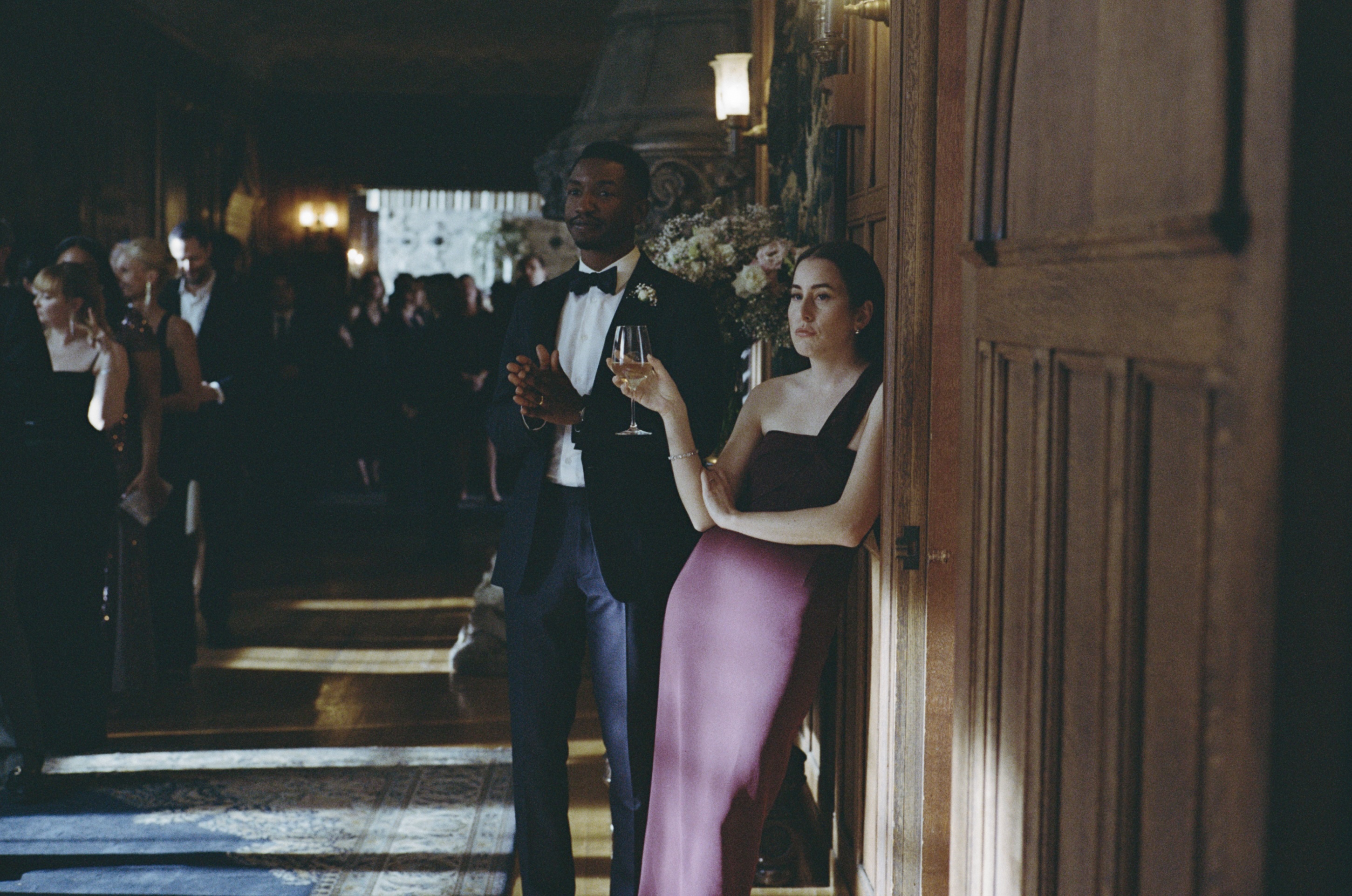
The latest example is The Drama, in which Robert Pattinson and Zendaya play Emma and Charlie, a young couple in love. They’re engaged to be married, busy with all the pregame mishigas these events entail—meeting with photographers, learning prescribed dance moves, writing little speeches of adoration for one another—and their closest friends, Rachel and Mike (Alana Haim and Mamoudou Athie), also a couple, are with them every step of the way. We see, in the first scene, how Emma and Charlie met cute in a café, but even that first encounter is grounded in deception: Charlie spots Emma reading a book; he takes a furtive photo of its cover and does a quick search on his phone to glean a few details about it. He then approaches Emma, burbling about how much he loves that same book, though obviously he hasn't read it. Emma ignores him at first—or so he thinks. But it turns out, as she explains when he's finally able to get her attention, that she’s deaf in one ear (there’s an earbud in the other). Then she smiles at him so radiantly that you see she’s fully buying his mini-con, even though, it's later revealed, he never does read that book. The couple lives in an enviable flat lined with filled bookshelves, the sort of thing you rarely see in movies anymore, and certainly not in real estate photos. The suggestion is that these are people who live with and actually read books—or maybe one of them does, and we can guess that it's Emma.
Charlie's initial deception is a small thing, right? In the world of The Drama—which might be better called a bleak comedy than a black one—maybe not so much. We see, in flashback sequences, how Emma and Charlie’s bond has deepened in the time they’ve been together. We never learn exactly what Emma—affectionate, sweet, but with a somewhat no-nonsense demeanor— does for a living, but it’s suggested that Charlie, charming and vaguely bumbling, works at a small, prestigious museum. In the movie's most ostensibly romantic scene, Charlie speaks softly but definitively in Emma’s nonhearing ear, testing to see if she might be able to pick up hints of sound or even just meaning. “I love you so much it hurts,” he tells her. “I want to marry you but I’m too afraid to even ask.” She can’t hear him at all—she repeats his words back to him as a kooky nonsense phrase—but the sentiment has been planted. Everything should go swimmingly as planned.
Yet it doesn’t. In the movie’s big reveal, about a third of the way in, we learn that Emma has a secret, a relic from her days as a gawky, unpopular teenager from a military family; she was forced to move so often that she could never get a foothold anywhere. The audience’s presumed enjoyment of The Drama hinges on knowing nothing about that secret going in, though it’s impossible to talk about the movie’s meaning—or lack thereof—without revealing that this action is not something Emma actually did, only something she thought about doing. Once Emma reveals this secret, she's distressed merely by recalling it; she flips out a little bit, tortured by imaginary flashes of the person she used to be. Charlie, too, is troubled, and has second thoughts about this woman he’d previously been nuts about. Haim’s Rachel blows a gasket and turns against her best friend altogether.
Mamoudou Athie and Alana Haim in 'The Drama' —Courtesy of A24In broad terms, Emma’s secret hinges on a trend that, in the United States in particular, has caused a great deal of suffering and political angst. It’s telling that the writer-director of The Drama is Norwegian, not American: Kristoffer Borgli—who previously made the wryly entertaining if uneven dark comedy Sick of Myself—may be trying to make some overarching political statement about American society, from a comfortable remove.
But then, it’s hard to have any idea what The Drama is trying to say or do, beyond tease its audience with its lack of specificity. Is it an examination of the way love can blind us—or, worse, make us wholly insensitive to another person’s pain? Is it a plea for greater empathy toward those suffering, or those who may have suffered, from mental illness? Is it suggesting that humans no longer know how to truly hear one another? You don’t need to have been looking at your phone for an hour and 40 minutes to be confused about what’s going on in The Drama. Why pay close attention when there’s no real payoff? When the wedding finally happens, it’s played for bitter, off-kilter laughs, though it’s anything but funny. The climactic scene, ostensibly the movie’s dramatic capper, becomes a kind of “Weddings! You know?” shrug.
You could argue that the stars of The Drama are its big draw, and maybe all the movie needs. Pattinson is a perceptive, subtle actor, and here he slithers from being untrustworthy to adorable to, possibly, truly reprehensible—in other words, he does everything the movie asks of him, whatever that might be. And Zendaya captures Emma’s bewilderment at the way Charlie turns against her; her inability to set things right represents, probably, the emotional damage that a failure to communicate can do to a relationship. Maybe that’s something, or it might not be much at all.
And sometimes the way a filmmaker treats a supporting performer tells you everything you need to know. Haim, the singer who made her beguiling acting debut, in Paul Thomas Anderson’s Licorice Pizza, as a kind of Mona Lisa California dream girl, plays a character whose response to her best friend’s revelation seems almost cartoonishly extreme, which is probably the point. But why is Haim shot so badly, often in tight closeup, so that it’s impossible not to be fixated on the ugly twisting of her mouth whenever she speaks? She becomes an inadvertent metaphor for the movie around her, which motors on without ever saying much. It’s worth half your attention. You might use the other half to mourn the memory of what movies, even enjoyably mediocre ones, used to be.
Hence then, the article about the drama is a bleak comedy with no payoff was published today ( ) and is available on Time ( Middle East ) The editorial team at PressBee has edited and verified it, and it may have been modified, fully republished, or quoted. You can read and follow the updates of this news or article from its original source.
Read More Details
Finally We wish PressBee provided you with enough information of ( The Drama Is a Bleak Comedy With No Payoff )


Also on site :
- Sikorski: Russia doesn’t have the forces to invade NATO
- 1988 Bob Hoskins Film, With $70 Million Budget, Ranked Among ‘Best American Fantasy Movies’ of All Time
- 1979 Country-Rock Ballad, Written for Linda Ronstadt in a Colorado Cabin, Became a Cross-Generational Hit