
Written by FERNANDA FIGUEROA and JESSE BEDAYN
Antonio Bustamante has kept a watercolor of labor leader César Chavez for more than 35 years, hanging it on the wall of his law office in Yuma, Arizona. As a young man, he was moved by Chavez and helped organize workers before joining his security team.
Like many others, Bustamante must now wrestle with reconciling the man he adored with the allegations Chavez groomed and sexually abused women and young girls.
“I’m trying to figure out how emotionally and intellectually I’ll be able to understand my perception of him as an extremely good man,” Bustamante said, his voice heavy with emotion, “compared to these things that are said he did.”
Chavez built a national reputation organizing in the fields. With Dolores Huerta — also one of his victims — he co-founded the United Farm Workers union, led a hunger strike, a grape boycott with Filipino farmworkers, and eventually pressured growers to negotiate better wages and working conditions for Mexican American farmworkers.
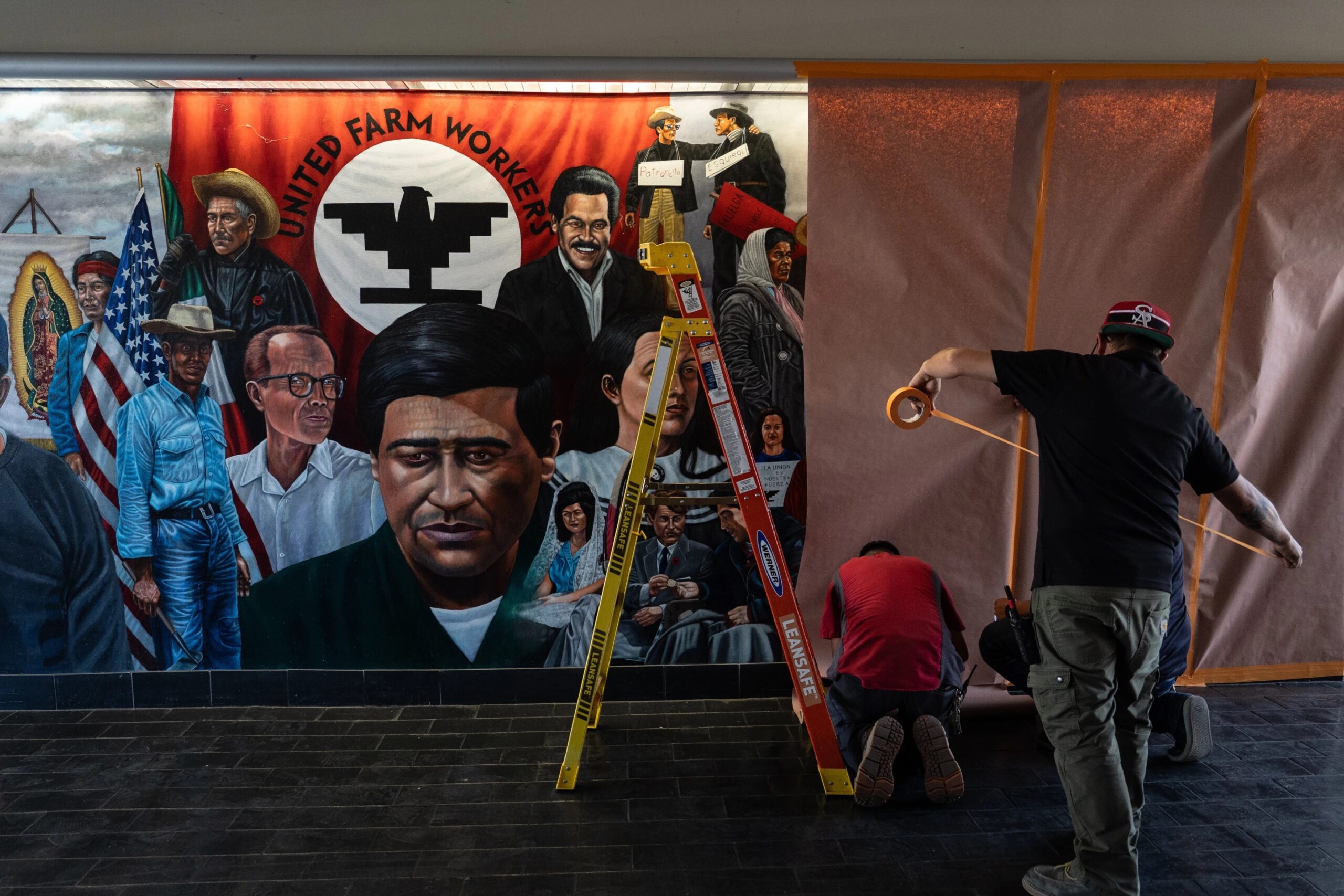
Nearly two weeks after a New York Times report detailing allegations of sexual abuse, communities and rights groups across the country are still figuring out how he should be remembered. His name and image have already been erased from monuments, streets and murals around the country.
Workers cover a mural by Emigdio Vasquez featuring Cesar Chavez and other figures at Santa Ana College in Santa Ana, California on Thursday, Mar. 19, 2026. (Photo via AP Photo/Jae C. Hong.)
Reckoning with a legacy
Bustamante said he learned of the allegations when an old friend called to tell him about the upcoming report. What flashed through his mind, he said, were the faces of others who had known and admired Chavez, and “how their eyes would be devastated.”
“We were looked down upon by society, we were Mexicans,” Bustamante said, recalling the first time he saw Chavez speak outside the Arizona Capitol in 1972 as he launched a hunger strike. He “gave us worth, and for young people that was everything.”
Now, some of Bustamante’s friends have taken down images of Chavez. In his community, Bustamante likened it to denouncing Catholicism and removing photos of the pope.
One person does not make a movement
For many, it’s an example of why movements should not be tied to a single leader.
Teresa Romero, president of United Farm Workers, said the contradiction between the Chavez’s legacy and the allegations is unavoidable.
“We have in one hand César Chavez, the man who committed horrible acts that we’re not going to justify,” Romero said. “On the other hand, we have César Chavez, the organizer who brought thousands and thousands of people together to be able to work for farm workers, and improve their lives and working conditions.”
Unfortunately, both of those things came from the same person, Romero said.
Sehila Mota Casper, executive director of Latinos in Heritage Conservation, said the farmworker movement was always driven by collective effort.
“The rights and protections that came from it belongs to the people that built it,” she said. “It wasn’t just one individual.”
That perspective, she said, offers a way to move forward: recognizing Chavez’s role without letting it overshadow the contributions of others, including Huerta, and the challenges they faced.
Advocacy groups like the nonprofit Voto Latino took a similar stance, saying, “The women who organized, marched, and sacrificed alongside farmworkers carried this movement on their backs.”
Dismantling a man, preserving history
The allegations also prompted swift public action. Within days, statues were removed and celebrations cancelled or renamed, including events tied to the federal César Chavez Day on March 31.
Political leaders from both parties have condemned the alleged abuse. Some Republicans, including Texas Gov. Greg Abbott, cited it as part of a broader criticism of Chavez’s progressive legacy.
Abbot said Texas — a state with dozens of Confederate monuments — would no longer celebrate César Chavez Day, saying the allegations “undermine the narrative that elevated Chavez as a figure worthy of official state celebration.”
At the same time, groups like the nonpartisan Latino Victory Project, which focuses on developing Hispanic political leadership, said this current moment should not distract from the still-ongoing civil rights battles.
“Those legacies are unchanged,” said Paul Ortiz, a labor history professor at Cornell University and director of graduate studies for Latino Studies. “And those legacies are all about people power.”
What seems inevitable, Bustamante said, is that there will always be an asterisk next to Chavez’s name.
“Does that take away the greatness of what his accomplishments were, the meaning of them? No, it doesn’t,” he said. “But can we look past that to honor him? That’s the tough part.”
For César Chavez Supporters, A Painful Question: What to Do With His Legacy Now Chapelboro.com.
Hence then, the article about for cesar chavez supporters a painful question what to do with his legacy now was published today ( ) and is available on chapelboro ( Middle East ) The editorial team at PressBee has edited and verified it, and it may have been modified, fully republished, or quoted. You can read and follow the updates of this news or article from its original source.
Read More Details
Finally We wish PressBee provided you with enough information of ( For César Chavez Supporters, A Painful Question: What to Do With His Legacy Now )


Also on site :
- Sikorski: Russia doesn’t have the forces to invade NATO
- 1988 Bob Hoskins Film, With $70 Million Budget, Ranked Among ‘Best American Fantasy Movies’ of All Time
- Issa Rae Is ‘Never Going to Stop’ Using Her Power for Good, Even as Mergers and AI Disrupt Hollywood: ‘This Is All Men’s Fault’