
6 min read
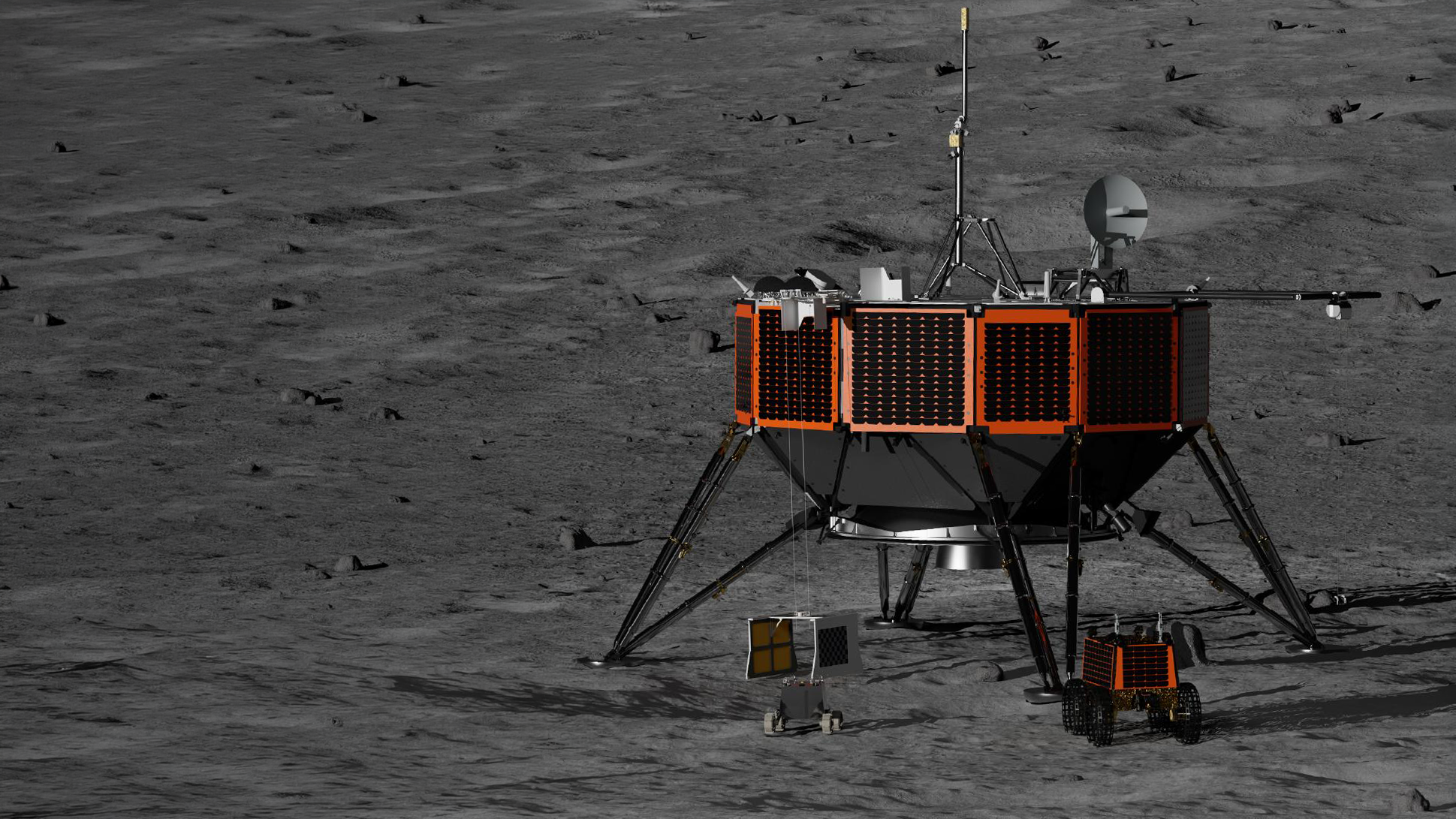
Preparations for Next Moonwalk Simulations Underway (and Underwater) A rendering of the Intuitive Machines larger cargo class lunar lander is pictured above with the Honeybee Robotics lunar rover (lower right) and the Australian Space Agency’s Roo-Ver lunar rover (lower left).Intuitive MachinesNASA has awarded Intuitive Machines of Houston, $180.4 million to deliver NASA-funded science and technology to the lunar surface as part of the agency’s CLPS (Commercial Lunar Payload Services) initiative and Artemis program. This lunar delivery, which includes seven payloads — five of them NASA’s — is expected to increase understanding of the chemical composition and structure of regolith, as well as the radiation environment in and around the South Pole region. This science will continue to build a sustainable human presence by future Artemis missions.
“NASA continues to progress lunar science and exploration by enabling commercial lunar landings,” said Joel Kearns, deputy associate administrator for exploration, Science Mission Directorate, at NASA Headquarters in Washington. “These science and technology investigations aim to support long-term sustainability and contribute to a deeper understanding of the lunar surface, test technologies, and prepare for future human missions at the South Pole.”
Intuitive Machines is responsible for delivering end-to-end payload services to the lunar surface, targeted to land at the Moon’s South Pole region in 2030. This is the fifth CLPS contract for the company, which has delivered payloads to the Moon twice with their IM-1 and IM-2 missions.
“As NASA prepares to send humans and more robotic missions to the Moon, regular CLPS deliveries will provide a better understanding of the exploration environment, accelerating progress toward establishing a long-term human presence on the Moon, setting the stage for eventual human missions to Mars,” said Adam Schlesinger, manager of the CLPS initiative at NASA’s Johnson Space Center in Houston.
The rovers and instruments, totaling 165 pounds (75 kilograms) in collective mass include:
Stereo Cameras for Lunar Plume Surface Studies (SCALPSS) will use enhanced stereo imaging photogrammetry, active illumination, and ejecta impact detection sensors to capture the impact of the engine exhaust plume on lunar regolith as the lander descends on the Moon’s surface. This payload flew on both Intuitive Machines’ IM-1 and Firefly Aerospace’s Blue Ghost Mission 1 and captured first of its kind imagery. The high-resolution stereo images will aid in creating models to predict lunar regolith erosion and ejecta characteristics, which is important as bigger, heavier spacecraft and hardware are delivered to the Moon near each other.Lead organization: NASA’s Langley Research Center in Hampton, Virginia Near-Infrared Volatiles Spectrometer System (NIRVSS) will observe light emitted or reflected by the lunar soil to help identify its composition. NIRVSS is designed to detect minerals and various types of ices that may be present. NIRVSS will also take high resolution images of the lunar soil and composition variability, which could help inform how ices interact with the lunar soil. The instrument successfully powered on and collected data while in flight on Astrobotic’s Peregrine Mission One in 2024. NIRVSS aims to measure the surface temperature at fine scales, which may help determine where ice can exist or remain stable.Lead organization: NASA’s Ames Research Center in California’s Silicon Valley Mass Spectrometer for Observing Lunar Operations (MSolo) will characterize the makeup of volatiles (things that easily evaporate) in the environment around the lander following touchdown. The mass spectrometer demonstrated its gas analysis capabilities in lunar conditions during Intuitive Machines’ IM-2 mission in 2025. MSolo measures low molecular weight volatiles, which can be used as resources on the lunar surface.Lead organization: NASA’s Kennedy Space Center in Florida Lunar Vehicle Radiation Dosimeter system (LVRaD), a suite of four radiation detectors, is designed to quantify the radiation environment on the lunar surface and assess its potential impacts of radiation on biology and the human body in preparation for future human-related activities on the Moon. Additional sensors will investigate volatiles and geological resources that will help us plan for long-term exploration, as well as gain insights into the Moon’s formation and solar system evolution.Lead organization: Korea Astronomy and Space Science Institute Multifunctional Nanosensor Platform (MNP) is a highly compact and sensitive chemical analysis instrument designed to advance understanding of the lunar environment. It will investigate how exhaust plumes from a lander’s engines interact with the lunar regolith by measuring volatile compounds over time and at varying distances from the landing site. These measurements will provide critical data to better understand plume-surface interactions and their effects, informing the design of safer, more sustainable landing systems and surface operations, directly supporting NASA’s broader lunar exploration objectives. To enable these measurements, the MNP instrument will be integrated into the Australian Space Agency’s rover (“Roo-ver”), a foundation services technology demonstration. The rover will showcase Australia’s robotics capabilities, with the ability to traverse complex terrain and operate with limited human intervention. In doing so, Roo-ver will validate key mobility and autonomy technologies in the lunar environment while serving as the enabling platform for MNP’s scientific objectives.Lead organization for MNP: NASA’ Goddard Space Flight Center in Greenbelt, MarylandLead organization for Roover: Australian Space Agency NASA’s Laser Retroreflector Array (LRA) is a small device that reflects laser beams transmitted by Moon orbiters or landing spacecraft to help them determine their orbit position or navigate to the surface. Made of eight quartz corner-cube prisms set into a dome-shaped aluminum frame, the array is passive, meaning it requires no power or maintenance. One LRA payload has already been delivered through CLPS to the surface of the Moon. These arrays will continue to be used to build a network of permanent location markers on the Moon for future exploration.Lead development organization: NASA’s Goddard Space Flight Center “Sanctuary on the Moon” is a lunar time capsule of 24 synthetic sapphire discs containing a curated archive of human civilization. The discs highlight over 100 billion micropixels of data including the history of science, technology, mathematics, architecture, culture, paleontology, art, literature, music, and the human genome. Sanctuary was developed in France.Lead organization: Grapevine ProductionsThrough NASA’s CLPS initiative, lunar landing and surface operations services are purchased from American companies. By sending science and technology to the Moon, we continue to learn how to prepare for human exploration that could eventually take us to Mars.
For more information about CLPS and Artemis:
www.nasa.gov/clps
-end-
Tiffany BlakeHeadquarters, [email protected]
Kenna Pell / Ivry ArtisJohnson Space Center, [email protected] / [email protected]
Hence then, the article about nasa selects intuitive machines to deliver artemis science tech to moon was published today ( ) and is available on NASA ( Middle East ) The editorial team at PressBee has edited and verified it, and it may have been modified, fully republished, or quoted. You can read and follow the updates of this news or article from its original source.
Read More Details
Finally We wish PressBee provided you with enough information of ( NASA Selects Intuitive Machines to Deliver Artemis Science, Tech to Moon )


Also on site :
- ‘Harry Potter’ Producer David Barron Backs AI Adaptation Of ‘The Call Of The Wild’
- Oil prices surge after Trump rejects Iran’s plan to reopen Strait of Hormuz
- Walmart Sells a Beautiful Toi Et Moi Birthstone Necklace That Instantly Upgrades Your Jewelry Collection