
Did you know that moving from one home to another in the same county is apparently more difficult in Mahoning and Trumbull counties than it is in the state as a whole?
A study released to the public about a year ago that focuses on ways to improve housing in Mahoning and Trumbull counties for the betterment of the community discusses that fact, saying 12% of Ohioans moved within the same county the previous year, while in Mahoning and Trumbull counties, the%age is 9.
The report suggests that one reason for not moving as often is what the report calls a “mismatch” between the number of families needing a home of one, two, three or four bedrooms and the number of homes that size that exist in the two counties.
For instance, the study states that in the two counties, there are 26,822 two-bedroom homes, but there are 50,927 two-person “households,” meaning there is a deficit of 24,105 two-bedroom homes available for those who want one.
There are more than enough three-bedroom homes in the two counties — 82,967, compared to the 18,355 “households” of three people. The study assumes a household of two, for instance, needs a two-bedroom home and a household of three people needs three bedrooms.
There are 29,672 homes with four or more bedrooms in Mahoning and Trumbull counties, but there are only 22,455 “households” of four or more people, the data states, a deficit of 7,227, the report states.
The population of the two counties is expected to drop by 21% by 2050, but the housing “mismatch” between supply and demand of housing is not expected to go away without intervention, the report states.
“There is a surplus of (owner-occupied homes with three or four bedrooms) in both Trumbull and Mahoning counties and a shortage of studio, one and two-bedroom units,” the report states.
REGIONAL HOUSING STRATEGY
The Youngstown-based Eastgate Regional Council of Governments commissioned the plan as part of the Mahoning Valley Regional Housing Strategy, which is aimed at creating programs to stabilize and strengthen all housing markets in the two counties, according to the study.
The strategy was unveiled a year ago in partnership with Youngstown/Warren Regional Chamber and The Youngstown Foundation. The Columbus based nonprofit Greater Ohio Policy Center developed the plan in conjunction with the Reinvestment Fund, a national financial group.
The Mahoning Valley Regional Housing Strategy unveiled a year ago “offers data recommendations about policy, program and funding adjustments that can help set the course for a better functioning housing market that encourages the types of housing that are needed in individual jurisdictions,” the plan strategy states.
Research and data generated for the strategy revealed that there is “ample vacant land, small “households,” a desire for new housing options and a need to address housing quality as top priorities for the Strategy, the report states.
The strategy contains various parts. The information about the “mismatch” is contained in a section called Housing Stock and Population Trends.
That section states that “Technically, there are enough housing units currently in Mahoning and Trumbull counties to house current and projected populations. But the conditions of some of the homes fall short of market expectations.”
It states that “In 2022, there were 183,725 households in Mahoning and Trumbull counties and 202,462 housing units, a surplus of over 18,000 units. However, these units are not well-matched to the population in terms of size and condition.”
It states that “Existing houses tend to be larger than they need to be to house the existing and projected populations. Between the two counties, 66% of the housing stock has three or more bedrooms, but only 30% of current (families or “households”) are large enough to need a house of that size, assuming one bedroom per person.”
Thirty-four percent of the homes in Mahoning and Trumbull counties have two bedrooms or less, but 70% of the households have two people or less.
Because of the “excess number of (housing units) already in the Mahoning Valley and the high cost of new construction, a major focus of the (Mahoning Valley Regional Housing Strategy) needs to be the renovation, repair and retrofitting of existing (housing) units,” the Strategy report states. “Home repair programs should be employed to improve the safety and marketability of the existing stock.”
EASTGATE’S ROLE
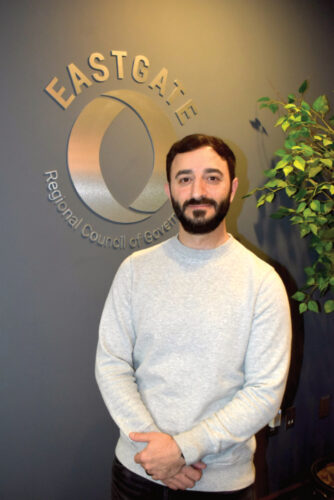
In the year since the Mahoning Valley Regional Housing Strategy was released, Eastgate Regional Council of Governments Director of Planning and Development Justin Mondok has been meeting with officials from cities, villages and counties to “arm them with information, so they can make the best decisions possible” about how to implement the strategies in the plan.
Mondok said the plan contains information that needs to be explained in a simpler way than the sometimes complex way the report was written. “We are going to put out some communications that really break it down in a different way that helps people get to know the information in a more simplified manner and eases people into the more technical information and helps inspire ideas about what to do with the information,” Mondok said during an interview at Eastgate’s downtown Youngstown offices.
Mondok said, “There are a lot of good resources in there. But if there is a barrier of knowing how to use it, what good is it? That is our next big step is how do we make different entry points for folks to be able to grasp the material and be able to use it fully so we can get more mileage out of that document.”
Mondok said the process of implementing the housing strategy by government and community organizations should be incremental. “You don’t want wholesale, broad based changes. This is really a game of inches, where you make small tweaks, you see how that plays, and change your practices and your systems you have set up, and you keep making that small progress until you get to a point where you’ve reached a place where you are no longer hindering development, you are not putting up arbitrary barriers.”
He said he has had “one-on-one-style conversations with our communities. We want to hear from them where they are going, where they see their communities going and where they need additional support.”
He said he realizes that a lot of communities in Mahoning and Trumbull counties “don’t necessarily have the time and a staff available to dig into these more (complex) topics.” He said, “That is where we feel we (Eastgate and partners) can be of service” and “be more useful to our local communities.”
Mondok said one of the “bigger points that came out of the housing strategy process was the creation of a housing consortium that will coordinate “all of the multiple facets of housing, saying it is a pretty broad, complex topic.”
He said Eastgate is creating a housing consortium as “a centralized place for folks who work in housing day in and day out to come, share information, share the successes they are having, also areas that they are struggling with that they need more support with.”
He said the plan is to bring “experts from outside for some educational and training opportunities as well.” He said there will be several events this year to make educational and expert opportunities available to the communities.
When Mondok was asked what he considers the important goals of the housing strategy are, he said one is addressing the sustained population loss in the two counties, which has lowered property values.
One key thing the study did was provide data on the “submarkets” of the communities in the two counties and “gave them a grade based on where they fall on a spectrum of strength of the housing market. We have some markets that are very strong. You could build a house and sell it and the builder will probably make a profit,” he said. Some middle markets might perform better with incentives to build or improve housing. And there are markets where a “subsidy really needs to come in to make it a viable place for housing development to happen.”
He said each housing submarket needs to be treated differently, and the data helps with that. “One tool is not going to be a perfect fit for each” community and submarket.
He said when looking at areas with a depressed housing market, “it requires a different set of tools, a different mindset from being able to put down a large (housing) development where those houses will sell.” He added, “We are looking at all market sectors and what are the levers we can pull to make sure everything gets better.” It’s an attempt to help all communities, he said.
“I think we have a good base of housing developers who are really interested. But I think there is certainly more work to be done in terms of getting people to think bigger and a little more creatively about some of the solutions we can use,” he said.
REGIONAL CHAMBER
When Guy Coviello, president and CEO of the Youngstown / Warren Regional Chamber, was asked about the Mahoning Valley Regional Housing Strategy, he said the Chamber’s role is “advocacy among all levels of government and education, providing information and promoting collaboration.”
He said, “We formed a Housing Council about a year ago, made up of about 20 Chamber members who work in housing. It includes builders, developers, lenders, suppliers, land banks and organizations like the Youngstown Neighborhood Development Corp and others.”
The Housing Council meets regularly “to discuss our collective role. It has adopted goals that include support to help drive construction of 1,000 new homes by 2030 across the region. We also are starting to develop a housing tool kit, which will be an in-depth directory that identifies and explains available programs to help make housing development more affordable to builders, developers and homebuyers,” he said.
The Regional Chamber has also advocated for programs like the Ohio Residential Economic Development District (REDD) grant to help cover some infrastructure costs for new construction, such as water and sanitary sewer lines. It was part of the biennial state budget.
“We encourage local governments to consider applying for the REDD grant, and we also have had conversations with federal legislators asking them to consider ways to help fund needed infrastructure” for such projects.
He said the Regional Chamber also has been talking to officials in Mahoning and Trumbull county communities where “in-fill” housing is a good option, such as Youngstown, Warren, Struthers and Niles. In-fill housing is a term used to describe “new housing that is built in an existing neighborhood,” according to the city of Shaker Heights’ website.
Coviello credited local organizations such as the Youngstown Neighborhood Development Corp. and Trumbull Neighborhood Partnership for their work in acquiring land and developing it into new housing, including on Glenwood Avenue in Youngstown and on the former Emerson School site on Warren’s northwest side.
“Often these types of homes are built with the help of state programs like Welcome Home Ohio that help defray the construction and development costs, making the new homes affordable,” he said.
The Regional Chamber issued a recent one-page summary of the Regional Housing Strategy that succinctly describes its mission being to “enhance the quality, accessibility and attainability of housing across the Valley by focusing on improving existing housing stock, developing new residential spaces and leveraging available resources.”
Its vision statement is “We envision a Valley where every resident has the opportunity to live in a vibrant, welcoming neighborhood, where new development fuels local prosperity, talent retention and equitable community growth.”
Hence then, the article about why do valley residents move less than others in ohio was published today ( ) and is available on TribToday ( Middle East ) The editorial team at PressBee has edited and verified it, and it may have been modified, fully republished, or quoted. You can read and follow the updates of this news or article from its original source.
Read More Details
Finally We wish PressBee provided you with enough information of ( Why do Valley residents move less than others in Ohio? )


Also on site :
- Zelensky’s endgame, Houthi dominance, German decline: RT stories that shaped the week
- Publisher Fully Drops Best-Selling Author and Longtime ‘Britain’s Got Talent’ Host Over Disturbing New Allegations
- Americans Affected by 2024 Data Breach Could Claim Up to $5,000 From Settlement — How to Check If You Qualify and What You Need to Submit