
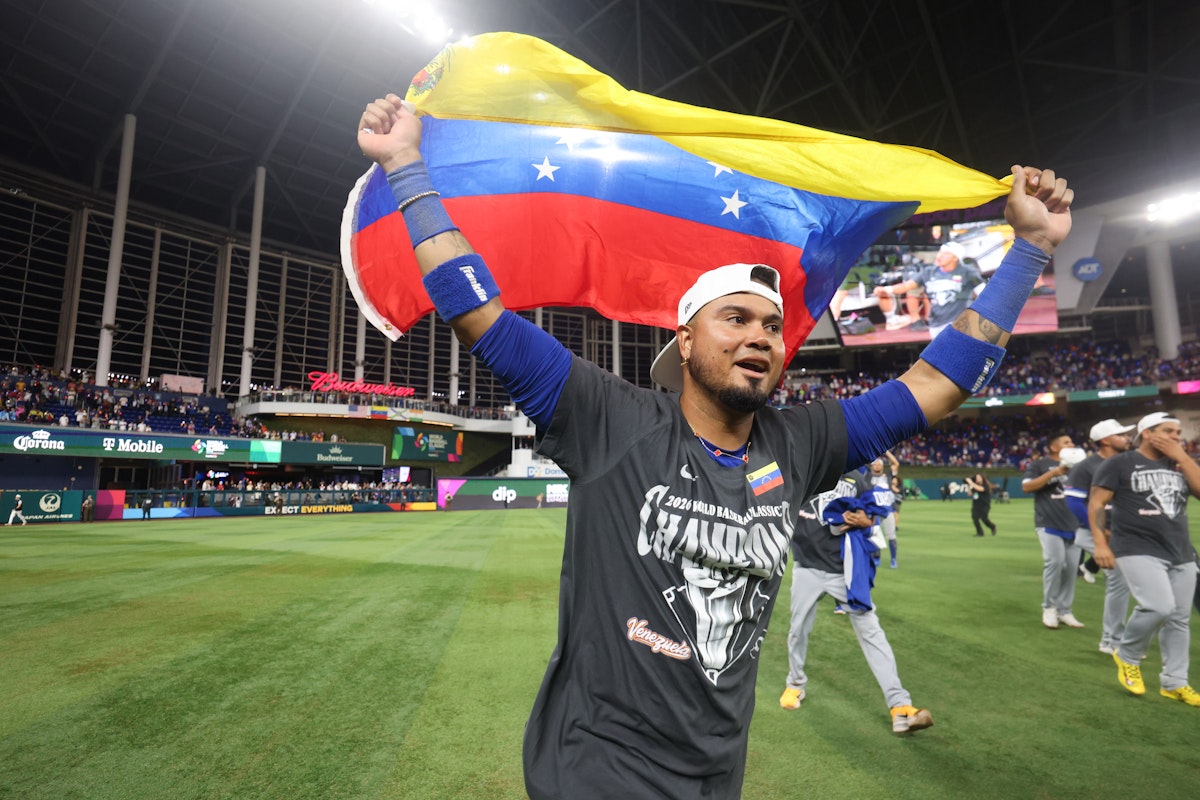
This year’s World Baseball Classic was, by most metrics, a smashing success for the sport. Venezuela’s 3-2 victory over the United States in Tuesday’s final cemented its status as a great baseball power. Many of the country’s players and coaches, some of whom have won World Series titles or been inducted in the Hall of Fame, were overcome with emotion after representing their homeland.
Other great stories abounded during the two-week tournament. Korea, buoyed by a raft of young KBO stars, made it out of the group stage for the first time ever. Italy’s Cinderella run to the semifinals began with an upset win over Team USA. Czechia held powerhouse Japan to a single run until the ninth inning in their match last week. Ondrej Satoria, a full-time electrician by trade, pitched four scoreless innings against the reigning champions, and Japanese fans gave him a standing ovation when he bid farewell to the Tokyo Dome.
One of the thrills of international competition is relishing our unique differences. Team Italy, which was almost entirely comprised of Italian-Americans playing under an ancestral flag, took espresso shots after each home run and bedecked the successful slugger in an Armani jacket. Mexico festooned players in a sombrero for their home-run celebration, while Great Britain’s players donned a beefeater uniform, complete with the iconic bearskin hat. The Dominican players danced and celebrated at every opportunity, not limiting themselves to just the biggest hits.
The only real exception in this tournament of joy was Team USA. Few of the players appeared to take any real pleasure or personal pride in playing in the WBC. Some seemed to treat it as a mere extension of spring training. Tarik Skubal, the Detroit Tigers ace and a reigning Cy Young Award winner, pitched in a group-level game against Great Britain and then went back to training camp, declining to participate in further stages. (He was still on hand in Miami on Tuesday night to receive a silver medal.)
Even when they won in the group stages, the USA dugout appeared dour and joyless. For other teams it was thrilling to play alongside their countrymen, outside the bounds of the usual professional teams with which they played, and to represent their countries on the international stage. Team USA players declined to draw upon our nation’s own cultural heritage. Instead they acted like they were at war.
First came a widely publicized moment between Team USA catcher Cal Raleigh and Mexican outfielder Randy Arozarena. During one at-bat, Arozarena extended a friendly hand to shake with Raleigh. Both men know each other well—after all, they play together on the Seattle Mariners. Raleigh didn’t move a muscle. Arozarena, understandably so, took it as a personal insult. In a post-game Spanish-language interview, Arozarena explained how he felt in greater detail:
I’d like to tell him in four languages, that’s what I’d like,” Arozarena said. “First I’ll tell him in Spanish, look. All he has to do is thank God he has such wonderful parents, yeah? That his parents are very well-mannered. I got to see them two days ago at the hotel, and they went to say hi, they gave me a hug. Said they were very proud of me and happy to see me again. The other thing I want to say to him, I’ll tell it to him Cuban-style. What he needs to do is go fuck himself. Mexican-style: he can go fuck himself. And in English, I’m gonna say it to him in English. That ‘good to see you’ he gave me? He can shove it up his ass.
Raleigh, on the other hand, saw no issue with his actions. “I love Randy. I do,” he later said in an interview. “I hate that this is a thing. There’s no beef. When we get back to Seattle, he’s my brother. We’re family. I already reached out to him, so it’s just a competitive environment and I know he would want the same for me when we’re on the team and playoff baseball. I just have a responsibility for my teammates here right now and my country, and emotions are running high.”
His message was somewhat undercut by the shirt he wore that said FRONT TOWARDS ENEMY. The phrase comes from markings on the M18A1 Claymore, an anti-personnel mine that first became widely used in the 1960s during the Vietnam War. In a tournament meant to symbolize baseball’s global reach and international spirit, Raleigh managed to invoke a Hegsethian fetishization of killing foreigners. He also emulated the Claymore’s imprecision by going 0-for-9 at the plate.
The moment symbolized Team USA’s misthinking about the tournament. For every other country, the WBC was an opportunity for both national brotherhood and international fellowship. For the Americans, it was largely framed as an opportunity to glorify American militarism—an embarrassing and reactionary approach to any sporting event, let alone a multi-continental tournament.
It is common for national teams to bring high-profile figures to speak to players and inspire them during a tournament. At one point, the players did hear from Michael Phelps, the most decorated Olympian in history, who knows something about representing the United States in front of the world. Prior to their matchup with Team Canada, however, Team USA instead got to hear from Robert O’Neill, a former Navy SEAL.
O’Neill is best known for claiming to have personally killed Osama bin Laden during the 2011 raid on his Abottabad compound. Other SEALs have disputed this and criticized O’Neill for taking personal credit for specific SEAL activities against their tradition and honor code. Nonetheless, he was able to levy the claim into two book deals, a Fox News contributor job, and a perch for culture-war commentary. Ahead of the 2024 election, for example, he insulted a group of young men for publicly supporting Kamala Harris and claimed, bizarrely, that they “would be my concubines.”
Why would you bring in this guy, of all guys, to speak to a bunch of professional baseball players? Team USA manager Mark DeRosa said this when asked about it during a press conference:
You never want it to get lost why you’re doing this, whatever that why is. And a lot of people, like Paul Skenes said to me when he signed up for this, ‘I want to do this for every serviceman and woman that protects our freedom.’ And that’s why we wear USA across our chest. And I just thought it would be like a time to kind of redirect and get those guys to understand that although this is an unbelievable event, you’re getting a chance to share a locker room with the game’s greats, there’s a reason why you’re doing it, and a reason why people protect our freedom at night. And I just wanted to honor that. So that’s why he came in to talk.
When I heard DeRosa’s answer, I felt an unusual sense of envy towards the other WBC teams. They get teams that want to play for their fans and supporters, as well as their nation as a whole. Even the Italians, who had no native players on their national team, celebrated them. Americans did not get that experience in this tournament. Yankees players play for New York City. Red Sox players play for Boston and New England. Dodgers players play for Los Angeles. Team USA, by its own terms, did not play for all Americans.
To say that they were honoring the troops is also not quite correct. For one thing, O’Neill is not and should not be taken as representative of the entire U.S. military. Beyond that, this was also not a Memorial Day game where teams naturally honor veterans and fallen soldiers. Team USA was not raising awareness of veteran suicide rates or trying to find housing for homeless ex-servicemembers. Nor were the players highlighting recent budget cuts to VA hospitals, planned changes to facial-hair policies that will disproportionately purge Black soldiers, or the Pentagon’s brief attempt to erase Jackie Robinson’s military service.
What is actually being venerated, whether intentionally or reflexively, is a militaristic worldview that fetishizes the use of force instead of actual national defense. It treats soldiers not as citizens first in a traditional republican society, but as some kind of super-citizens around whom the national identity must be built. To the Founders, who feared the dangers that a standing army would pose to American liberties and emphasized civilian control of the military, there could be few greater heresies from the American civic faith.
This cultural trend is much greater than Team USA, of course, and they are largely a product of it. With a few exceptions, they come from a generation of young men who do not remember America before the September 11th attacks. They grew up in an age where a presidential administration framed opposition to the Iraq War as an attack on active-duty soldiers and veterans alike, a dissent-suppressing mindset that somehow persisted even after most Americans turned against the war.
Paul Skenes, the generational pitching talent from the Pittsburgh Pirates, wrote an open letter to young baseball fans titled “A Letter to All the Little Leaguers Out There” on the eve of the WBC’s group stage. Some of it extolled hard work and dedication, the usual messages that baseball players send to youngsters. But most of the column revolved around the virtues of military service and his own brief experiences with it.
“My respect for our service men and women knows no bounds,” he wrote. “I’m in awe of those folks. And all that they do to keep us safe. Anything that enables me to honor those who serve this country, I’m going to do. So knowing that service members around the world will be watching these WBC games, some of them deployed far from home, some of them on active duty … it means everything to me. I just want to make them proud.”
Most of the article can be read as Skenes grappling with his own decision to pursue a professional baseball career over a career in the armed forces. He transferred from the Air Force Academy to Louisiana State University after his sophomore college season. Equating his Team USA tenure to actual military service appeared to be how he reconciled his decision, as if there was anything shameful about being a civilian baseball player.
“I was never deployed myself,” he wrote, “but I know how much pride those individuals take in wearing that uniform — with your name on the right side of your chest and the U.S. Air Force or Army lettering on the left side … because that’s what you put over your heart. Not your name, your country.” There should be pride in playing for Team USA as well, of course, even if you’re carrying a ball instead of a rifle.
Team USA’s flawed mindset permeated through every aspect of its performance. Some players and coaches described themselves as the Dream Team, hearkening back to the iconic men’s basketball lineup at the 1992 Olympics. It was always a poor fit, implying a false American dominance over a sport where the best players now come from Japan and Latin America as well.
On the field, the lineup oscillated between blowing out weaker teams and barely scraping by against more formidable ones. A sense of entitlement and arrogance seem to permeate the Americans’ approach. Even from the television broadcast, viewers could tell that the vibes—an essential component of any championship team—were off. When pitcher Mason Miller received his silver medal on Tuesday night, he already began taking it off by the time the officials had moved on to the next player.
There are two pieces of good news out of this. One is that Team USA won’t be making a White House visit to eat cold McDonald’s hamburgers with President Donald Trump. FBI Director Kash Patel made no warrantless incursion into the winning team’s locker room this time. With baseball on the cusp of a new golden age, Americans won’t have to see some of the sport’s brightest young stars denigrate themselves by donning chintzy red hats for the White House’s self-serving partisan goals, as the men’s hockey team did last month.
The other saving grace is Team USA won’t have to wait until the next WBC for a cultural reset. Baseball is returning for the 2028 Summer Olympics in Los Angeles, and players are already clamoring to participate in it. DeRosa’s rocky run as manager despite the raw talent as his disposal—he appeared to forget at one point that the team hadn’t made it out of the group stage yet—could open the door to new leadership before the next big international tournament.
Every adult is allowed to have a few adolescent beliefs. One of mine is that baseball can be a reflection of the national soul. With any luck, the next iteration of Team USA will celebrate things about our country than its ability to kill large numbers of people overseas. Hopefully they’ll be wearing cowboy hats, playing jazz music, eating hot dogs, quoting from Star Wars, ringing the Liberty Bell, or something similarly fun and corny whenever they hit a home run. After all, if the only thing you love about America is the military, then you don’t really love America at all.
Hence then, the article about team usa s soulless militarism was their undoing in the wbc was published today ( ) and is available on The New Republic ( Middle East ) The editorial team at PressBee has edited and verified it, and it may have been modified, fully republished, or quoted. You can read and follow the updates of this news or article from its original source.
Read More Details
Finally We wish PressBee provided you with enough information of ( Team USA’s Soulless Militarism Was Their Undoing in the WBC )


Also on site :
- In ‘Marshals’ Season 2 Premiere, Kayce Dutton Goes Rogue to Save His Son—and Our Exclusive Sneak Peek Offers a First Look at the Action
- Eddie Murphy to Make Major Career Transition with New Peacock Series From Critically Acclaimed ‘Mad Men’ Creator
- Zhou Yuxiang hired food delivery riders to sell AI to factories. Now he’s chasing China’s industrial AI breakthrough