
This article is from the 2025 Technical Update.
The human factors TDT looks for and creates opportunities to influence design to leverage human strengths and to protect people and missions. The human factors team has experts with knowledge of human performance in all aspects of NASA missions as well as from other safety-critical industries. The goal is to ensure that science-based human factors knowledge and lessons learned are applied throughout the mission lifecycle. The strategy is to 1) modify existing and create new discipline tools that meet NASA’s needs and constraints, 2) build strategies to enhance the disciplines’ chances for success, 3) enhance simulation techniques to gain maximum information even when verification and validation opportunities are limited, 4) develop new analysis methods for human performance in NASA mission contexts, and 5) reframe understanding of human performance to emphasize the key role of human resilience in mission success.
This article highlights a set of analytical models of crew workload, training, and expertise that can be used to aid decision makers in determining the size of a Mars crew adequate for crew safety and mission success. These tools are built on a Department of Defense (DoD) capability that has been used extensively to evaluate the success of specific designs. Unlike missions in low Earth orbit or even to the Moon, a crewed Mars mission will operate under extraordinary constraints, primarily a significant communication delay with Earth and prolonged communication blackout periods. This necessitates a radical rethinking of mission design, including the human elements of crew size, workload, expertise, and resilient performance.
To address this gap, the NESC developed a systematic and quantitative methodology, along with an associated suite of modeling tools, to enable the development of an evidence-based trade space for guiding crew size decisions for human Mars missions. This work provides actionable analysis to programs and projects early in development, enabling simultaneous consideration of mission architecture, operational concepts, and the roles human will play throughout the mission. This analysis supports the development of mission designs that preserve and enable human resilient performance to ensure the success and safety of future Mars exploration.
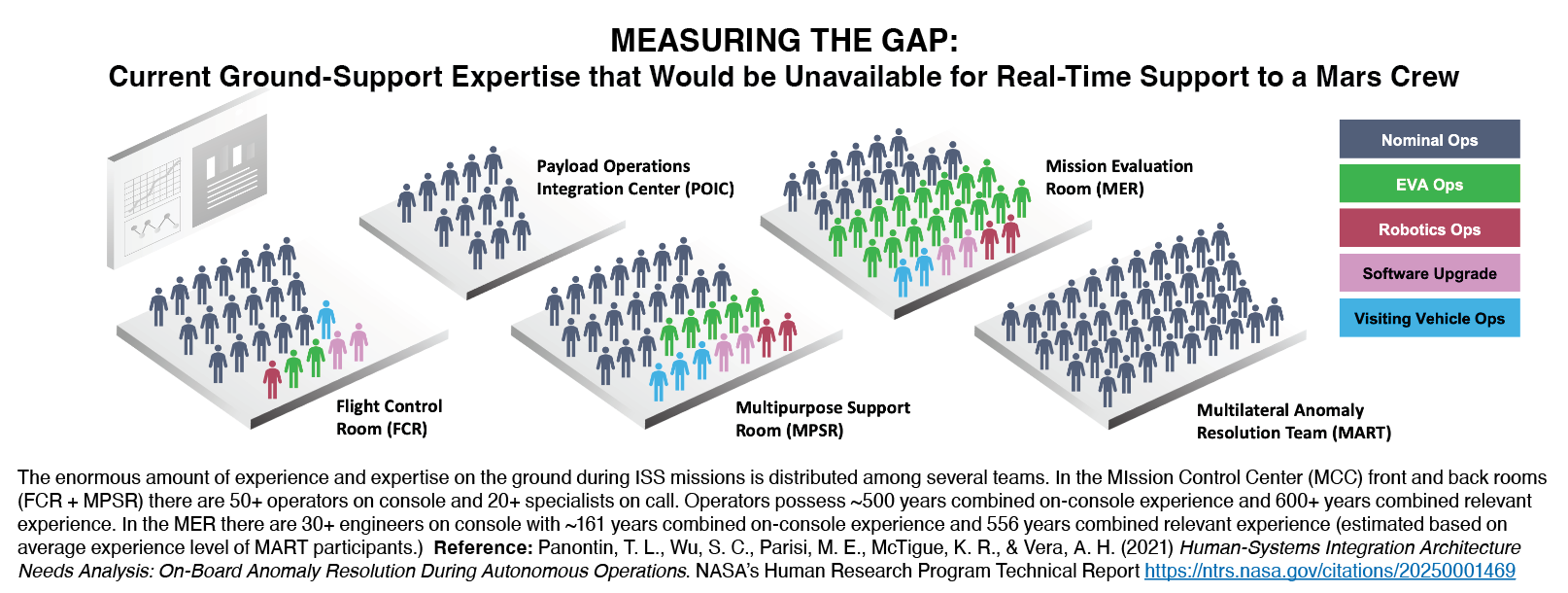
Historically, NASA’s human spaceflight programs have relied on real-time support from extensive ground control, composed of a collective intellect that acts as an extended crew to manage objectives and respond to anomalies. As depicted in Figure 1, the volume of ISS ground personnel highlights the vast support structure available for Earth-proximal missions. However, for Mars, communication delays of up to 22 minutes one-way and blackouts lasting up to three weeks during superior conjunctions will eliminate this real-time lifeline. This demands a new focus on the capabilities required of the onboard crew, who will face time-critical decisions and unforeseen failures with only their knowledge and onboard decision-support systems, often without pre-existing procedures.
Current ground-support expertise for ISS missionsThe NESC’s methodology fills a longstanding gap, as past Mars crew size determinations often lacked detailed quantitative analysis of crew tasking, workload, and expertise. Extending DoD methodologies for manpower determination, the NESC human factors trade space methodology offers a repeatable and data-driven means to assess whether a given crew complement possesses the capability to accomplish mission objectives and respond successfully to unforeseen failures that have potential loss of crew or loss of mission (LOC/LOM) consequences. The core process involves gathering Mars mission concepts and information, determining use cases to model, creating a trade space evaluation framework, conducting human performance modeling, and performing trade space analyses. This iterative approach, conceptually represented by the Mars Crew Size Decision Process (see Figure 2), allows for adaptation as technologies and mission assumptions evolve.
Central to this methodology are four human performance models, each revealing critical insights into the human factors of Mars mission design.
1. IV Operations for Planetary Surface EVA Model: This model examined the mental workload of intravehicular (IV) Mars crewmembers supporting a planetary surface extravehicular activity (EVA), simulating activities currently performed by Mission Control Center personnel for ISS EVAs. It predicted that during a Mars surface technical EVA conducted at the pace of an ISS EVA, the workload for an IV crewmember performing combined essential flight controller duties would be unacceptably high, indicating a severe negative impact on task performance. This finding underscores the necessity of reconsidering EVA pacing, task automation, or increasing IV support crew complement to ensure mission-critical EVAs are safely conducted independently of Earth-based support.
2. Robotic Arm Assisted EVA Operator Model: This model assessed the mental workload of a crewmember operating a robotic arm (see Figure 3) in both manual and automated control modes on a Mars transit vehicle. The model results indicate that two crewmembers may be necessary to mitigate unacceptably high workload during manual robotic arm operations. Furthermore, consistent with the scientific literature, the model predicted that stressors like sleep debt increase mental workload and degrade performance, extending task completion times. This highlights the importance of accounting for crew well-being in crew-size determinations.
3. Mars Transit Crew Model: This analysis focused on crew utilization and staffing requirements during a 9-month Mars transit mission, reallocating planned and unplanned tasks from ground control to the crew. The modeling, using ISS-equivalent task assumptions, predicted that more than six crewmembers (given average rates for unplanned events) would be needed to achieve the same number of work hours as a four-person ISS mission. This substantial increase emphasizes the critical impact of Earth-independence on daily crew workload and the imperative for adequate crew complement to manage ongoing responsibilities.
4. Personnel, Expertise, and Training Model: Given the communication delay/blackout with Mars, paired with no rapid return-to-Earth options, NASA will need to rely on the expertise of the crew to respond to unforeseen failures. A custom model was developed to quantify the crew expertise required to meet mission objectives and respond to unforeseen events with LOC/LOM potential and short time-to-effect. Based on analysis of ISS historical data, the probability of at least one occurrence of such a failure during Mars transit is greater than 99%. A sensitivity analysis of the relationship between a successful crew response and LOC/LOM outcome was conducted for cases in which the crew gave a successful response 90%, 95%, 98%, and 99.985% of the time. The estimated likelihood of a LOC/LOM consequence for all but the most conservative of these cases is greater than 1%, which is considered in the “very high” (red) range, per the Human System Risk Board risk matrix. The likelihood of LOC/LOM consequences only drops below 0.1% (yellow) for a successful response rate of 99.985%. When unforeseen failures occur on a mission to Mars, it will be critical that the crew have the necessary level of expertise to accurately diagnose problems and restore critical functionality. The Personnel, Expertise, and Training model is designed to provide the agency with the capability to consider the trade space
The NESC’s proposed methodology to aid crew-size determinations. Trade-space parameters are input into any of four models, whose output characterizes the risk level associated with a given crew size. Astronaut Anne McClain using the Space Station Remote Manipulator System on ISS.Hence then, the article about expanding the human factors toolbox an approach to balancing crew and mission design parameters was published today ( ) and is available on NASA ( Middle East ) The editorial team at PressBee has edited and verified it, and it may have been modified, fully republished, or quoted. You can read and follow the updates of this news or article from its original source.
Read More Details
Finally We wish PressBee provided you with enough information of ( Expanding the Human Factors Toolbox: An Approach to Balancing Crew and Mission Design Parameters )


Also on site :
- Publisher Fully Drops Best-Selling Author and Longtime ‘Britain’s Got Talent’ Host Over Disturbing New Allegations
- Ogden residents push for safety changes at South Union Street and Stony Point Road intersection after 88-year-old woman killed in crash
- The $290 Million Role That Matt Damon Regrets Turning Down: ‘You Will Never Meet an Actor Who Turned Down More Money Than Me’