
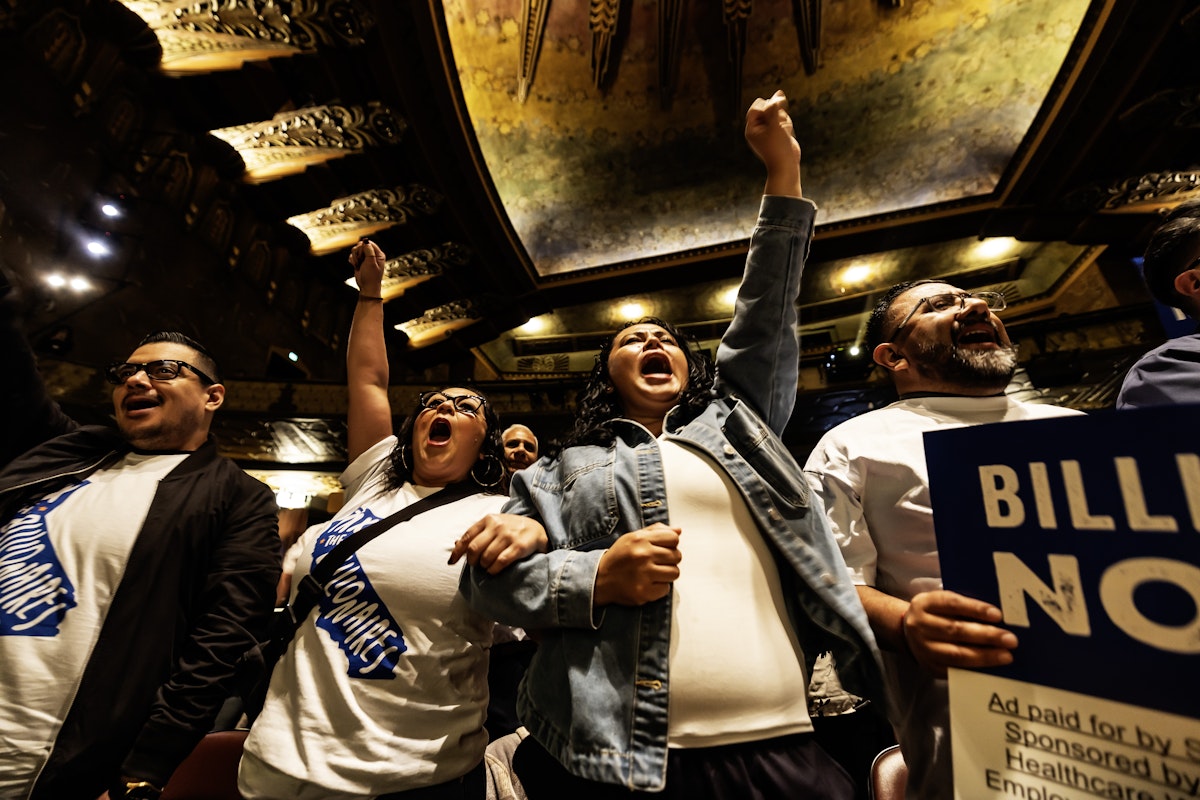
When the Los Angeles chapter of 50501, one of the loosely organized groups behind the No Kings marches against President Trump over the past year, heard about a proposed initiative to tax Californian billionaires, its volunteer members quickly signed up to help get the measure on the November ballot. The idea of a wealth tax wasn’t new to many activists, but the timing was right. Hunter Dunn, a 50501 member, said he’s noticed a change in the way his colleagues have talked about taxing the rich in the past few years. Instead of using the slogan that billionaires should pay “their fair share,” people use a more open-ended call: “Make billionaires pay.” That shift might seem subtle, but there’s an important distinction: Only the latter implies punishment.
“[The billionaires] went too far supporting the American Gestapo,” Dunn said. “They went too far actively bowing down to Trump and donating him money for destroying the ballroom, and then there were many, many, many of them directly referenced and associated with [Jeffrey] Epstein and [Ghislaine] Maxwell, child sex traffickers…. They’re not just sitting at a table with an alleged Nazi. They’re sitting at a table with an alleged predator, sex trafficker, and pedophile as well. And the American people do not want that table to exist anymore.”
At first, the tie between Epstein, who died in prison in 2019 while awaiting trial on sex trafficking charges, and a California ballot initiative isn’t obvious. But when viewed as part of the ever increasing anger at America’s elite and the role they play in supporting the Trump administration, it makes more sense. Taxing billionaires has been popular with voters since Senators Elizabeth Warren and Bernie Sanders, who supports the California proposal, proposed it in their 2020 campaigns for president, but legislators haven’t answered the call. This year, California voters may be taking the matter into their own hands—and the proposal, no matter how imperfect, may ride the growing tide of left-wing populism to passage in the November elections.
Diego Marquez, a 38-year-old optician who collects signatures for the proposal near his home in downtown L.A., says a lot of the voters he speaks with also mention Epstein. They want to “screw the billionaires,” he said. “A lot of people are fed up.”
The proposed initiative is sponsored by the United Healthcare Workers West, a chapter of the Service Employee’s International Union, which began collecting signatures in January. The measure would implement a one-time tax of 5 percent for any legal California resident with assets over $1 billion in 2026. To land on the state’s typically proposal-heavy ballot, the campaign must gather enough signatures to equal 5 percent of the total votes cast in the last gubernatorial election—so about 875,000 signatures. The deadline for collecting and verifying those signatures is June 8.
The Teamsters have signed up to support the effort, as has 50501 and the local chapter of the Democratic Socialists of America. The SEIU-UHW has more than 5,000 volunteers collecting signatures and has approved up to $25 million in spending for this and two other ballot measures.
But the measure hasn’t gotten universal support, even from the left. The SEIU-UHW has sponsored many ballot initiatives in the past few years—45 since 2012—such that the union’s president, Dave Regan, has become somewhat notorious for it. According to recent reporting from The Information, a tech publication that covers Silicon Valley, not all of labor leadership in California is on board with the billionaire tax, worried it would make it harder to pass other wealth taxes or raise revenue for other programs. Some say Regan uses ballot initiatives “more as bargaining chips or political tools than as policy proposals,” according to The Information. In the past, ballot proposals have spurred the state legislature to act on measures or provide more health care funding ahead of potential ballot measures.
Even many left-wing observers are questioning whether the proposal is a wise policy. A one-time tax on billionaires, of which there are about 200 in the state, isn’t exactly going to solve inequality. “Before this country starts messing around with major wealth taxes (which have a miserable track record in other countries), we ought to tax high incomes—not just billionaires—at a much higher rate, and increase capital gains and corporate tax rates as well. All these income-based taxes stand today at what, historically, are appallingly low levels,” my colleague Timothy Noah wrote in January.
Few countries attempt to tax wealth, Noah noted, and often don’t raise much if they do. This is why many policy experts have objected to wealth tax proposals from Warren, Sanders, and others in Washington. Many politicians object, too—and not just Republicans. New York City Mayor Zohran Mamdani has proposed closing the city’s budget deficit by increasing the income tax on millionaires, but can’t do so without action from the state government in Albany—and Governor Kathy Hochul opposes a hike. (State legislators are warmer to the idea. If it fails, Mamdani may end up having to raise local property taxes instead.)
Similarly, the California proposal has gained a formidable opponent in Governor Gavin Newsom. “It’s a badly drafted effort,” he said in January, arguing that it could cost the state revenue over the longer term if the wealthy flee the state over the tax. Some have threatened to do just that, including Peter Thiel, the PayPal founder and Trump supporter, and Google founder Larry Page. In the past, few of the ultra-wealthy have made good on such promises to leave when taxes are raised or politicians promise to raise them, but the threats, along with Newsom’s caution, could give Californians pause. “It’s going to be interesting to see if the moderate position from leaders by Newsom is going to maybe demotivate people,” said Carey Stapleton, a lecturer of computational political science at the University of Massachusetts. “[Voters are] getting inconsistent messages from their party leaders, the people they look up to.”
Two initiatives have launched to fight the proposal, Stop the Squeeze and Golden State Promise, with the latter reporting a $10 million contribution from a San Francisco blockchain company. And Silicon Valley billionaires, including Google’s other founder, Sergey Brin, are spending on a group called Building a Better California, which is sponsoring three other initiatives, some of which would conflict with the billionaire tax proposal by preventing retroactive taxes or prohibiting its spending provisions.
Opponents have said that a wealth tax, whether it’s one time or long-term, would diminish some of the innovation centered in Silicon Valley by driving out the billionaires who invest in startups in the region now. Representative Ro Khanna, who represents part of Silicon Valley, supports the billionaire tax and is cosponsoring a similar federal tax with Sanders. But supporters of the tax say these concerns are misplaced. “I think if you walk down the dorm halls of Berkeley or Stanford and ask any aspiring entrepreneur, ‘Would you like to make a billion dollars from your startup, but the price is a 1 percent tax to keep California hospitals open, I think every single entrepreneur takes that deal,” said Kris Cuaresma-Primm, who’s worked at Uber and other Silicon Valley startups and is now head of partnerships for the California billionaire Tax Act. “And if we go back in time, I bet the Google founders would have taken that deal too.”
The SEIU-UHW has heard the critiques, and counters that the proposed tax was very deliberately designed to solve a specific problem caused by Republicans in Washington. The One Big Beautiful Bill Act, which President Trump signed into law on July 4, made cuts to health care, food stamps, and public education that are causing an acute fiscal emergency in states around the country. California could lose as much as $19 billion per year in Medicare and Medicaid spending and as much as $5 billion in food assistance spending. (Most states are in the same boat because they’re all likely to lose federal funding in the bill, which also makes rural and community hospitals especially vulnerable to cuts in services and closures.)
Suzanne Jimenez, chief of staff of the SEIU-UHW, said the goal is “to try to save our health care system and make sure that it’s functional, just until we find a longer term solution.” It became clear that focusing on billionaires, the most fortunate among us in California, paying a very minimal 5 percent one-time tax to just bolster the healthcare system… it just made the most sense.”
David Gamage, a professor of law who specializes in tax law at the University of Missouri and helped write the proposal, said that the simplicity of the tax was part of its appeal. The SEIU-UHW wanted to raise money very quickly, and the fact that the tax would affect such a small number of taxpayers means the state could easily conduct hand-audits to collect it. But it also means that the projected revenue—about $100 billion over five years, since the billionaires would not have to pay the tax all at once—could be impacted if even a few billionaires made good on their promise to leave.
The proposal relies on California’s legal definition of residency, which means that if they are “domiciled” in California but leave for a transitory or temporary purpose, they may still count as a resident. Simply buying a second property elsewhere wouldn’t count. “Certainly, a lot of billionaires bought some property in Florida and were reported as maybe leave,” Gamage said. “Whether any of them actually left as a matter of California law, I haven’t seen any critical reports that make me think so. I wouldn’t be surprised if … one or two did…I would be very surprised if it’s a substantial number did.” It’s unclear if any billionaires changed their residency before January 1 in a way that abides by California law, and they’d likely have to prove the change in court.
But these technical questions may be irrelevant to the California voters who are angry about the direction of the country under Trump and want to express their rage at the ballot box in November.
Anger and populism go hand-in-hand, and it’s been rising on the left for some time—at least since the Great Recession, which took a magnifying glass to the widening economic inequality in America. Ryan Dawkins, an assistant professor of political science at Carleton College in Minnesota, notes that while populist anger on the right today targets markers of social change, like immigration and diversity in public life, the left’s targets are the tightening web of political and financial elites. “There’s just this frustration around affordability ... like we can’t live our lives, like we can’t even pay our bills, and we’re seeing that the top 1 percent ... all the wealth is accumulating to them, and that’s what’s driving this growing inequality,” he said.
The growing inequality and the affordability crisis are stirring an anger that is easily directed at billionaires, and voters might be less concerned about the specifics of the tax than who it’s targeting, Stapleton said. “Most people are not paying attention to politics daily. They’re not thinking about policy every day,” he said. “But then when they see a politician publicly be angry about something, that gives them kind of more time to think about their own anger, which ultimately makes them angrier about things, and then turn out to vote.”
Hence then, the article about the battle to enact a billionaire s tax in california was published today ( ) and is available on The New Republic ( Middle East ) The editorial team at PressBee has edited and verified it, and it may have been modified, fully republished, or quoted. You can read and follow the updates of this news or article from its original source.
Read More Details
Finally We wish PressBee provided you with enough information of ( The Battle to Enact a Billionaire’s Tax In California )


Also on site :
- How to Try WhatsApp's New Scheduled Messages Feature Early
- 30 Years Ago, ‘X-Files’ Aired Their Most Famous Episode – Only to Have it Promptly Banned Amidst Severe Backlash: ‘I Got a Screaming Call the Next Day That the Episode Would Never Air Again’
- ‘Reagan’ Star Reveals She Jumped Out of a Moving Car as a Teen to Escape Terrifying Stranger: ‘I Was Covered in Blood’