
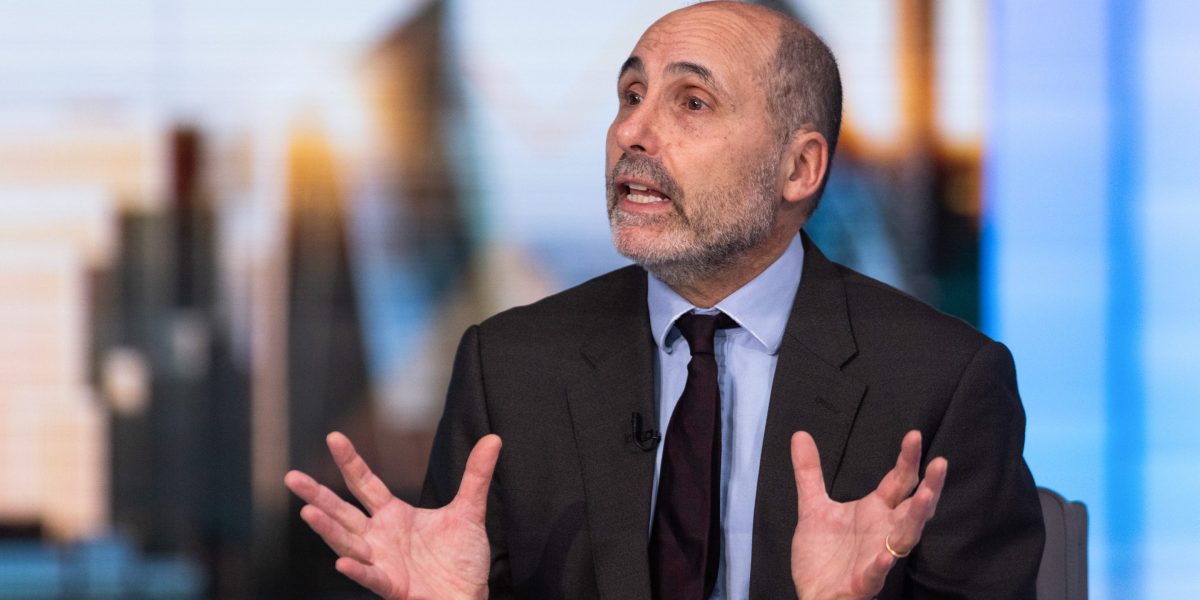
One of Wall Street’s most closely watched equity strategists is sounding an alarm: The stock market is exhibiting some of the same dangerous characteristics it did in the run-up to the Global Financial Crisis, and a correction could be imminent. And warnings from Peter Oppenheimer, Goldman Sachs’ chief global equity strategist, carry particular weight—because his contrarian calls have a strong track record.
In a research note published Wednesday, Oppenheimer warned equity risk premia—a measure of how much extra return investors demand for owning stocks over safer assets—“have fallen sharply and are now, mostly, back to levels seen in the run-up to the financial crisis.” That signal, Oppenheimer wrote, has left equities “more vulnerable to disappointments or shocks” driven by technology competition or a worsening growth-inflation mix.
To be clear, Oppenheimer is not predicting a bear market, but warned the risks of a correction are high. Furthermore, he pointed out, equity valuations are elevated not only in the U.S., which has been true for many years, but every single region around the world shows valuations “above their own longer-term histories.” In other words, stocks are expensive everywhere, and due for a fall.
A strategist who saw it coming
As far back as 2024, Oppenheimer made a gutsy and prescient call that U.S. stocks were becoming too expensive, and urged investors to diversify internationally. This move paid off handsomely as European and Japanese markets surged while American tech stumbled in the so-called sell America trade. He followed that up in November 2025 with a 10-year outlook forecasting the S&P 500 would deliver just 6.5% annual returns—the worst of any major region—and emerging markets would lead with returns of nearly 11% per year. He has also flagged AI as a potential bubble risk, drawing explicit equity market parallels to past speculative cycles. (Clearly, it’s too early to decide on the accuracy of those calls.)
How these predictions bear out could weigh on the seriousness of any near-term correction, as some market signals resemble the Global Financial Crisis of 2007–08, yet private-sector balance sheets are healthy across households, corporations, and banks. For this reason, market watchers have been prone to compare the situation in markets to the bursting of the dotcom bubble in the early 2000s. Earnings have continued to tell a bullish story, with Goldman’s own research acknowledging global earnings estimates have actually risen since the start of 2026—an unusual and historically positive signal.
At any rate, Oppenheimer, writing alongside colleagues Sharon Bell, Guillaume Jaisson, and Giovanni Ferrannini, called the current combination of geopolitical uncertainty and AI-driven market anxiety “a significant headwind for risk assets to absorb in the short term.”
Oppenheimer noted the behavior of cyclical stocks could compound the risk, as sectors sensitive to economic swings have dramatically outperformed defensive ones over the past year, and cyclicals now trade at roughly the same valuation as defensives. This pricing dynamic leaves little margin of safety if confidence wavers. Any fresh shock to oil prices, a trade disruption, or escalation in the Middle East could quickly erode it.
Tech’s historic unraveling
At the sector level, Oppenheimer highlights one of the most striking reversals in modern market history: Technology stocks have just endured one of their weakest periods of relative performance against other sectors in the past 50 years. The rotation—driven by investor anxiety about AI capital expenditure plans and fears that software business models face disruption—has rapidly narrowed the valuation premium that tech long enjoyed. In a striking reversal, U.S. asset-heavy industrial stocks now trade at a price-to-earnings premium over asset-light technology companies.
Despite the elevated correction risk, Oppenheimer does not expect the market to tip into a protracted bear market. Goldman’s economists forecast U.S. GDP growth of 2.8% this year; global earnings estimates have actually risen since January; and private sector balance sheets—households, corporations, and banks—remain healthy enough to absorb shocks without triggering systemic contagion. Oppenheimer has previously noted most geopolitical shocks produce a median S&P 500 correction of about 6% over 18 days before stabilizing.
Ultimately, Oppenheimer recommended investors maintain broad geographical, sector, and factor diversification—the same playbook he has been advocating for over a year, and the one that has already proved its worth.
“We see correction risks as high given current valuations,” Oppenheimer wrote, “but expect this to present a buying opportunity with relatively low risk of a more protracted and deep bear market.”
This story was originally featured on Fortune.com
Hence then, the article about goldman s top strategist warns stocks are flashing the same warning signs as before the 2008 financial crisis was published today ( ) and is available on Fortune ( Middle East ) The editorial team at PressBee has edited and verified it, and it may have been modified, fully republished, or quoted. You can read and follow the updates of this news or article from its original source.
Read More Details
Finally We wish PressBee provided you with enough information of ( Goldman’s top strategist warns stocks are flashing the same warning signs as before the 2008 financial crisis )


Also on site :
- SWAT response shuts down streets in Chicago's Logan Square neighborhood
- Macklemore Says His Call to ‘Free Palestine’ Is Not a ‘Criticism’ of Jewish People: ‘None of Us Will Be Free Until We Are All Free’
- 2005 Coldplay Hit, Written by All Four Band Members, Considered ‘One of the Greatest Songs of All Time’