
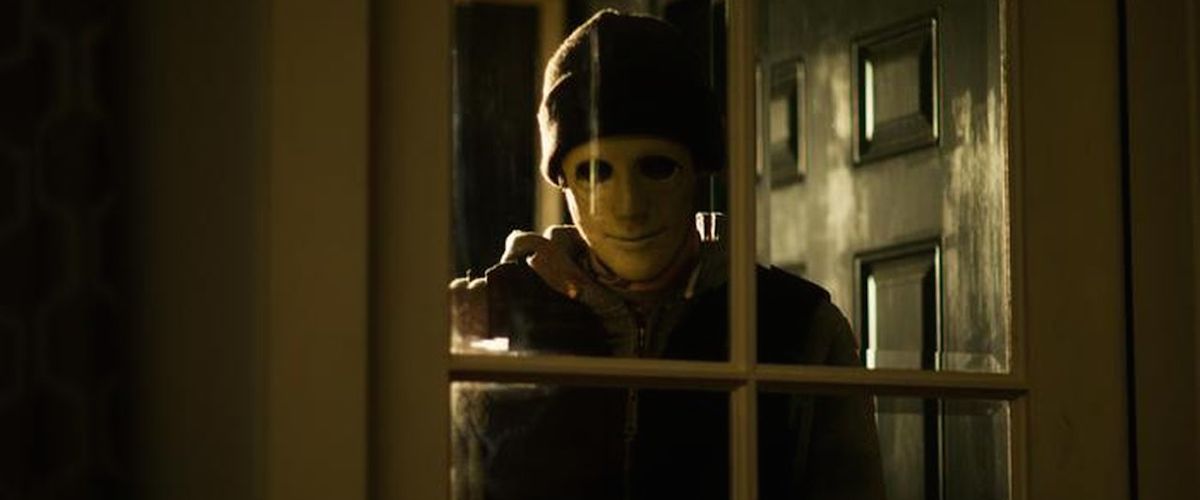
Back in 2016, I was searching for the perfect 90-minute movie and came across “Hush.” Arguably prolific horror director Mike Flanagan’s breakout film (though some might say that was 2013’s “Oculus”), “Hush” was quickly snapped up out of South by Southwest earlier in 2016 by Netflix, signaling a partnership between the streamer and auteur that would span “Gerald’s Game,” “The Haunting of Hill House,” “The Haunting of Bly Manor,” “Midnight Mass,” “The Midnight Club,” and “The Fall of the House of Usher.” It stars frequent Flanagan collaborator Kate Siegel, who is also his wife and co-wrote the script with him, as Deaf author Maddie Young living alone in a remote cabin. She is stalked by a masked killer, played by John Gallagher Jr., who is intent on ending her life.
It’s that simple—and extremely effective. “Hush” incorporates horror and thriller tropes, such as the single location, which has proven successful in all manner of horror films from Alfred Hitchcock’s “Rear Window” (1954) to recent entries like Christopher Landon’s “Drop” (2024) and Sam Raimi’s “Send Help” from January.
It also efficiently makes use of a sparse cast, with Flanagan mainstays Samantha Sloyan and Michael Trucco as Maddie’s ill-fated neighbors, Emma Graves as Maddie’s sister, who only appears via FaceTime, and Gallagher Jr. as her initially masked tormentor.
“Hush” owes a debt to “Wait Until Dark,” the 1967 horror film starring Audrey Hepburn as a blind woman terrorized in her home by a drug gang, and is a precursor to the subsequent rash of horror films incorporating disability, such as 2018’s “A Quiet Place,” starring Deaf actress Millicent Simmonds, “Bird Box” from the same year, in which blindness is a salvation from a vision-based contagion that causes suicide, and the “Smile” franchise, which explores trauma, mental illness, and suicidal ideation.
Disability advocates have been vocal about the lack of representation of actual Deaf people in “Hush,” as neither Siegel nor Flanagan is Deaf. However, they employed a Deaf consultant on the film, and Siegel actually learned American Sign Language for the role.
Speaking to IndieWire in 2020, Simmonds told Kristen Lopez, critic and author of Popcorn Disabilities: The Highs and Lows of Disabled Representation in the Movies, that despite the research and consideration Flanagan and Siegel put into “Hush,” “You can’t really do enough research if you’re not living it. If you’re not in this situation, and you’re not living with it, and you don’t sign [then] it’s hard to express that and [have] it still feel real.” I don’t presume to speak for the Deaf community as a non-disabled person myself, and the absence of people with lived experience in front of and in power positions behind the camera makes me feel some type of way, but I think there’s still value to “Hush” despite this.
Where it most resonates is in Maddie’s refusal to play the victim. Despite the limitations of her disability and the fact that she lives in a remote cabin, Maddie is far from the damsel in distress, using the biases of her stalker, known only as The Man, to her advantage. Maddie weaponizes sound against The Man, using her car alarm and a piercing, flashing smoke detector to catch him off guard, and uses her heightened senses to feel his breath on her neck when he approaches from behind.
Most horror movies—and, you know, real life—would have The Man be someone close to Maddie (and “Hush” does hint at that when Maddie rebuffs text messages from her ex earlier in the film), but “Hush” resists this temptation. The Man is just some random psychopath with no clear motive for targeting Maddie—he initially expresses surprise that Maddie is Deaf—leaving audiences as perplexed and spent as Maddie at the conclusion, “Hush” is even more unsettling than it would be if it explained away its killer’s catalyst.
All of this makes “Hush” an extremely satisfying payoff for relatively low buy-in. But where can viewers find “Hush” if they choose to take a gamble on it? Despite being initially bought by Netflix, which, for a time, seemed to crown Flanagan the new king of horror, his deal there ended in 2022 when he moved to Amazon Studios, for which he has yet to produce any content. (A “Carrie” series is coming later this year.) Though Flanagan’s long-form series remain on Netflix—for now—“Hush” disappeared from it in 2023 and is not currently available to stream on any of the major platforms, though it’s accessible on video-on-demand for a fee, and Plex has it for no cost.
Ultimately, “Hush” has been a casualty of the streaming-industrial complex, and Flanagan has been critical of Netflix’s prioritization of subscriptions over physical media. There is a push back against this and a move towards physical media again, especially when titles can disappear from platforms altogether, like “Hush,” making it the best horror movie you probably haven’t seen.
Hence then, the article about hush is the best horror movie you probably haven t seen was published today ( ) and is available on Roger Ebert ( Middle East ) The editorial team at PressBee has edited and verified it, and it may have been modified, fully republished, or quoted. You can read and follow the updates of this news or article from its original source.
Read More Details
Finally We wish PressBee provided you with enough information of ( “Hush” is the Best Horror Movie You Probably Haven’t Seen )


Also on site :
- On Air Today: Local Musician Jesse Fox on 97.9 The Hill Presents Tabitha Meeks and Jesse Fox at Cat’s Cradle Back Room
- Could Texas Elect a Democratic Governor for the First Time in More Than 30 Years? Polls Show a Tight Race
- This Compact Sony Soundbar Is Under $100 for October Prime Day