
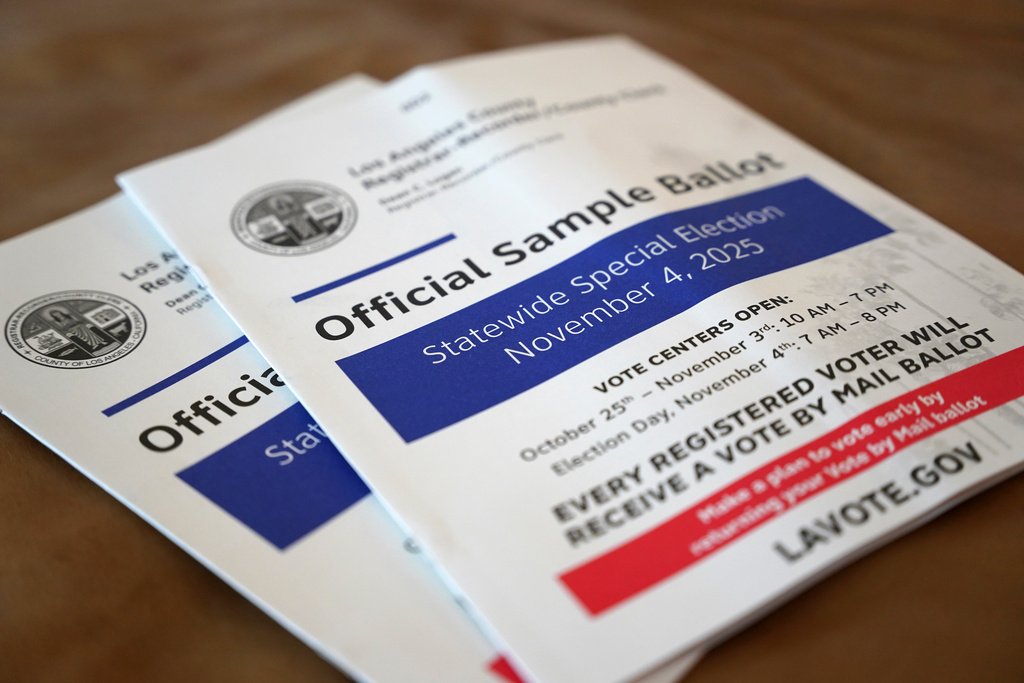
Recent events in the United States, along with disinformation circulated in order to undermine the integrity of voting, have led to a dramatic drop in confidence in elections across both major parties and independents.
In a national survey of 11,406 eligible voters by the Center for Transparent and Trusted Elections, 60% of respondents said they are confident votes will be counted accurately nationwide in the 2026 midterms, according to research that UC San Diego released Wednesday.
Just after the 2024 presidential election, that figure stood at 77%.
The survey of 11,406 eligible voters, conducted Dec. 19, 2025 through Jan. 12, found trust declined by 17% among Republicans, 13% among Democrats and 16% among independents.
The survey’s key findings were as follows:
Confidence in national vote counts registered 70% just before the 2024 presidential election, rose to 77% in the days shortly after that contest, but has fallen to 60% over the year since. The large partisan divide over trust in elections that was present before the election closed just after it, and now trust among all political groups has been declining in parallel. Republican respondents said they had particular distrust in mail ballots (50%) and whether non-citizens will be prevented from casting ballots (51%). Democrats (51%) and independents (48%), however, do not trust that Congressional district lines are drawn in a way that fairly reflects what voters want, compared to 34% of Republicans. Looking toward the 2026 midterm elections, 44% of Democrats, 34% of independents, and 30% of Republicans said they think it is likely that Immigration and Customs Enforcement officers will be at voting locations in their areas. When asked whether the presence of ICE officers would make them more or less confident “that votes in your county or city will be counted as voters intend,” more respondents in every racial and ethnic group responded that it would make them less rather than more confident. 31% of Asian American respondents, 31% of Latino respondents, 21% of Black respondents, and 8% of white respondents agreed with the statement “I worry that going to the polls could put me at risk of being questioned by federal immigration officers, despite being a U.S. citizen.”“Our data reveal it’s not just an abstract fear — many voters expect ICE at their polling place, and that expectation erodes confidence in the count,” said Lauren Prather, CTTE co-director and associate professor of political science at the School of Global Policy and Strategy.
When asked whether recent redistricting efforts such as those in California and Texas amount to attempts to “rig” the 2026 midterms, survey respondents most often blamed the opposing party.
However, nearly 25% of members of each party also assigned responsibility to their own leaders.
“When both parties see redistricting as ‘rigging,’ it’s a sign of a deeper legitimacy problem: Our data show voters don’t believe the lines are being drawn for fairness — they think they’re being drawn for advantage,” said Thad Kousser, CTTE co-director and professor at UCSD’s Department of Political Science.
California Gov. Gavin Newsom, Texas Gov. Greg Abbott and President Donald Trump have publicly discussed the political implications of redistricting. The two states have differed, however, because California put redistricting to a public vote, whereas Texas did not.
The far-right Heritage Foundation — one of the biggest backers of the Safeguard American Voter Eligibility Act, which would require proof of citizenship to vote — has for years baselessly claimed that noncitizens voting is “a major issue.” In the group’s own records, there have been 68 documented cases of noncitizens casting a ballot in a United States election since the 1980s, somewhere around 0.0001% of all votes cast in the past 40 years.
The SAVE Act would require a passport or Real ID to vote, both of which cost money, which critics point out is essentially a poll tax which could disenfranchise millions.
It has passed in the House but would require 60 votes to pass the Senate.
The Center for Transparent and Trusted Elections is a nonpartisan initiative to build sustained partnerships with election administrators across the country, test new ways to increase transparency and share strategies with the goal of “growing lasting trust across the political spectrum,” according to the center’s mission statement when it launched last year.
This survey was produced in collaboration with the university’s Yankelovich Center for Social Science Research.
Hence then, the article about recent events contributed to major drop in election confidence ucsd report says was published today ( ) and is available on Times of San Diego ( Middle East ) The editorial team at PressBee has edited and verified it, and it may have been modified, fully republished, or quoted. You can read and follow the updates of this news or article from its original source.
Read More Details
Finally We wish PressBee provided you with enough information of ( Recent events contributed to major drop in election confidence, UCSD report says )


Also on site :
- The US Should Defend Democracy – and Calin Georgescu – in Romania .. Opinion
- Amazon's 'Luxurious' $24 Cotton Hoodie Is a Perfectly Oversized Staple for Late Summer and Early Fall
- Celebrity Cruises Just Announced Its 2028–2029 Lineup—Complete With a Brand-New Ireland Stop and Gorgeous New Poolside Restaurants