
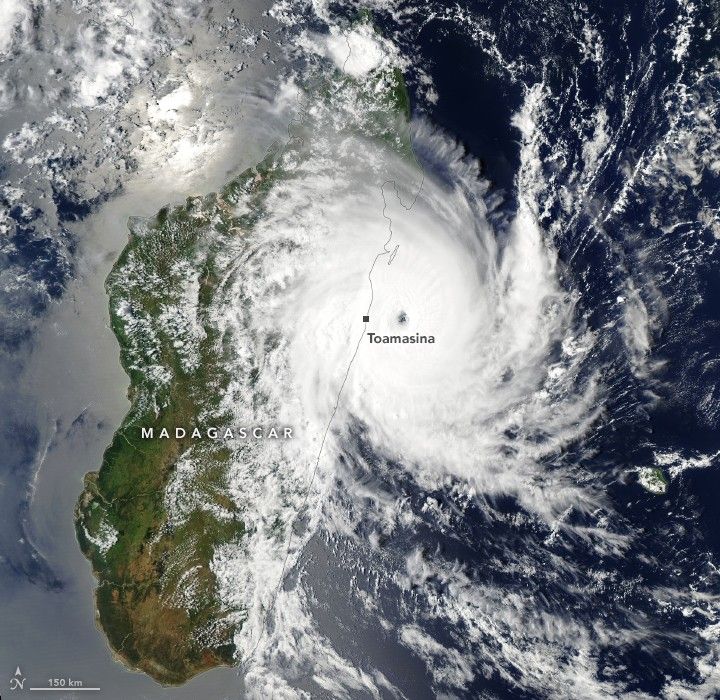
For the second time in two weeks, a powerful tropical cyclone struck Madagascar. On January 31, Fytia battered the remote northwestern coast of the island with destructive winds and torrential rains that displaced thousands of people. Less than two weeks later, Gezani made a direct hit on one of the island’s largest cities before sweeping past areas that Fytia had just flooded.
The MODIS (Moderate Resolution Imaging Spectroradiometer) on NASA’s Aqua satellite captured this image of Gezani as it neared Madagascar on February 10, 2026. At the time, the storm was undergoing rapid intensification. Its sustained winds peaked at 200 kilometers (125 miles) per hour before making landfall at Category 3 hurricane strength.
According to meteorologists with the Joint Typhoon Warning Center, the storm developed amid conditions “highly favorable” to strengthening, including sea surface temperatures above 28 degrees Celsius (82 degrees Fahrenheit), wind shear below 20 kilometers (12 miles) per hour, and an unusually moist atmosphere. As the storm passed near Toamasina, Madagascar’s second-largest city, satellites that contribute to NASA’s IMERG (Integrated Multi-satellite Retrievals for GPM) product measured rain rates up to 4 centimeters (1.6 inches) per hour.
The deluge caused widespread flooding in Toamasina and several other parts of the island. Preliminary damage assessments from Madagascar’s National Office for Risk and Disaster Management linked the storm to dozens of deaths, hundreds of injuries, and damage to more than 27,000 homes. Reports from news outlets and humanitarian groups described chaotic conditions in Toamasina, with widespread power outages, numerous collapsed roofs, and a lack of clean water.
January 29, 2026 February 14, 2026 In this false-color image acquired before the flooding, the Rianila and Rongaronga rivers merge near the town of Brickaville. River water appears dark blue against a bright green background of farmland and savanna forest. NASA Earth Observatory / Lauren Dauphin In a false-color image acquired after the flooding, waterways appear much wider, and floodwater covers large portions of the landscape west of the two rivers, both north and south of Brickaville. NASA Earth Observatory / Lauren Dauphin January 29, 2026February 14, 2026 In this false-color image acquired before the flooding, the Rianila and Rongaronga rivers merge near the town of Brickaville. River water appears dark blue against a bright green background of farmland and savanna forest. NASA Earth Observatory / Lauren Dauphin In a false-color image acquired after the flooding, waterways appear much wider, and floodwater covers large portions of the landscape west of the two rivers, both north and south of Brickaville. NASA Earth Observatory / Lauren Dauphin January 29, 2026 February 14, 2026Before and After
January 29, 2026 – February 14, 2026
CurtainToggle2-Up
The OLI (Operational Land Imager) on Landsat 8 captured this false-color image of severe flooding near Brickaville, just south of Toamasina, on February 14, 2026 (right). For comparison, the left image shows the same area before the storm. Villages and farmland along the Rongaronga River appear particularly hard hit. Crops commonly grown in this area include rice, vanilla, lychees, black pepper, cloves, and cinnamon, according to researchers from the French Agricultural Research Centre for International Development.
Madagascar is one of the most cyclone-prone countries in Africa, with about six storms typically affecting the island each year and two making direct landfall. The cyclone season generally runs from November through April, with peak activity between January and March.
NASA Earth Observatory image by Lauren Dauphin, using MODIS data from NASA EOSDIS LANCE and GIBS/Worldview and Landsat data from the U.S. Geological Survey. Story by Adam Voiland.
Downloads
February 10, 2026
JPEG (3.04 MB)
January 29, 2026
JPEG (5.40 MB)
February 14, 2026
JPEG (6.00 MB)
References & Resources
ACAPS (2024) Cyclone exposure and vulnerabilities. Accessed February 17, 2026. Associated Press (2026, February 12) Cyclone Gezani destroys 18,000 homes and causes at least 36 deaths in Madagascar. Accessed February 17, 2026. BNGRC (2026, February 16) Cyclone Gezani: Preliminary Assessment of Recorded Damage. Accessed February 17, 2026. BNGRC, via Facebook (2026) Posts. Accessed February 17, 2026. CIMSS Satellite Blog (2026, February 10) Cyclone Gezani makes landfall on Madagascar as a Category 3 storm. Accessed February 17, 2026. France24 (2026, February 11) Cyclone Gezani ravages Madagascar, leaving dozens dead and much of second city in ruins. Accessed February 17, 2026. Global Disaster Awareness and Coordination System (2026, February 17) Overall Red alert Tropical Cyclone for GEZANI-26. Accessed February 17, 2026. NASA Earthdata Tropical Cyclones. Accessed February 17, 2026. The Washington Post (2026, February 11) Death toll rises to 31 after Tropical Cyclone Gezani hits Madagascar and crushes houses. Accessed February 17, 2026. World Meteorological Organization (2026, February 13) Tropical cyclone Gezani hits Madagascar and threatens Mozambique. Accessed February 17, 2026. Yahoo News (2026, February 13) Madagascar cyclone death toll rises to 40, water, power still out. Accessed February 17, 2026.You may also be interested in:
Stay up-to-date with the latest content from NASA as we explore the universe and discover more about our home planet.
Senyar Swamps Sumatra
3 min read
A rare tropical cyclone dropped torrential rains on the Indonesian island, fueling extensive and destructive floods.
ArticleRagasa Steers Toward China
3 min read
The super typhoon headed for Guangdong province after lashing Taiwan and northern Luzon in the Philippines.
ArticleImelda and Humberto Crowd the Atlantic
3 min read
The tropical cyclones are close enough in proximity that they may influence one another.
Article 1 2 3 4 Next Keep ExploringDiscover More from NASA Earth Science
Subscribe to Earth Observatory Newsletters
Subscribe to the Earth Observatory and get the Earth in your inbox.
Earth Observatory Image of the Day
NASA’s Earth Observatory brings you the Earth, every day, with in-depth stories and stunning imagery.
Explore Earth Science
Earth Science Data
Hence then, the article about a second cyclone slams madagascar was published today ( ) and is available on NASA ( Middle East ) The editorial team at PressBee has edited and verified it, and it may have been modified, fully republished, or quoted. You can read and follow the updates of this news or article from its original source.
Read More Details
Finally We wish PressBee provided you with enough information of ( A Second Cyclone Slams Madagascar )


Also on site :
- Anthropic Sued for Using Elvis Presley Music to Train AI Models
- Sephora’s Sleek New Skincare Tool Instantly Depuffs and Sculpts the Skin
- Japan’s Gulliver’s Kingdom opened in 1997 with $350 million in loans; a court auction sold it for about $12 million