
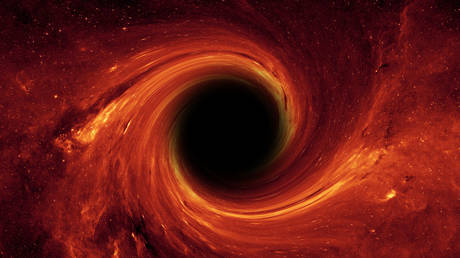
Scientists say a failed supernova resulted in a quiet transformation of a once-bright massive star
A star in the Andromeda galaxy 13 times the mass of the Sun has quietly turned into a black hole after failing to go supernova, according to a new scientific paper.
Massive stars can become black holes following a supernova, a spectacular cosmic event. At the end of their life cycle, when nuclear fusion in the core can no longer counteract gravity, it collapses. The resulting shockwave expels the outer layers. The core either turns into a black hole immediately or forms a neutron star that can later pull in more mass and collapse.
A team led by Columbia University astronomer Kishalay De believes a far less dramatic black hole birth that was not accompanied by a supernova was recorded by NASA’s NEOWISE mission in our neighboring galaxy 2.5 million light-years away.
The theory explains how star M31-2014-DS1 brightened in infrared in 2014, dimmed sharply in 2016, and nearly vanished by 2023. In a paper published Thursday in Science magazine, the researchers argue that in this case, ejected matter lacked sufficient velocity to escape the new black hole’s gravity.
Location and disappearance of M31-2014-DS1 © Science”Ten years ago, if someone said a 13 solar-mass star would turn into a black hole, nobody would believe that,” De told Space.com. “It was completely outside what was considered the norm.”
Black holes are so massive that even light cannot escape them. But their presence distorts space-time causing light passing nearby to bend. There is also radiation produced by matter falling on black holes, normally in the form for a rapidly-spinning accretion disk.
READ MORE: Potentially habitable Earth-sized planet discovered
A faint infrared glow from the dust cloud surrounding the location of M31-2014-DS1 remains detectable by sensitive instruments such as the James Webb Space Telescope, researchers say. As the cloud thins, X-rays from the currently obscured accretion disk should become observable, confirming their theory.
”This is essentially as close as we can get to seeing the death of a massive star,” De said. “In the end, I think it teaches us a lot more about stellar physics by not exploding.”
Hence then, the article about black hole born without a bang in neighboring galaxy study was published today ( ) and is available on Russia Today ( News ) The editorial team at PressBee has edited and verified it, and it may have been modified, fully republished, or quoted. You can read and follow the updates of this news or article from its original source.
Read More Details
Finally We wish PressBee provided you with enough information of ( Black hole born without a bang in neighboring galaxy – study )


Also on site :
- Beach Hazards Statement issued October 4 at 10:46AM PDT until October 9 at 11:00PM PDT by NWS Los Angeles/Oxnard CA
- Air Force removes all bombers from British base and redeploys them to the U.S. after a planned terror attack linked to Iran was foiled
- WikiLeaks at 20: The leaks that shook the world (VIDEOS)