
Iran’s internet connectivity has been partially restored, but experts are warning that, even on the other side of the digital blackout, the outlook for Iranian internet access remains bleak.
Internet monitoring experts at NetBlocks and Kentik said that some traffic resumed on Tuesday – nearly 20 days after the Iranian government cut the internet and international calls as it sought to crush massive anti-government protests. Thousands of demonstrators were killed in the crackdown.
In the meantime, the Iranian regime has made progress on its long-standing plans to “retire” access to the international internet, according to digital monitoring experts, who warn that Iran is entering “a new age of digital isolation.”
“Every time we have an internet shutdown in Iran, usually we don’t go back to normal,” said Amir Rashidi, a cybersecurity expert and the director of digital rights and security at the Miaan Group, a nonprofit that supports human rights in Iran.
After previous internet shutdowns, some platforms never returned. Instagram was blocked after the internet shutdown in 2022, amid widespread protests following the death of 22-year-old Mahsa Amini in police custody. And the popular messaging app Telegram was banned following protests in 2018.
Now, the Iranian government has made strides towards more broadly implementing technology that allows only people with security clearance to access the international web, Rashidi told CNN.
Experts call it “whitelisting,” and it involves a small subset of users being cleared to have a cell phone SIM card or other permissions that allow unrestricted access to the outside internet. Everyone else is effectively censored and forced to rely on the country’s national internet, where the regime can track users and block unapproved websites.
Such whitelisting is a move away from the country’s longstanding tactic of blacklisting specific websites and apps, towards a policy of keeping large swathes of Iranians perpetually in the dark, Rashidi explained
Since partial connectivity was restored on Tuesday, internet traffic patterns have been very jagged, according to the director of internet analysis at Kentik, Doug Madory. He speculated that “maybe a new traffic filtering system has been installed and can’t keep up.”
NetBlocks noted on Wednesday that “most ordinary users still face heavy filtering and intermittent service under a whitelist system despite a significant increase in internationally visible networks and datacenters.”
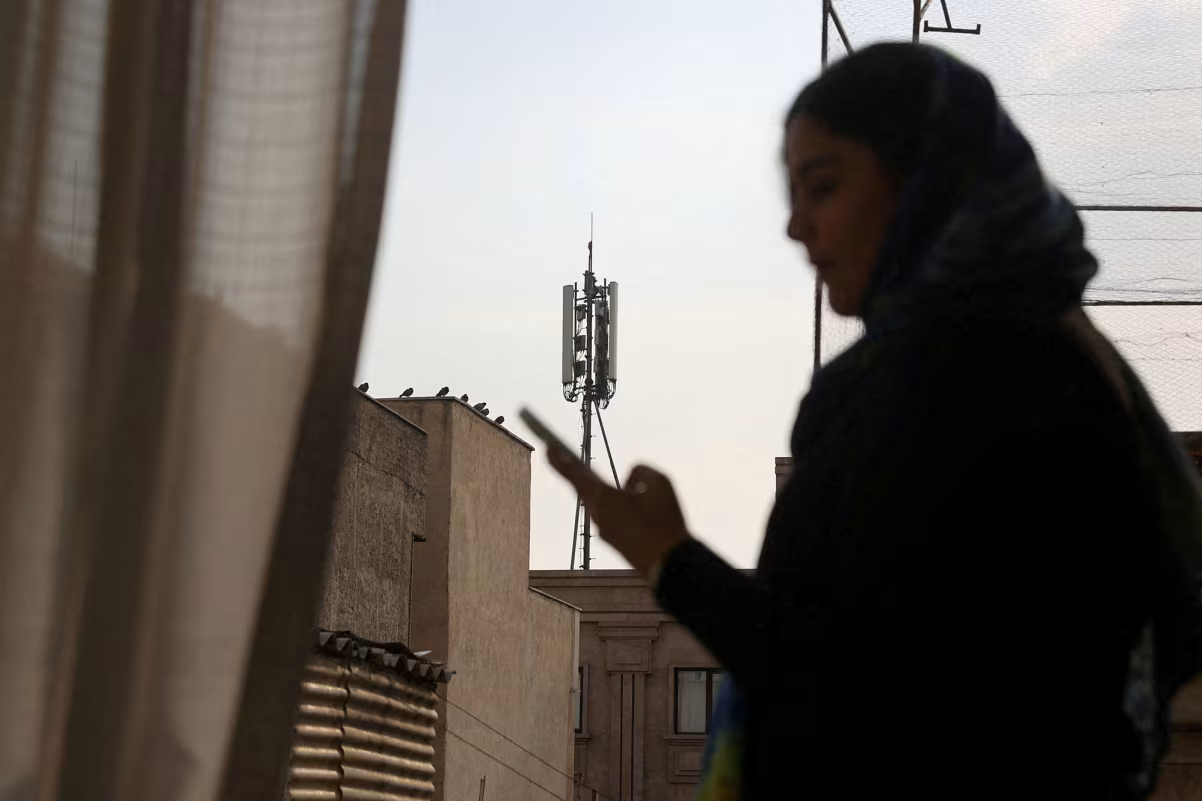
People in Tehran use their phones on Tuesday, when some internet connectivity resumed. Since partial connectivity was restored, internet traffic patterns have been very jagged, according to the director of internet analysis at Kentik.Fatemeh Bahrami/Anadolu/Getty Images
“We do believe they’re going to rapidly move into the direction of implementing that policy… the infrastructure exists,” Rashidi said of the expanding whitelisting policy, citing Miaan’s analysis of hacked emails that revealed some of the Iranian judiciary’s potential plans for censorship.
“I think the future is much darker,” Rashidi told CNN, noting that he also expects to see more military control and surveillance of the internet in the future.
Clampdown on internet workarounds
Internet censorship has become a cat-and-mouse game in Iran, where the population is one of the most sophisticated in the world when it comes to circumventing web restrictions, according to Mahsa Alimardani, associate director of technology threats and opportunities at the human rights monitor Witness.
Chief among the circumvention tools is satellite internet, like Elon Musk’s Starlink, which the company has made free in Iran.
“What is really becoming a game changer is the fact that we can have connectivity that does not depend on sovereignty,” Alimardani told CNN, noting that even former Iranian officials have speculated that internet shutdowns could become an obsolete tool in the coming years due to the availability of satellite internet. “The story of Starlink in Iran has been pretty incredible.”
But it’s estimated that in the country of roughly 92 million people, only about 50,000 Starlink terminals have been smuggled into the country, according to digital activists cited by FreedomHouse. Estimates vary, though.
And the Iranian government is cracking down on satellite internet users and arresting those smuggling the terminals. Possession of a Starlink terminal now carries the threat of a prison sentence, and there have been reports of a physical crackdown on homes and rooftops where satellite receivers have been spotted.
The regime has also worked to disrupt Starlink signals using electronic warfare tools, although Alimardani said that some of those efforts are believed to be exaggerated by the regime, as it tries to deter more people from buying satellite internet. The terminals are already expensive – about $2,000 on the black market – and it’s in the government’s interests to convince people that the investment would be wasted, she explained.
Rashidi, at the Miaan Group, added, “I do believe in the future, they (the Iranian government) would invest more in controlling satellite internet.”
A Starlink receiver sits atop a house in northwest Iran. Satellite internet terminals inside the country made connectivity possible for some during the blackout.Middle East Images/AFP/Getty Images
Aside from Starlink, the US government has for years funded virtual private networks (VPNs) in Iran, which make it appear as though internet users are coming online from a different country. The Trump administration last year cut funding for efforts to provide circumvention tools like VPNs amid a broader reduction in US foreign assistance.
Regardless, VPNs can only work if some level of internet connectivity is available.
Proton VPN, which offers free products to help people circumvent censorship, said on January 8 that the blackout cut off its user base in Iran.
And even when internet connectivity is present, the company said it has seen authoritarian governments like Iran going a step further, blocking VPN downloads and implementing sophisticated systems that can identify VPN web traffic to cut it off.
“Sometimes it happens that the shutdown is lifted, but then there are these very strong capabilities that are very hard to bypass,” said Antonio Cesarano, lead product manager for Proton VPN.
“What we’ve been observing in the last year or so is that people prepare themselves… people have probably multiple VPNs, so they try each one and see if it is working or not,” Cesarano told CNN. “It’s really whatever it takes to get back on the internet, to continue with your life, to talk to your family abroad.”
High costs of censorship
Compared to some other autocracies, it’s easier for Iran to implement broad-brush internet censorship because the country is so isolated. There are no international credit card transactions keeping its economy churning, and no foreign services like Netflix, Uber or Amazon that get disrupted in an international internet shutdown. Rather, similar services are carried out by domestic Iranian companies.
But there are still costs to shutting off the internet at a broad scale.
“There’s been a lot of push and pull because, of course, there are stakeholders within the regime itself that benefit economically from having this access, whether it’s (companies) that make money off of selling WiFi data packages for the international internet, or it’s the various businesses that need their workers to have various levels of connectivity,” Alimardani said.
“I don’t think within the regime itself they even know what direction they’re going to go,” she added.
The latest total shutdown marked the longest blackout in Iranian history – nearly two weeks longer than the 2019 internet shutdown, which a former head of Iran’s Chamber of Commerce estimated cost the country a whopping $1.5 billion.
CNN’s Sean Lyngaas contributed to this report.
The future of Iran’s internet connectivity is still bleak, even as weeks-long blackout begins to lift Egypt Independent.
Hence then, the article about the future of iran s internet connectivity is still bleak even as weeks long blackout begins to lift was published today ( ) and is available on EGYPT INDEPENDENT ( Egypt ) The editorial team at PressBee has edited and verified it, and it may have been modified, fully republished, or quoted. You can read and follow the updates of this news or article from its original source.
Read More Details
Finally We wish PressBee provided you with enough information of ( The future of Iran’s internet connectivity is still bleak, even as weeks-long blackout begins to lift )


Also on site :
- Record-Setting Falcon 9 Launch from Vandenberg SFB Scheduled for Late Monday into Early Tuesday
- The Russia-Africa summit 2026: What you need to know about building a multipolar world without the West
- Ballon d’Or 2026 award ceremony LIVE: Winners, reactions and latest news