
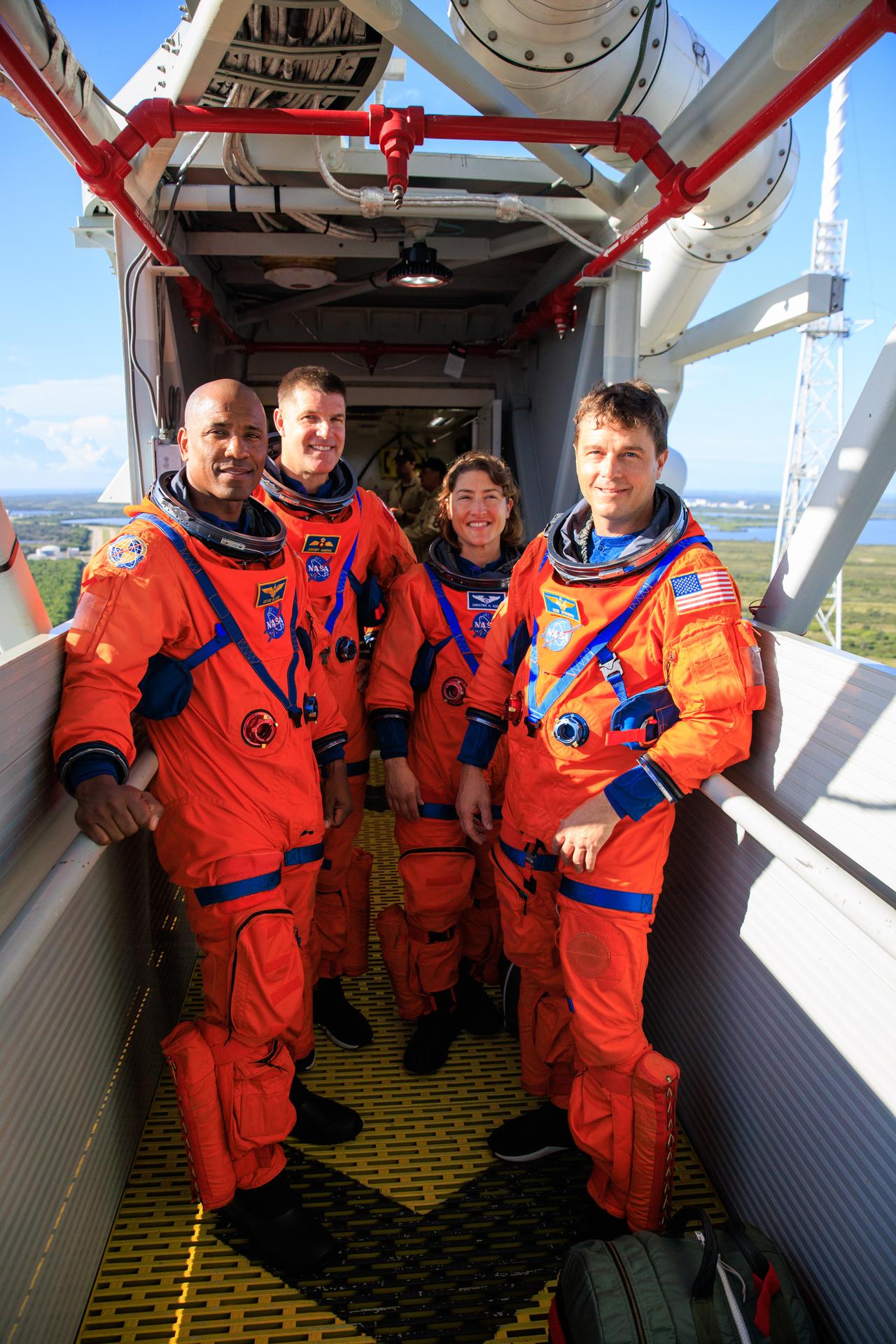
Four astronauts will soon travel beyond low Earth orbit and fly around the Moon on Artemis II, a mission that will test NASA’s systems and hardware for human exploration of deep space.
Since June 2023, NASA astronauts Reid Wiseman, Victor Glover, Christina Koch, and CSA (Canadian Space Agency) astronaut Jeremy Hansen have been preparing for their lunar journey. The approximately 10-day mission will test the SLS (Space Launch System) rocket and Orion spacecraft, named Integrity by the crew, while requiring the quartet to operate with greater autonomy and make critical decisions far from Earth.
Training for Artemis II is all risk mitigation. By preparing the astronauts and flight controllers for what they might encounter, we enable mission success.
Artemis II Chief Training Officer
Jacki Mahaffey
Unlike missions to the International Space Station, Artemis II offers no nearby safe harbor and no option to be back on Earth within hours of a problem. Training reflects that reality. Crews are prepared not just to follow procedures, but to understand spacecraft systems well enough to adapt when conditions change.
Training began with mission fundamentals, including how Orion and SLS systems function individually and together. From there, the crew progressed through phases of training that moved from routine on-orbit operations to more complex mission segments such as ascent, entry, and landing. Each phase builds on the last as the crew moves closer to flight.
In parallel, astronauts trained in medical operations, exercise systems, spacesuits, and daily life aboard Orion. Together, these elements form a single, integrated mission timeline.
Observing the Moon Through the Lens
The Artemis II crew practices lunar photography at NASA’s Johnson Space Center in Houston.NASA/Kelsey YoungA key part of Artemis II training includes lunar observation and photography. At NASA’s Johnson Space Center in Houston, astronauts studied the Moon’s far side, learning to identify crater shapes, surface textures, color variations, and reflectivity.
Although Artemis II will not land on the Moon, the crew will conduct detailed observations from lunar orbit to prepare for future Artemis missions.
Flight Training at Ellington Field
Artemis II crew members Reid Wiseman and Christina Koch during T-38F flight training at Ellington Field.NASA/Josh ValcarcelIn addition to classroom instruction and simulations, the Artemis II crew trains in T-38 jet aircraft at Johnson’s Ellington Field. The T-38 exposes astronauts to high-workload, dynamic flight conditions that build spatial awareness and adaptability, skills that translate directly to decision-making under pressure in spaceflight.
Protecting Crew Health in Deep Space
The Artemis II crew don their Orion Crew Survival System spacesuits for post landing emergency egress inside the Orion Mockup at Johnson’s Space Vehicle Mockup Facility.NASA/James BlairThe crew donned their Orion Crew Survival System spacesuits during training to support testing of Orion’s environmental control and life support systems. The suit provides pressure, oxygen, and thermal protection during launch, entry, and contingency scenarios while Orion’s life support systems manage cabin oxygen, water, temperature, and overall crew health throughout the mission.
Mastering Orion Systems and Simulations
Artemis II Commander Reid Wiseman (front) and Pilot Victor Glover participate in an Artemis II entry simulation at Johnson Space Center.NASA/Bill StaffordInside the Orion Mission Simulator at Johnson, the crew rehearsed every phase of the mission, from routine operations to emergency response. Simulations are designed to teach astronauts how to diagnose failures, manage competing priorities, and make decisions with delayed communication from Earth.
Through this process, the quartet learned every aspect of the Orion crew module’s interior, including how to navigate onboard displays and execute the procedures used to fly and monitor the spacecraft.
Science Preparation and Geology Training
Artemis II Mission Specialist Christina Koch stands in a windswept volcanic field during geology training in Iceland, where volcanic terrain serves as an analog for lunar landscapes. NASA/Robert MarkowitzWhile Artemis II astronauts will not land on the Moon, the geology fundamentals they develop during field training in remote environments are critical to meeting the mission’s science objectives.
During the mission, the crew will examine a targeted set of surface features, including craters and regolith, from orbit. Astronauts will document variations in color, reflectivity, and texture to help scientists interpret geologic history.
Preparing for Splashdown and Recovery
The Artemis II astronauts during water survival recovery training at NASA’s Neutral Buoyancy Laboratory. NASA/Josh ValcarcelThe mission will conclude when the Artemis II mission splashes down.
The crew worked through splashdown and recovery operations at the agency’s Neutral Buoyancy Laboratory. They rehearsed how to exit the Orion spacecraft safely in different scenarios, stabilize the spacecraft, and board a raft – skills they will rely on after returning from their mission around the Moon.
The Crew is Go for Launch
Artemis II crew members (left to right) Reid Wiseman, Victor Glover, Christina Koch, and Jeremy Hansen stand in the white room on the crew access arm of the mobile launcher at Launch Pad 39B at NASA’s Kennedy Space Center in Florida.NASA/Frank MichauxThe Artemis II crew also completed integrated ground systems tests at NASA’s Kennedy Space Center in Florida. These included suited tests, full mission rehearsals, and launch-day dry runs that walked astronauts through every step, from traveling to the launch pad to entering Orion at Launch Pad 39B.
As Artemis II moves closer to launch, the focus shifts from preparation to readiness as the crew enters the next era of exploration beyond low Earth orbit.
About the Author
Sumer Loggins
Share
Details
Last Updated Jan 30, 2026Related Terms
Johnson Space CenterArtemisArtemis 2GeneralExplore More
3 min readNASA Johnson Celebrates 25 Years in Space with Community Day
Article 16 hours ago 3 min readI Am Artemis: Doug Parkinson
Article 24 hours ago 5 min readNetworks Keeping NASA’s Artemis II Mission Connected
Article 2 days ago Keep ExploringDiscover More Topics From NASA
Missions
Humans in Space
Climate Change
Solar System
Hence then, the article about preparing for artemis ii training for a mission around the moon was published today ( ) and is available on NASA ( Middle East ) The editorial team at PressBee has edited and verified it, and it may have been modified, fully republished, or quoted. You can read and follow the updates of this news or article from its original source.
Read More Details
Finally We wish PressBee provided you with enough information of ( Preparing for Artemis II: Training for a Mission Around the Moon )


Also on site :
- ‘Triangle of Sadness’ Producer Backs Park Syeyoung’s Memory-Bending Love Motel Drama ‘Satellite of Love’ at Busan Asian Project Market
- Taylor Swift Shows Up on ‘Law & Order: SVU’ Set With a Surprise—and Mariska Hargitay Can’t Stop Talking About It
- ‘Two and a Half Men’ Creator Says Charlie Sheen Made Show a ‘Nightmare’: ‘I Had No Choice But to Shut Down’