
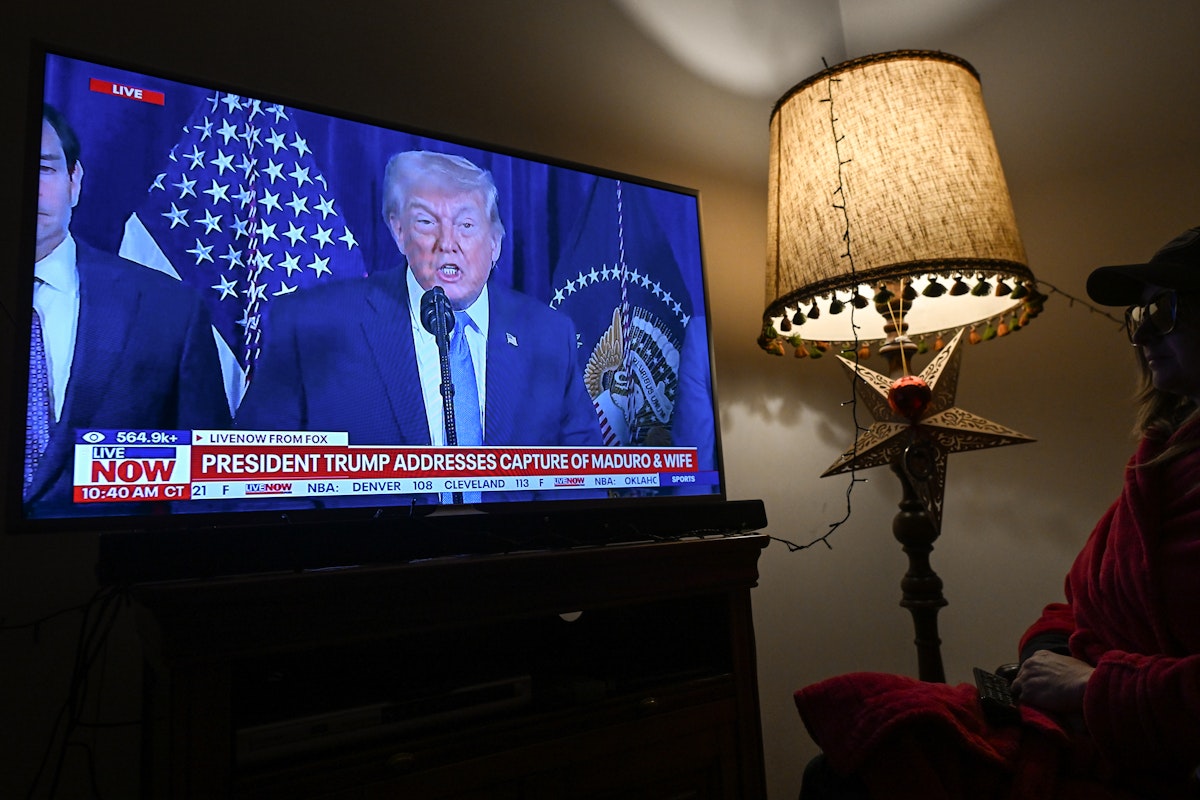
She behaved horribly. And then she ran him over. She didn’t try to run him over. She ran him over.
—Donald Trump, speaking to New York Times reporters about ICE agent Jonathan E. Ross firing point blank into the head of the 37 year-old American citizen Renee Nicole Good, killing her. Trump then showed the reporters a video that revealed Good did not run over Ross, nor appeared to be trying to.
President Donald Trump’s astonishing capacity to spout lies—even, as we saw last week, when documentary evidence like the video of Renee Good’s killing flatly contradicts him—is outpacing the press’s ability to correct them. I don’t fault the press for this state of affairs; it has expended considerable resources on the fact-checking project. But the job has gotten too big. We’ve never before seen a president flood the zone with whoppers on this scale, and it’s only gotten worse in Trump’s second term as his native mendaciousness is accelerated by encroaching dementia.
CNN’s Daniel Dale still bird-dogs Trump’s lies as well as any human could, but there are only so many hours in a day. Ditto for the Poynter Institute’s PolitiFact, the University of Pennsylvania’s FactCheck.org, and parallel efforts by the Associated Press and Reuters. Glenn Kessler fact-checks Trump’s lies in his Substack newsletter, but after he retired last summer as The Washington Post’s Fact Checker columnist the Post was too cowardly to replace him.
Indeed, as Kessler noted in his final Fact Check column, fact-checking is in retreat everywhere. Meta ended its fact-checking program shortly before Trump took office; Google threw in the towel six months later, and Trump’s dismantlement of the United States Agency for International Development slashes funding for fact-checkers abroad. Globally, the Duke Reporter’s Lab reported in June, the volume of fact-checking articles is down 6 percent compared to 2024. “In an era where false claims are the norm,” Kessler wrote, “it’s much easier to ignore the fact-checkers.”
Clearly, we need a new approach. I propose that instead of chasing Trump’s lies, the press should experiment with treating as major news those very rare instances when a statement coming out of Trump’s mouth actually turns out to be true. What we call “fact-checks” today are mostly lie-checks made newsworthy by a consensus that truthfulness is society’s expected norm. Instead, let’s try “truth checks” made newsworthy by society’s growing recognition that, with Trump, mendacity is the expected norm.
If that sounds to you like surrender, it needn’t be. The most appalling Trump lies, like what he and his lackeys have been saying about Good, still warrant coverage. And I certainly don’t propose we shut down existing fact-checking operations. If nothing else, they’re a godsend to those of us with a professional interest in quickly sorting political truth from reality: journalists, political scientists, rival politicians, and so on.
But fact-checks don’t seem to be getting through to the broader public. If they were, Trump’s approval rating (which, deservedly, has been falling since inauguration day) would now be well below the current 43 percent. Maybe Trump wouldn’t be president at all.
Or maybe he would. We’ve seen polls in the past that show majority approval for Trump even among that segment of Republicans that recognizes he’s a congenital liar. A Gallup poll last month found that 30 percent of Americans judge Trump “honest and trustworthy,” which suggests an additional 13 percent nonetheless approve of his job performance. Among Republicans, nearly one-quarter said he was not “honest and trustworthy,” even as 89 percent approved of the job Trump is doing.
The larger point is that an overwhelming majority of Americans—70 percent—are well aware that Trump is a habitual liar. Even if you support the guy there’s a decent chance you know this. Evidence is growing that the response is to tune Trump out—and tune out the news along with him. A December Pew Research Center poll found that since Trump first appeared on the political scene in 2016, the proportion of Americans who follow the news closely has fallen from 51 percent to 36 percent.
Social media and the dwindling of news sources no doubt account for most of this decline (the Pittsburgh Post-Gazette just announced it will go out of business in May), but surely the worthlessness of Trump’s public utterances plays some role. Even I pay much less attention than I once did to presidential interviews, because I know that Trump will lie his head off, and when caught in a lie he’ll bury his interlocutor in gibberish. Trump’s public statements are of interest only to measure the steady weakening of his mental state. His lies require only a highlight reel.
How would a truth-check work? I propose it be preceded regularly by the following boilerplate:
Dear Reader. The president’s public statements are so consistently untruthful that while we continue to monitor them, we well understand if you no longer care to listen. For those of you who, quite reasonably, judge Trump a habitual liar, we record here those instances when our reporting finds that, whaddya know, he’s telling the truth. It does happen now and then!
Let’s try this with Trump’s most recent posts on Truth Social.
Item: On Thursday, Trump committed the novel offense of being too truthful, by posting some jobs figures 12 hours ahead of their announcement by the Bureau of Labor Statistics. The pre-release embargo assures that markets receive this information all at once so nobody gains an unfair trading advantage. While typically any number Trump states out loud will pretty reliably be wrong—often wildly so—if it’s in a chart prepared by BLS or some other respected statistical agency it will likely be correct, as best that agency knows.
Item: On Friday, Trump announced he was meeting with oil companies at the White House to discuss Venezuela. That actually happened. We can’t vouch for anything Trump told oil executives at the meeting.
Item: On Friday Trump announced that the United States seized an oil tanker “which departed Venezuela without our approval.” That’s true, with the caveat that if Venezuela really were, as Trump claims, under our control, then the ship never would have left port to begin with.
Nothing else Trump said on Truth Social between Thursday evening and Friday afternoon was notably truthful. For example, Trump’s claim that the United States called off a planned “second Wave of Attacks” was almost certainly Trump’s usual nonsense. It’s very doubtful any such wave was under serious consideration. Our truth-check beta will therefore ignore it.
I haven’t worked all the kinks out of this model. Rome wasn’t built in a day! But I do think that when a president recites falsehoods to the unprecedented extent Trump does, the press must reconsider how to communicate what is actually happening as opposed to what is a figment of the president’s fevered imagination. Otherwise the news becomes more a mirror of Trump’s delusions than of the world we live in.
Hence then, the article about the only time trump makes news is when he tells the truth was published today ( ) and is available on The New Republic ( Middle East ) The editorial team at PressBee has edited and verified it, and it may have been modified, fully republished, or quoted. You can read and follow the updates of this news or article from its original source.
Read More Details
Finally We wish PressBee provided you with enough information of ( The Only Time Trump Makes News Is When He Tells the Truth )


Also on site :
- Meet the CEO whose century-old company never laid off employees through the Great Depression, the recession, or Covid
- Medtronic Announces Strategic Partnership with Cornerstone Robotics to Further Expand Global Access to Robotic-Assisted Surgery
- HUMAIN Collaborates with Compal to Drive Cloud-to-Edge AI Expansion, Showcasing Partnership at LEAP 2026