
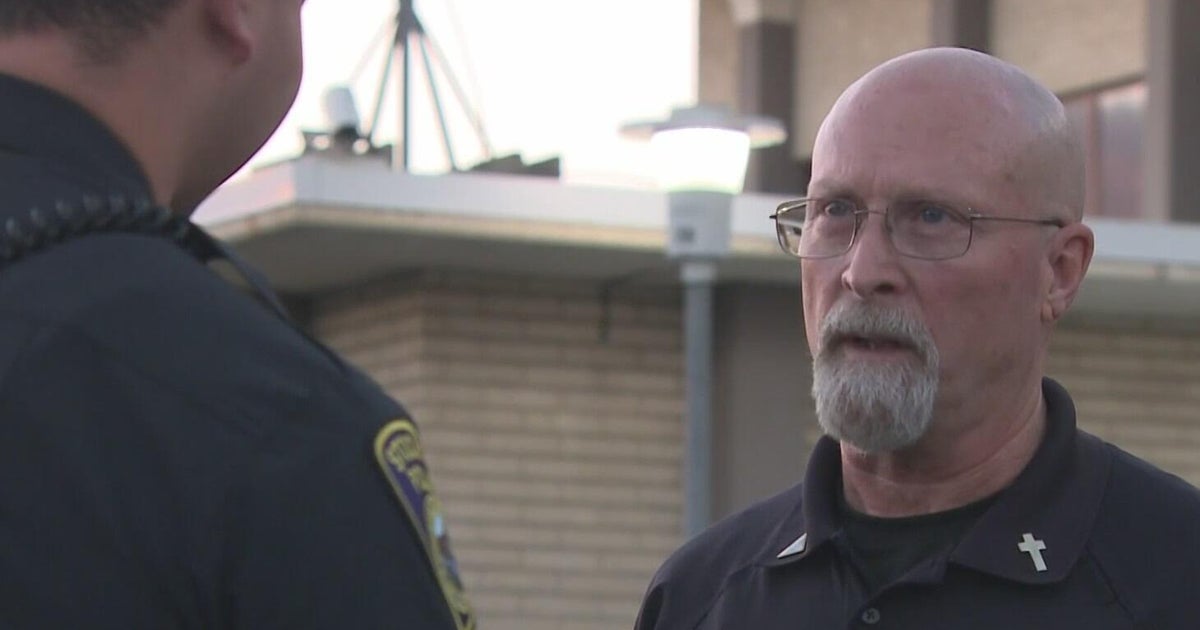
The Stockton Police Department is utilizing a holistic approach to combat and help the trauma police officers face on a daily basis and it starts with their chaplaincy executive director, Chaplain Jesse Kenyon, San Joaquin County's only full-time chaplain.
"One of the guys that I trained under, he said, 'You know, when you're driving out in the country and you see a possum that's been squashed on the road, you think, Ah well, you know, it's an animal that runs around on the ground. But if you saw an eagle on the road and it had been hit by a car, it would break your heart.' And that's how I see our officers."
In his 15th year, the veteran is embedded within the department and embodies a ministry of presence.
"I like to refer to it as a presence of ministry in that, yes, we are in the moment with them, we walk alongside of them," Kenyon said. "We go in the cars with them, we go on the calls with them, we're in the officer-involved shootings with them. We observe what they go through. We understand what they go through and then we walk alongside of them as they deal with that. It's amazing how much they carry and there's difference in the jobs that they have."
Both in the field and back at the station, Kenyon is able to share light and hope amidst the trauma officers face. One of the many stories throughout his career where he's been able to make an impact for the Stockton Police Department involved a detective who was struggling personally because of not being able to solve cases and how much it weighed on him "heavily" for the cases where he couldn't bring a conclusion to the family.
"Eventually, that led him into the use of some decongestants and, it wasn't the 'fatal alcohol' and it wasn't illegal drugs, but he started abusing decongestants and he went through a path that was really difficult," Kenyon said. "He was on the verge of losing his family. He reached out and we were able to negotiate getting into rehab and getting him resources and it wasn't an easy story. We had to go through a couple times, but in preserving, keeping that together, we were able to successfully save his marriage and get his life back on track."
Other officers can sometimes face the blurry lines of their identity becoming 'police officer' as opposed to them also being fishermen and fisherwomen, sports coaches, brothers or sisters, and Kenyon talked about how when they have an injury and need to retire early, with the city making that decision, it can be devastating.
"That can put them in a pretty dark place," Kenyon said. "There's been a couple of that I've walked alongside and those particular times, worked to get them out of alcoholism. They were struggling because their marriage fell apart. Being able to work with them and help them reestablish their identity and help find value past that was something that was very fulfilling for me and also very important. And I now see some of those guys at retirement gatherings and I think, 'Alright, they made it and they're surviving'."
Kenyon also leads the Stockton Police Department's Wellness Center, available for officers and their families with an in-house clinician, an on-call psychologist, peer support and chaplaincy team, and a comfort dog.
"With all of these assets, we work together as a team to address the community concerns," Kenyon said. "Especially something like what we went through with the mass shooting just a few weeks ago, we have all these things that are available."
Kenyon's military background helped him understand the culture to be understanding and effective in law enforcement ministry. Although he recognizes the real difference law enforcement and military personnel face with police officers not being able to go back to a "safe" place after their deployment overseas but that every day in their community may not be safe while on the job.
"I've learned more intimately the price that our men and women in law enforcement pay to do the job," Kenyon said. "We learn about the demons that they slay, the dragons that they deal with on a regular basis, working alongside of them, seeing the cost of what they do, we oftentimes use the phrase, in appreciation, that we thank them for what they do. But I think the average person doesn't recognize how much trauma an officer carries. How much it impacts their life and how much it impacts their families. So, getting to learn the depth of that, has been pretty touching to me."
What makes this chaplaincy department unique is how Kenyon and the chaplains are embedded in the police department, something Kenyon advocates for.
"The success of the chaplaincy is really largely dependent on the agency," Kenyon said. "Oftentimes, agencies will use chaplaincies simply in a ceremonial capacity. They'll say prayers at swearing-ins or at retirements or at funerals. That doesn't use the full potential of the ministry that chaplains can do. And our agency has been amazing. And our Chief McFadden, in particular, has given me a great deal of free reign in the chaplaincy to really deeply impact and embed in our agency in a way that's been able to allow us to be highly effective."
"Chief McFadden, in particular, has given me a great deal of free reign in the chaplaincy to really deeply impact and embed in our agency in a way that's been able to allow us to be highly effective," Kenyon said. Stockton Police Chief Stanley McFadden's statement to CBS SacramentoAlong with being a ministry of presence, Kenyon also affectionately called this a "ministry of interruptions.".
"Well, I call it a ministry of interruptions," Kenyon said. "So, whatever's happening, sometimes it's the call goes out and everybody's running, so you jump in a car and you follow. You'll notice in my office, I have coffee. I have candy. I have all kinds of things. An officer walks in, picks up a piece of candy, talks about the weather, and then casually mentions his marriage is falling apart. We close the door and we talk."
Kenyon has helped officers' marriages, gotten them help for substance abuse, and is on the front lines as a resource for them and the community. Chaplain Kenyon is thankful for the support the department has given him and the chaplaincy team. He is the only salary full-time chaplain in the county and said that it is "rare" as many departments operate with volunteer chaplains.
"The Stockton Police Department is committed to supporting an environment that prioritizes the mental, physical, and spiritual well-being of all our staff," Stockton Police Chief Stanley McFadden said. "We believe that by supporting each other, we enhance our ability to effectively serve each other and our community. We recognize the importance of Organizational Wellness and will continue to provide the necessary resources and support systems to ensure every department member can perform their roles with excellence and compassion. Together, we strive to build a safer community for all."
There are also a team of seven volunteer chaplains who operate on 10-hour shifts. At one point, they had 40 volunteer chaplains. The seven current volunteers are full-time pastors of local churches, Kenyon said, and their goal is to have their door always open and they minister to a diverse array of officers.
"Learning to walk with them in the trauma is important and understanding that day-by-day, they're going to be seeing things that the average person doesn't see," Kenyon said. "A lot of what we do is relational. And, I say relational because you have different personalities in here. The warrior spirit that exists oftentimes comes across as pretty hardened and crusty and cynical. But, they're very deep people. They care a lot for our community. Learning the different personalities, learning how the job is impacting, recognizing when there's changes in personalities requires you to be invested in them, to be around them."
Kenyon said the trauma these officers face is the "cost of doing business," but that self-care is important, "you can't save the world when your life boat is sinking."
"If you're serving in law enforcement, you're doing something incredibly honorable," Kenyon said. "The price that you're paying is something that can be shouldered with other people, other resources. Other people can come alongside of you. Don't feel like you have to do it alone. And for chaplains and family members, just know there's help for you, as well. What you see and what you deal with, just reach out. Talk to people. And, of course, ultimately we all know that God's got our back. He goes before us, He walks alongside of us and He comes behind us. He's a provider and a defender. So, we can depend on Him and when we have that support, we can face all the evil that exists in this world."
Hence then, the article about stockton police chaplains support officers and their families cope with trauma was published today ( ) and is available on CBS sacramento ( Middle East ) The editorial team at PressBee has edited and verified it, and it may have been modified, fully republished, or quoted. You can read and follow the updates of this news or article from its original source.
Read More Details
Finally We wish PressBee provided you with enough information of ( Stockton police chaplains support officers and their families cope with trauma )


Also on site :
- Oatly Is Dropping Three New Flavors for Fall
- 67 Years Ago Today ‘The Twilight Zone’ Premiered Changing Sci-Fi Forever; Rod Serling’s Series Is Ranked No. 20 on the List of Best TV Shows Ever
- Shivon Zilis Shares Elon Musk’s Last Text and Calls Him a ‘Tortured Soul’ After Sudden Breakup