
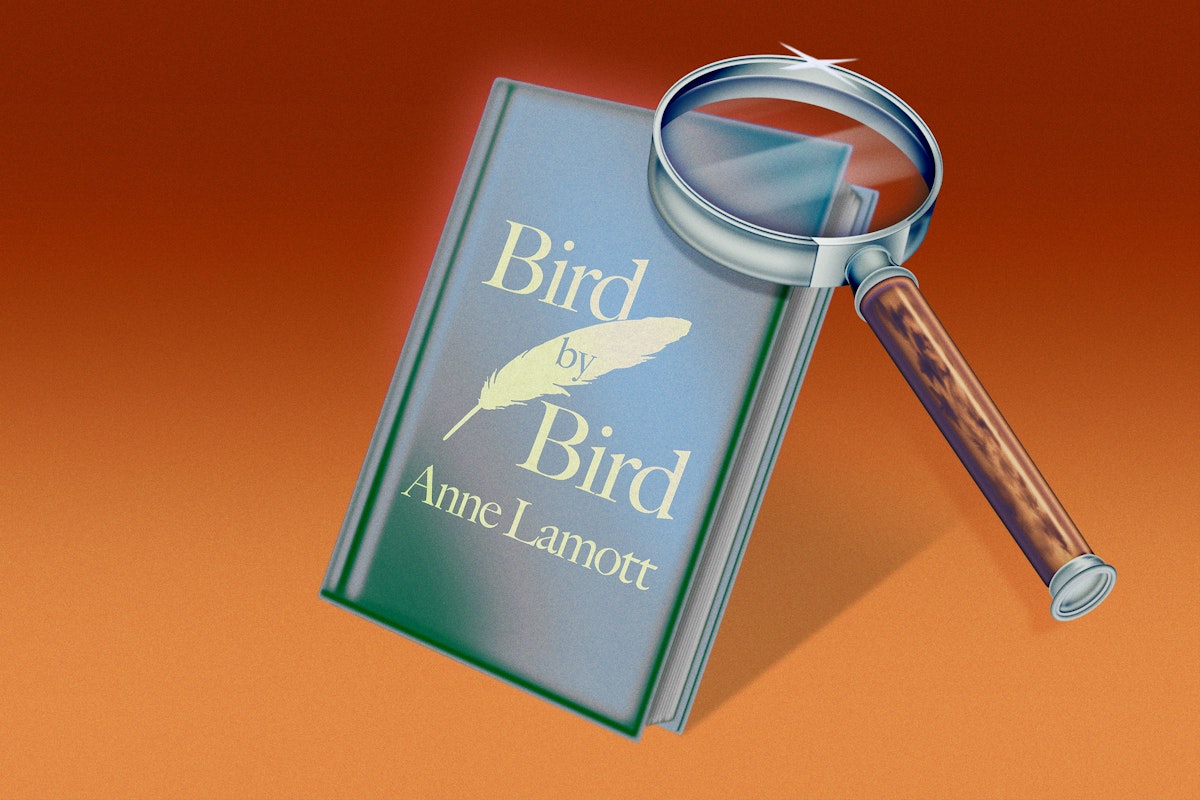
First published in the spring of 1994, two months before the birth of Amazon and one month after the death of Kurt Cobain, Bird by Bird by Anne Lamott has far outlasted the era of its origin, becoming one of the most influential writing guides of all time. During its 31 years in print, it has sold over a million copies. Its title has taken on a life of its own, referenced in TikToks and pep talks. On Ted Lasso, Ted yells, “Bird by bird!” to encourage struggling football players.
The phrase comes from a childhood memory that Lamott recounts early in the book. Her 10-year-old brother had to write a report on birds and procrastinated until the night before. Near tears, he was “immobilized by the hugeness of the task ahead.” Their father cut through his paralyzing despair by telling him, “Bird by bird, buddy. Just take it bird by bird.” The anecdote is classic Lamott. It conveys “some instructions on writing and life” (the book’s subtitle) in a way that’s quirky, a little bit cheesy, and hard to forget.
I first encountered Bird by Bird when I was a stressed-out teenager looking for someone to teach me how to turn my amorphous literary aspirations into an actual writing career. It helped and (at times) horrified me in a way that still lingers all these years later.
Before Bird by Bird, most of the writing advice I read was about setting standards for smooth, stylish, publishable prose. I gravitated to my grandma’s shelf of old-school how-to-write books: Strunk and White’s The Elements of Style, Robert Graves and Alan Hodge’s The Reader Over Your Shoulder, William Zinsser’s On Writing Well. These books taught me to be persnickety about punctuation, to cultivate a Jiminy Cricket–style internal critic, and/or to strive to write like a Yale man. I also read classic manifestos like George Orwell’s “Politics and the English Language,” with its rousing premise that blurry prose is a political sin, and Mark Twain’s “Fenimore Cooper’s Literary Offenses,” which advised me to “avoid slovenliness of form” and “eschew surplusage.” All these authors write with robust confidence about the importance of direct, efficient, streamlined writing. They abominate vague ideas and messy sentences, seeing them as an insult to readers, or worse. And with the exception of Twain, who has a rollicking time trashing an author he clearly enjoys, their attitude toward writing is as serious and dignified as the prose style they praise.
It’s no wonder that Bird by Bird was a shock to my system. Lamott’s authorial persona is a neurotic mess—anxious, envious, disorganized, and depressed. She keeps joking about suicide. And her dozens of lurid descriptions of the creative process make sitting at a desk and trying to write seem like a cross between a body horror film and an Alcoholics Anonymous bottoming-out story. A sample:
every form of mental illness … surfaces, leaping out of water like trout: the delusions, hypochondria, the grandiosity, the self-loathing, the inability to track one thought to completion, even the hand-washing fixation, the Howard Hughes germ phobias.…
after two sentences you begin to worry about complete financial collapse, what it will be like to live in a car.…
you sit staring at your blank page like a cadaver, feeling your mind congeal, feeling your talent run down your leg and into your sock.
For Lamott, writing is a high-stakes struggle with personal demons. She devotes entire chapters to perfectionism, jealousy, and writer’s block. But she also encourages writers to write no matter what, and to learn to regularly excrete “shitty first drafts”—another phrase that has entered the popular lexicon. (Ever committed to memorable metaphor, Lamott compares a productive writing day to having amoebic dysentery!)
She’s irreverent, but she’s reverent too, in the style of a hippie aunt. There’s a mystical quality to a lot of her advice—so much so that she jokes about seeming too “California” or “Cosmica Rama.” She approvingly cites the Dalai Lama, Rumi, Wendell Berry, Ram Dass, Tibetan nuns, her Presbyterian pastor, and a Catholic priest named Tom. The flip side of writing misery, it turns out, is occasional writing-induced ecstasy produced by committing to daily writing as a devotional practice. At one point she says, “You don’t have to believe in God, but it’s easier if you do.” She turns “Trust the process” into an entire philosophy of life.
Readers of many religious persuasions—or none—have appreciated the spiritual aspects of the book. One commenter on Goodreads describes it as their “new bible.” Another says, “I pull it off the shelf now and then and read whatever page I land on—and always find my way back to my own writing.” When I asked the writer Pooja Makhijani about Bird by Bird, she said, “I love the self-help-y/religious nature of the book, especially because I’m not particularly religious in the conventional sense, but find a sense of comfort and awe from reading and writing. I know what it feels like to be in a flow state while writing, which feels otherworldly in nature; every time I sit down to write, I’m chasing that high.”
Bird by Bird is not that kind of sacred text for me. Still, it has reassured me by taking for granted that psychological barriers are a common part of the writing process and can be overcome. And it has helped me set aside impossible standards long enough to get some writing done.
What sets Anne Lamott apart from most other writing guides is her insistence on writing’s inherent grotesque indignity.Anne Lamott didn’t invent rough drafts, of course. Nor did she invent writing instruction as religion-infused self-help. She was writing in a long tradition of books that blend writing advice, life advice, and spirituality, including Brenda Ueland’s If You Want to Write, Natalie Goldberg’s Writing Down the Bones, Annie Dillard’s The Writing Life, and Julia Cameron’s The Artist’s Way. In recent years, Elizabeth Gilbert’s Big Magic and Suleika Jouad’s The Book of Alchemy have developed the mystical aspects of this genre, while Jami Attenberg’s 1000 Words is a new riff on the down-to-earth, just-do-it, butt-in-chair approach. What sets Lamott apart from most of these writers is her insistence on writing’s inherent grotesque indignity. Ueland promises to take the pain out of the writing process, Dillard often makes it look glamorous, but Lamott insists it will always be at least somewhat ugly and embarrassing. She also has a gift for catchy phrases, offbeat metaphors, and practical writing exercises that amounts to a kind of pedagogical genius. When I asked some writers and writing teachers about Bird by Bird, I got a slew of positive responses. Pooja published an essay based on the “School Lunches” prompt. Alex Marzano-Lesnevich frequently uses the “One-Inch Picture Frame” exercise and also imagines “making naysayers really tiny and plopping them into a jar (with air holes).” Similarly, Catherine Osborne still thinks about “Radio KFKD,” the imaginary radio station that plays in your ear all day telling you how much you suck. (You have to learn to turn it down.) Several teachers reported that whenever they assign the “Shitty First Drafts” chapter of Bird by Bird, students say it’s their favorite thing they read all semester.
It’s clear that Bird by Bird holds up as a set of practical aphorisms and discrete chapters, but does it hold up as a book? Rereading Bird by Bird now, it’s clear that some things haven’t aged well. Lamott’s jokes about how she has to be a writer because otherwise she’d be totally unemployable are grating in an economy where even prolific published writers have to support themselves with nonwriting jobs. Her eye-rolling exasperation with students who ask her how to get published feels mean-spirited too when opportunities are so scarce for newcomers and have come comparatively easily to her; she is a nepo baby who grew up watching her father write and inherited his agent. The least she could do is to try to open the door for writers without those advantages, and to take their ambition seriously.
In addition to her many cultural references that were dated even at the time (Tricia Nixon, Charlie McCarthy, the Gabor sisters), Lamott has an uncomfortably glib way of treating Special Olympics competitors and people with cancer as fonts of wisdom or occasions for her own personal writing epiphanies. Perhaps my least favorite passage in the book is when she watches a documentary about people dying from AIDS and her takeaway is that life’s too short to stay friends with a successful writer she envies: “Finally I felt that my jealousy and I were strangely beautiful, like the men in the AIDS movie, doing the dance of the transformed self, dancing like an old long-legged bird.”
This kind of self-absorption pervades Bird by Bird. It’s why Lamott dismisses her students’ desires for publication while indulging her own. And it’s what causes her to respond to criticisms from an editor by literally showing up at his house and pacing back and forth in his living room explaining how and why he was wrong, a move that she seems to think is gutsy and admirable, but one that could quite possibly end a career. (An editor I know was particularly appalled by this story.)
I love Bird by Bird’s attention to the difficulty of the writing process, but I don’t love how it frames it primarily as a struggle with ego, as opposed to a struggle with words, images, ideas, thought.I love Bird by Bird’s attention to the difficulty of the writing process, but I don’t love how it frames it primarily as a struggle with ego, as opposed to a struggle with words, images, ideas, thought. Writing isn’t hard just because it’s a confrontation with yourself. It’s hard because it’s a skilled craft and a complex art and an undercompensated form of real-world labor. Lamott obviously knows this, but she spends so much time on the other stuff.
Perhaps it’s perverse to say this, but after 20 years as a writing teacher, I’ve come to believe that many writers could stand to be more perfectionist, not less. I’ve observed that for every writer who is stymied by perfectionism, there is a writer who is held back by the lack of it: who is phoning it in (or ChatGPT-ing it in) and doesn’t understand why that’s a problem. And for every writer who is eaten up by jealousy, there is a writer who could be helped by learning to admire and pay attention to other writers more.
Lamott’s instructions were life-giving to me when I was a young perfectionist dealing with writing-related panic attacks. But now, as a middle-aged writer and writing teacher, I’m no longer stuck in the exact same writing psychodramas that I was when I was young. (It turns out I’ve got some new ones that Bird by Bird can’t help me with.) I also don’t want to presume that my students’ struggles are the same as mine or Anne Lamott’s. Still, despite some reservations, I continue to cite Bird by Bird in my teaching, and I appreciate its obsession with process and difficulty more than ever.
In the last chapter, Lamott takes a brief break from offering advice to contemplate the state of the world. “The society to which we belong seems to be dying or is already dead,” she writes. “I don’t mean to sound dramatic, but clearly the dark side is rising.… But the tradition of artists will continue no matter what form the society takes.”
Three decades later, the dark side has risen, and the tradition of artists is threatened in unprecedented ways that were unimaginable in 1994. For the first time in history, the writing process is optional. An essay can be produced with a few simple prompts. And as writing becomes increasingly automated, the inefficient, irreplaceable human practice of writing is arguably becoming ever more precious. In the words of novelist and Bird by Bird fan Jessica Penner: “In a time when AI has invaded every spectrum of life with its glossy EZ-bake tendrils, we need to reinforce that permission to be shitty—because it’s through the shittiness that we make discoveries about ourselves and others.”
These days, “shitty first drafts” produced one bird at a time are more than just a writing exercise. They are an antidote to corporate, algorithm-generated “enshittification.” And although creativity without effort may initially feel like a blessing, I suspect that someday soon, readers will turn to Bird by Bird with nostalgia for the days when trying to write was a struggle demanding everything we had to give.
Hence then, the article about anne lamott s battle against writer s block was published today ( ) and is available on The New Republic ( Middle East ) The editorial team at PressBee has edited and verified it, and it may have been modified, fully republished, or quoted. You can read and follow the updates of this news or article from its original source.
Read More Details
Finally We wish PressBee provided you with enough information of ( Anne Lamott’s Battle Against Writer’s Block )


Also on site :
- In 1994, Dolly Parton Recounted an Eerie Night in Her Nashville Home; Mysterious Footsteps and Faucets Turning On by Themselves Left Her Believing in Spirits
- Brian Laundrie admitted to killing 22-year-old Gabby Petito in a notebook found near his body, the FBI confirmed
- American Stephen Hubbard released by Russia, Witkoff says