
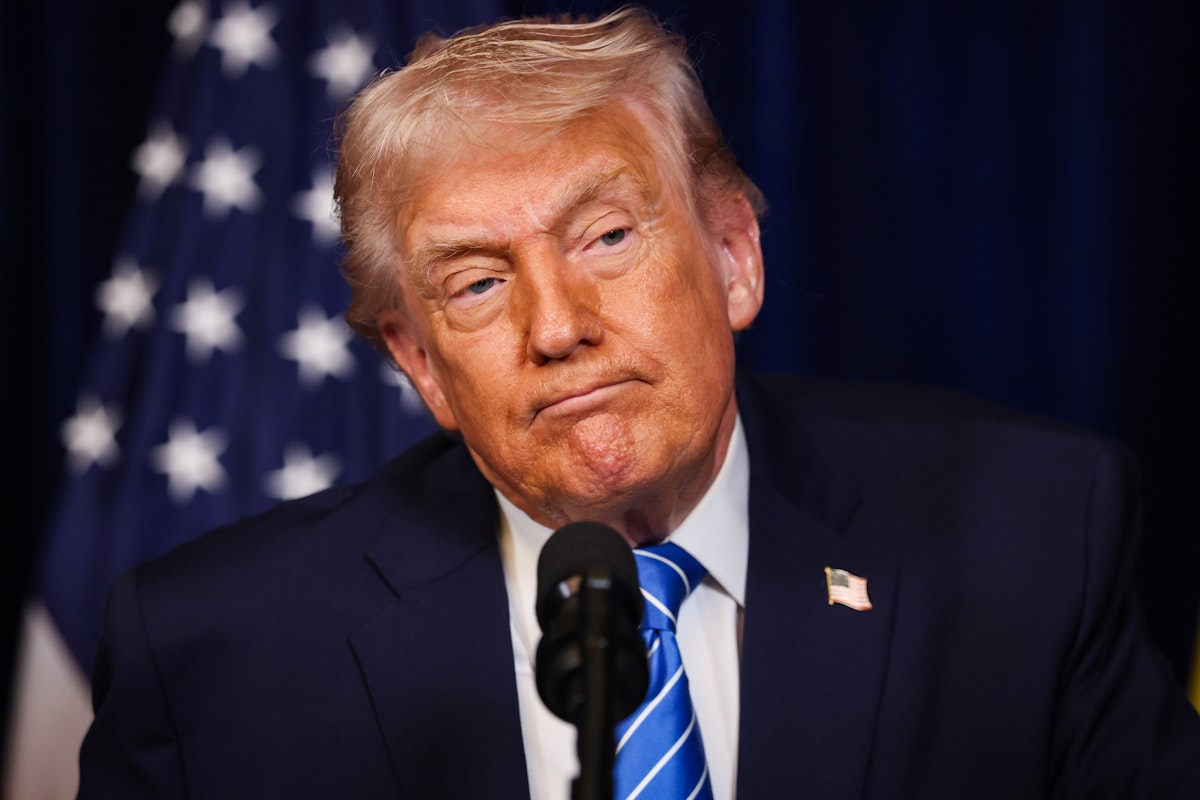
The following is a lightly edited transcript of the January 7 episode of the Daily Blast podcast. Listen to it here.
Greg Sargent: This is The Daily Blast from The New Republic, produced and presented by the DSR Network. I’m your host, Greg Sargent.
Last year, Senator Mark Kelly and five other Democrats posted a video with a stark message: Military service members and officials are not obliged to carry out illegal orders. This infuriated Donald Trump, and now Defense Secretary Pete Hegseth is taking the extraordinary step of bringing disciplinary action against him as a retired Navy man. Mark Kelly offered a striking response to all this in a second video, which is about his own service and about Trump’s lack of it. It’s very powerful stuff. Here’s our question: What if Trump is giving illegal orders to the military? How do we make that part of the discussion? Today we’re working through all this with legal expert Leah Litman, who’s great at puncturing Trump’s lawlessness. Leah, nice to have you on.
Leah Litman: Great to be back.
Sargent: So Pete Hegseth tweeted that these proceedings have begun against Senator Mark Kelly, which are being brought because he’s still subject to military discipline. The procedure could result in his retirement rank getting reduced and a cut to his military pension. Hegseth called Kelly’s warning seditious, which is odd because Kelly was merely stating what the law says about illegal orders. Leah, can you walk us through what Hegseth is doing here and why it’s so wildly inappropriate?
Litman: Yeah, absolutely. So I guess just starting at a high level, you know, it’s no accident that, of course, this administration would think it is illegal to tell people to comply with the law because that’s, at bottom, what Secretary of Defense Pete Hegseth is doing.
What he is doing is attempting to leverage the power that the secretary of defense has over not just service members, but also retired service members to punish Senator Kelly for his speech, for expressing the view that military officers don’t have to and indeed shouldn’t carry out illegal orders.
So under the Uniform Code of Military Justice, the secretary of defense does have power over former service members, but there are real questions about whether Secretary of Defense Hegseth has identified a violation of any law. And second, even if he has, I think Senator Kelly would have very solid First Amendment defenses as well as legislative immunity defenses.
Sargent: Yeah, I think it’s clear that the real reason Trump and Hegseth are in a rage about this is because Kelly is telling people to follow the law.
Litman: Right. Which they don’t want people to do because we have seen so many of their unlawful military escapades. Of course, we are all living through the aftermath of their invasion and capture of a leader of a foreign state.
We have also been living through for the last several months their unlawful summary executions in the Caribbean as well as in the Pacific. So we know, right, they want to order the military to do illegal things. So, of course, they have a problem with people pointing out that military members shouldn’t do that.
SargentL Yeah, that is very obviously a problem for them. So Mark Kelly did this video, which was a response to this whole thing. I think we should listen to all of it. Here goes.
Mark Kelly (voiceover) I’ve got a question for you. How many generations of Donald Trump’s family have served in the military? Zero. Now for me and my family, service to our country is in my blood. My great grandfather served in the U.S. Navy after immigrating from Ireland. Both of my grandfathers served during World War II. Both of my parents wore uniforms. My dad in the 82nd Airborne and both of them as career police officers. And when it was our turn, my brother and I started as volunteer EMTs as teenagers before becoming Navy captains, pilots in the United States Navy, and NASA astronauts. Donald Trump, he deferred the draft five times because he had bone spurs! Look, not everyone has to serve in our military. I get that. But when you’re gonna question my patriotism and lecture me about duty to this country and threaten me with a Court martial, four generations of service to this country earns me the right to speak. Five deferments earns nothing.
Sargent: That’s striking stuff on any number of levels, but one thing that interests me about it is how it sounds like it’s again aimed at members of the military. He’s basically saying in a subtle way here: This commander in chief really doesn’t have your best interests at heart. What do you think of that?
Litman: I mean, I think that is a powerful reminder because through so much of the first Trump administration and even in the lead-up to and the initial period of the second, we have been told that a major protection against the excesses of the administration would be other members of the federal executive branch who would be willing to adhere to their legal obligations, their constitutional duties, their moral obligations, even if the leaders of the administration wouldn’t do so.
And we did see some examples of that during the first Trump administration, whether it was individuals who were part of the executive branch refusing to go along with Trump’s allegations of voter fraud or whatnot. And I think Senator Kelly is appealing to that same duty, that same obligation, but for a group of people that he was a part of and is a retired service member. And he’s trying to appeal to their sense of duty, loyalty, and obligation that other people have felt and acted on.
Sargent: Yeah, and I think it’s really good to have Democrats talking this way. Don’t you? I mean, it’s really good for Democrats to be getting out there in a very kind of prominent sense and saying, you know, there are actual values and rules and laws that are worth standing up for here. And this guy is just trampling them regularly, including with this attack on Kelly.
Litman: Yes, exactly. I mean, there have been so many calls for Democrats to actually put up a fight and be fighters. And I think Senator Kelly is very much displaying that. And, in part, I think what people want is these very clear and forceful statements about why the Trump administration is acting illegally and why what they are doing is so dangerous and problematic. And I think that’s very much what Senator Kelly is doing here.
Sargent: I agree one hundred percent. So Hegseth also sent a formal letter of censure to Kelly. He attacked Kelly for making ‘a sustained pattern of public statements, calling various military operations illegal.’ At another point in the letter, Hegseth says Kelly has accused him and others of war crimes. But, but Leah, is, is this punishable behavior? Isn’t this just speech? Can you walk us through the guts of the legal issues here?
Litman: I mean, there are no guts, right? It is very basically, right, just telling someone you are violating the law because of the things you have said and the views you are expressing. As I kind of joked about earlier, only it’s not really a joke, you know, they are saying it is literally illegal to encourage people to follow the law, right? That is expressing a different view about what the law is or isn’t, what it does or doesn’t say, than the Trump administration’s view, which is basically they can do anything they want and that makes it legal. Senator Kelly is saying, No, that’s not how it works.
Even if Senator Kelly were not a legislator, he would still have First Amendment protections. The government can’t attack people because it doesn’t agree with the views that they are expressing. And then you add to that First Amendment defense the fact that Senator Kelly is a legislator and does enjoy speech and debate protections. And there’s some question about whether the statements he is making are done in his capacity as a legislator. But there is a serious argument that they are.
So I think both of those defenses are very powerful and plausible ones that he has to block any effort to censure him or penalize him that Hegseth is doing. And I just want to add, I’m surprised that Secretary Hegseth has had the time to do all of this, given that he is apparently running or coercing Venezuela at the same time.
Sargent: Yeah, that’s a good point. You’d think he’d be busy with bigger things here. But the biggest thing of all is Donald Trump and how he feels about stuff. I mean, that’s just the bottom line, right? Leah, can you just sort of get at this question: Is there a shred of legitimacy to what Hegseth and Trump are doing here, or is it just entirely illegitimate?
I mean, it seems to me that whatever the answer to that question—and I would love to hear you explain that—it also seems like it’s really about saying to other people: You better not criticize us, you better not call us out for illegal acts, because we’ll bring the weight of the law against you and so forth. What do you think of that?
Litman: Yeah, exactly. So just two quick things. One is to the extent there is any shred of legitimacy here, it is true that, as I was saying earlier, the Uniform Code of Military Justice has been held by multiple courts to apply to former service members. It is also the case that the Supreme Court has said former service members are held not just to the Uniform Code of Military Justice, but also to all other federal laws.
So in theory, the secretary of defense can attempt to censure or penalize former service members. He can also do so not just for violations of military code, but also federal law. But as ever, the problem is their application of these theories or principles. Because no matter their authority, they can’t use it to violate someone’s First Amendment rights.
And I just think it’s so clear that that’s what they’re doing here. They don’t have a plausible argument to the contrary. And I agree with you that the point of this isn’t necessarily to scare Kelly. He’s going to be fine whether or not they take away his retirement benefits. The point is to scare other people. This is something that judges have written about in their opinions describing the executive orders targeting law firms. The problem wasn’t just the targeted firms.
The problem was everyone else feeling chilled and scared and censoring themselves, preemptively complying, obeying in advance, and avoiding criticizing the administration and doing anything they were concerned the administration wouldn’t like.
Sargent: Well, let’s step back for a second. Can you just explain in a big-picture way why it is that we have this idea out there that members of the military, service members, military officials are not obliged to follow illegal orders? Where did that come from and why is it good?
Litman: I’m not sure I could identify a single source, but every individual who serves in the federal government is still bound by law, still takes an oath to support and uphold the Constitution. So when the Constitution and laws are violated, your oath is to the law, not to the men telling you to violate the law.
That’s what it means for ours to be a system of the rule of law, not a rule of men or one man, or whatever weirdos are running the executive branch. Why is it important? I mean, we have, as we have seen from the most recent series of events and many others, an extremely powerful military. They are very good at exercising force and performing lethal strikes.
And so we want them to exercise their powers responsibly and with care, in compliance with the laws that attempt to constrain their awesome powers. It’s a cliché. I’ll recite it: With great power comes great responsibility. And we want them to take their powers seriously.
Sargent: Yeah, and I think at a very fundamental level, Donald Trump and Pete Hegseth really reject the idea that they are bound, that the power of the military should be bound by rules and laws. I mean, Hegseth has essentially said that, hasn’t he?
Litman: Yeah, I mean, Stephen Miller is running around on the media, making tours saying it’s all about force and strength. Who cares about law?
Donald Trump, after the invasion of Venezuela, said people shouldn’t be saying it’s unconstitutional. They should be saying awesome job. So they have made very clear their views that they don’t care about the law. They don’t think anyone else should care about the law. Like, might makes right is their basic view of things.
Sargent: Right. And I think that gets at the elephant in the room here, which you got at earlier, which is that Trump is giving illegal orders to the military—or very well may be. The bombings of the so-called drug boats in the Caribbean clearly look illegal. Now this attack on Venezuela looks illegal. It’s clearly unconstitutional to do this without Congress. It violates international law.
It’s sort of odd to me that this basic fact is not more central to the discussion—the underlying question of whether it’s reasonable for Mark Kelly to be giving warnings like this or not. It is reasonable because Donald Trump is giving illegal orders.
Litman: Of course. I would hope again that people are willing to say, you know, ‘Don’t violate the law when someone orders you to do so.’ Like, we just think of that as basic decency, right? Basic civic duty, basic responsibility of people who hold political power and political office and actually have a platform to make these claims heard. I can post on Bluesky as much as I want that people should follow the law. But when Senator Kelly and Senator Slotkin make videos, they have a greater platform. And that message is going to be heard by more people. And it carries more force.
So of course we want people kind of reaffirming obligations for the law. And just to back up, those statements actually matter under the law. They matter for international law. In determining whether something violates customary international law, we look to the response that people and states have.
In determining whether the president has certain authority, we look to see whether Congress has stood up and said, ‘No, he doesn’t,’ and acted against the exercise of the president’s authority. So these statements matter. They matter not just for basic rule of law reasons, but they matter formally, you know, under the law as well.
Sargent: I think if I’m hearing you correctly, you’re essentially saying that there’s more to the law than what’s written, than the written, you know, black letter code of it. What also matters is what the world perceives about how bound our top officials are by those laws, right?
Litman: Yes, that’s exactly right.
Sargent: Can you maybe go into that a little more because it’s an interesting concept. I think maybe people don’t really realize that there’s this kind of fuzziness to law that you all kind of live every day. You live and breathe this fuzziness every day. And it’s something that’s really being thrust to the forefront now by Donald Trump’s lawbreaking and skirting of the law in all kinds of ways. Can you talk about this gray area?
Litman: So when, for example, international lawyers or international organizations ask, Did this country, did this person violate customary international law? they have to figure out what obligations under international law are. And those aren’t all just written down on a piece of paper or in a treaty or whatnot. Instead, they are norms that states basically affirmed and reaffirmed. How do they do that? They make statements in support of them. They say, That’s a breach of that norm. And that is something that helps to actually establish what international law is. So that’s one component.
And then even domestically, our law of the separation of powers is based not just on what statutes Congress has written that say the president can do this or the president can’t do this. They are also based on what the cases have called gloss or historical practice or acquiescence. Did Congress sit down and say nothing when the president asserted the authority to run a foreign country?
If they did, then that’s some evidence that the president has that power. Whereas if they instead stood up and spoke out and say, No, like, you can’t order an invasion of a foreign country, seize a leader, and run the country, that’s evidence, right, that under our constitutional system of separated powers, the president doesn’t have that authority.
Sargent: That is really, really unsettling. I just want to close on an unspoken aspect of this whole battle, which is that it’s kind of about public service. Trump and MAGA, I think, reject the very idea of public service on a fundamental level.
Trump doesn’t see himself as serving the American people in any real sense. He punishes parts of the country for not voting for him in all kinds of ways. In a way, he’s not even serving his own supporters, though he kind of doles out the spoils of governing to his people.
Trump doesn’t think that he’s under any obligation to make sacrifices to serve the public at large and doesn’t feel bound by the laws that the rest of us are bound by. I think that’s what Mark Kelly is getting at with his takedown, in a way. Can you talk about that big picture?
Litman: Yeah, absolutely. So we have seen examples of Donald Trump and his administration threatening to cancel funding in ways that harm Democratic-leaning states. We have seen him attempt to punish states that don’t do what he wants, like releasing an individual from Colorado imprisonment and incarceration when he said, I want the state to actually release that individual who was convicted of a crime. And so we have seen him gleefully punish entire swaths of people that he is nominally in charge of representing.
Like, for him, his obligation doesn’t run to the entire country. His obligation runs to himself, right, and people in his good graces. And that is a very disturbing, I think, autocratic view of what it means to hold power and office. Mark Kelly is instead voicing the view that when you hold power, you represent not just the people who you like and who like you and who voted for you—you represent the public interest and the public at large.
And that’s why service members have an obligation to the law and the public interest, not just to following the commands of one single very terrible, no good, very bad person.
Sargent: And the flip side of that is that they use the law and abuse it horrifically to punish and harm and inflict sadistic damage on those who displease the leader. What do you expect to happen with Mark Kelly? What’s going to happen in the next, I don’t know, six months with this?
Litman: I think this case is going to go nowhere and quickly. I think like any court that gets it is going to say, like, you can’t penalize him for expressing the view that what you’re doing is unlawful and that service members, right, should only follow lawful orders. And I would just be shocked if it came to any other resolution.
Sargent: Well, I sure hope it doesn’t end up chilling people along the way because a big part of the game here is to make it clear that you will have to expend resources on lawyers and so forth to defend yourself, you know?
Litman: Yep, exactly.
Sargent: Well, folks, if you enjoyed this, make sure to check out Leah Litman’s great book, Lawless, about the Supreme Court. Leah, great to have you on as always.
Litman: Great to be here. Thanks again for having me.
Hence then, the article about trancript senator s harsh takedown of trump hits home bone spurs was published today ( ) and is available on The New Republic ( Middle East ) The editorial team at PressBee has edited and verified it, and it may have been modified, fully republished, or quoted. You can read and follow the updates of this news or article from its original source.
Read More Details
Finally We wish PressBee provided you with enough information of ( Trancript: Senator’s Harsh Takedown of Trump Hits Home: “Bone Spurs!” )


Also on site :
- Greg Evigan Shares Sweet ‘My Two Dads’ Throwback With Paul Reiser and Staci Keanan: ‘I Adore These 2 People!’
- JoAnna Garcia Swisher Breaks Her Silence After Shocking ‘Sweet Magnolias’ Cancellation: ‘How Do You Say Goodbye?’
- Carole King Wrote ‘Will You Love Me Tomorrow’ at 18 and It Became the First No. 1 Song by Any Girl Group; She Sang It 11 Years Later on Tapestry