
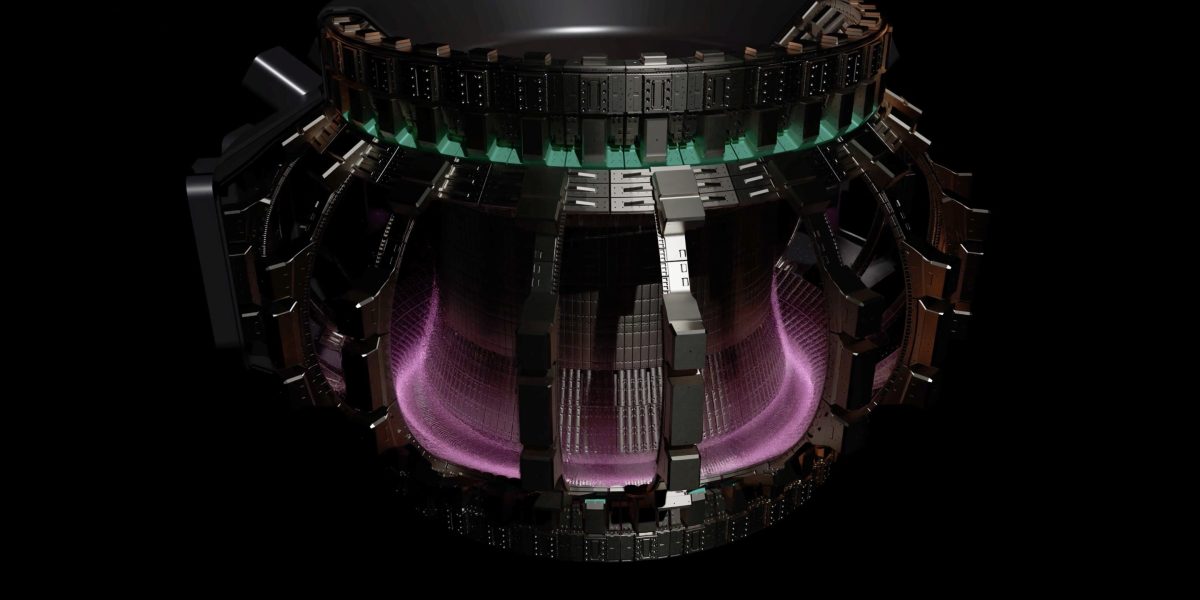
Fusion power industry leader Commonwealth Fusion Systems is building its first demonstration plant utilizing the same process that fuels the sun, and now it’s partnering with Siemens and Nvidia to use AI to eventually help power the AI boom.Essentially marking the debut of fusion power at CES 2026 in Las Vegas, Commonwealth CEO Bob Mumgaard joined Siemens CEO Roland Busch during his Jan. 6 keynote to tout their teamwork and the ambitious plans for consistent, clean power without radioactive waste, intermittency issues, or the dependence on foreign supply chains.“AI factories and data centers require gigawatts of electric power,” Busch said on stage. “What if we had an energy source that was clean, safe, affordable, and practically limitless?”
Backed by Nvidia, Google, Mitsubishi, Bill Gates, and more, Commonwealth Fusion Systems (CFS) leads the nascent fusion sector in funding, contracts, and has the advantage of being founded earlier than most in 2018 through a spinoff from the Massachusetts Institute of Technology.
“Fusion is no longer a science project; it’s actually the next big thing in tech,” Mumgaard said.
CFS is currently building its SPARC demonstration project outside of Boston, and just installed the first of 18 high-temperature, D-shaped superconducting magnets that power the machinery. The magnets that CFS manufactures are theoretically strong enough to lift an aircraft carrier out of the water, Mumgaard said. SPARC will nearly be completed by the end of 2026 and will produce its first plasma energy in 2027.
“The main argument against fusion is making it work, and that’s why we’re building SPARC and showing that it can work,” Mumgaard told Fortune in an interview prior to the keynote. “That will be a big moment for fusion overall, not just for us.”
If SPARC succeeds, CFS’ first commercial fusion plant, ARC, is slated to be built and to come online in the early 2030s just outside of Richmond, Virginia. If all goes as planned, the 400-megawatt plant would become the world’s first fusion plant providing steady power to the grid—enough to power about 300,000 homes.
Whereas traditional nuclear fission energy creates power by splitting atoms, fusion uses heat to create energy by melding them together. In the simplest form, it fuses hydrogen found in water into an extremely hot, electrically charged state known as plasma to create helium—the same process that powers the sun. When executed properly, the process triggers endless reactions to make energy for electricity. But stars rely on overwhelming gravitational pressure to force their fusion. Here on Earth, creating and containing the pressure needed to force the reaction in a consistent, controlled way remains an engineering challenge.
CFS is now working with Nvidia Omniverse AI tech and Siemens industrial software to create a digital twin of the SPARC project to experiment, process data, and answer questions without having to open up the physical machinery. CFS also works with Google DeepMind AI systems. CFS likens DeepMind to a co-pilot and the Nvidia digital twin to the virtual airplane.
“The way to think about it is that the physical world and the digital world are increasingly merging, and we’re increasingly able to get the best out of both sides,” Mumgaard said, arguing that he’s optimistic the digital twin tech will accelerate the development of ARC.
Trumped up competition
There is of course competition, including even from the Trump family.
In December, the Trump Media & Technology Group and fusion developer TAE Technologies announced an unexpected $6 billion merger to become the first fusion player to go public—soon owned in part by the Trump family—on a belief that an influx of capital will speed up the launch of fusion power on the grid.
The deal is for a so-called merger of equals with Trump Media, which will become a Truth Social media, cryptocurrency, and fusion power conglomerate.
“Having a public fusion company was something I think the industry always expected to happen. I don’t think anyone had it on their bingo card for it to happen quite this way. But it’s good to have one, and I wish them success,” Mumgaard told Fortune. “With the Trump connection, fusion has been bipartisan, and we’d like to make sure it stays bipartisan.”
CFS also is racing against others competitors such as Helion—backed by OpenAI’s Sam Altman and SoftBank—which aims to build a fusion plant east of Seattle to power Microsoft data centers.
CFS is the leader in the most common form of fusion tech—the oddly named “tokamak.” The tokamak—shortened from toroidal chamber magnetic—relies on its powerful magnets. The design essentially involves a massive, doughnut-shaped machine that traps the plasma in a high-temperature, superconducting magnetic field.
The running joke is that fusion power is mythical and it’s always 30 years away. Not so any longer, Mumgaard said, even if it will still take a couple of decades before fusion is a key player in the global power grid.
“Parts are arriving and it’s being assembled,” Mumgaard said of SPARC. “It’s a complicated Lego set, but we have a good set of instructions and a good set of people that will put it together.”
This story was originally featured on Fortune.com
Hence then, the article about fusion power nearly ready for prime time as commonwealth builds first pilot for limitless clean energy with ai help from siemens nvidia was published today ( ) and is available on Fortune ( Middle East ) The editorial team at PressBee has edited and verified it, and it may have been modified, fully republished, or quoted. You can read and follow the updates of this news or article from its original source.
Read More Details
Finally We wish PressBee provided you with enough information of ( Fusion power nearly ready for prime time as Commonwealth builds first pilot for limitless, clean energy with AI help from Siemens, Nvidia )


Also on site :
- Barbra Streisand Decries Trump’s “Unchecked Ego” Amid His Assertion That The Kennedy Center May Be Torn Down
- ‘Charlie’s Angel’ Star Gets Brutally Honest About Why the Show Never Won Any Major Awards: ‘They Put Us Down… We Were Barbie Dolls’
- Fan-Favorite ‘Scream’ Star Says He Regrets and ‘Feels Ashamed’ About Taking Part in New Sequel: ‘I Blew That, I’m on the Wrong Side of History’