
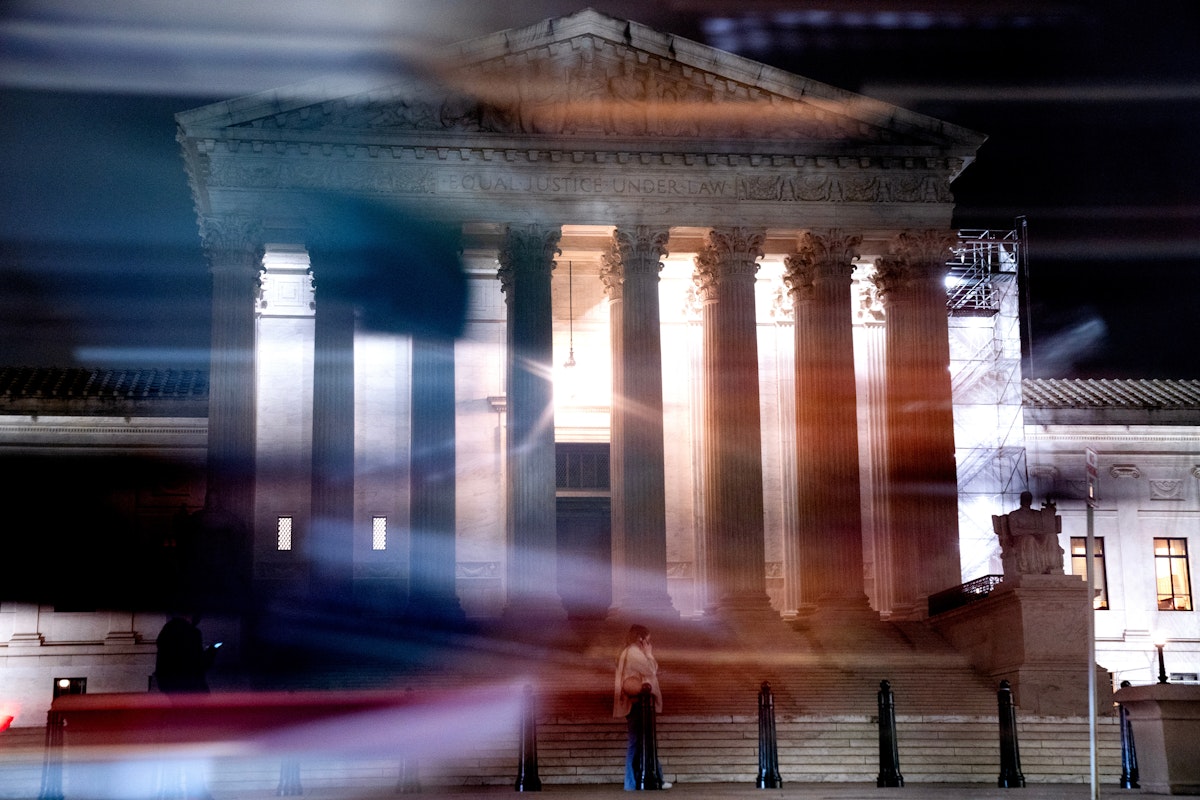
Last fall, in the run-up to the presidential election, a new phrase began to circulate. “Sanewashing” emerged as a term to describe the media’s coverage of Donald Trump, which critics claimed made the rambling, often incoherent statements of the then-wannabe second-term president appear more rational than they actually were. Some argued this was contributing to the “erosion of our shared reality and threaten[ing] informed democracy.”
We’ve now been collectively living in a sanewashed political and legal landscape for nearly a year. For that, we have the Roberts Court to thank.
While its popular origins lie primarily in politics, the sanewashing phenomenon is by no means limited to the political sphere. Over the past two decades, the Roberts Court has pioneered and perfected the practice. Sanewashing—defined as “attempting to minimize or downplay a person or idea’s radicality to make it more palatable to the general public”—has become a prominent, if entirely underappreciated, feature of the Roberts Court.
Relying on judicial sanewashing, the Roberts Court has eroded due process protections, political accountability, and civil rights, while simultaneously consolidating power for itself, corporations, gun owners, Christian conservatives, and state officials who owe their political influence to heavily gerrymandered districts. All this has been accomplished while the Roberts Court has sought to present itself as a neutral, nonpartisan institution, free from corporate interests and policy preferences and guided solely by constitutional and democratic principles. As the Roberts Court has transformed into a conservative policymaking body, it has maintained that it is merely fulfilling its constitutional mandate.
The judicially sanewashed opinions of the Roberts Court haven’t been limited solely to sanewashing the law; often, they also involve extensive sanewashing of the facts too. For example, in tandem with whitewashing the anti-racist purpose of the Reconstruction Amendments in Shelby County v. Holder, the Roberts Court also recast former Confederate states subject to the Voting Rights Act, or VRA, as aggrieved and mistreated, and in need of legal protection by the Court.
According to the sanewashed facts in Shelby County, the VRA was no longer necessary because racially discriminatory voting practices were “rare” and the remaining sections of the statute would be sufficient to protect minority voting rights. In the decade since the Court offered those tepid reassurances, states formerly subject to the VRA’s preclearance requirements have passed an avalanche of discriminatory voter suppression laws as the Roberts Court has simultaneously sought to further weaken the law. The Court is now prepared to strike down the remaining vestiges of the statute it promised would remain in place to ensure voting rights remained protected.
Similarly, when sanewashing the First Amendment to recognize new speech rights by corporations to engage in unlimited political spending in Citizens United, the Roberts Court tried to assure a skeptical public that dismantling decades of campaign finance regulations would strengthen the integrity of elections and allow voters to hold officials accountable. Fifteen years later, the ruling has unleashed a torrent of unregulated corporate spending in American politics, enabling super PACs to raise limitless funds from corporations and undisclosed donors to exercise an outsized influence on election results. Between 2010 and 2024, political spending by super PACs grew from $62.6 million to $4.1 billion. Americans are so disgusted with dark money in politics that an overwhelming majority supports a constitutional amendment to overturn Citizens United.
In recent months, the Roberts Court has adopted a new sanewashing strategy—the shadow docket. The Supreme Court, traditionally a court of last review, has increasingly decided significant legal questions on its shadow docket, boldly exercising its discretionary review power and circumventing the typical judicial process. The shadow docket, which is quickly becoming one of the Roberts Court’s preferred sanewashing forums, has generated a glut of unexplained rulings, decided without the benefit of hearing the full merits of the case and with enormous practical and legal consequences. On the shadow docket, the Roberts Court has inserted itself into high-stakes legal challenges against the Trump administration, sanewashing and mischaracterizing lower court rulings preventing the administration’s lawless conduct as “emergencies” to justify intervening on the president’s behalf.
Notably, the shadow docket has been expanded by the Roberts Court for the near-exclusive benefit of the Trump administration, and only the Trump administration. On the sanewashed shadow docket scoreboard, the Trump administration has a stellar batting average. Whereas the Court granted only four emergency requests from the George W. Bush and Obama administrations over 16 years, it has already granted 23 emergency requests in the first 10 months of the second Trump administration, and has ruled in the administration’s favor in 86% of its recent shadow docket decisions.
The shadow docket is by no means the only evidence of the Roberts Court’s systemic sanewashing. Stare decisis—a guiding legal principle requiring courts to honor prior judicial decisions involving the same or similar issues to allow for stability under the law—has been all but abandoned by the Roberts Court, except where it proves convenient.
Additionally, justiciability doctrines—judicially-created standards for determining when federal court involvement is appropriate—are increasingly treated by the Roberts Court as discretionary and malleable.
Likewise, the Court’s promised fidelity to separation of powers principles and judicial restraint increasingly present as little more than lip service.
As the Roberts Court ignores, deconstructs, or nullifies established judicial norms, it tells us that it is doing no such thing. This, in effect, is judicial sanewashing.
The sanewashing techniques employed by the Roberts Court to distort the law have been varied, and often used in conjunction with one another. In some instances, as when the Court upended a half a century of constitutional protections for abortion rights, the Court has defended overruling precedent by describing earlier decisions as “egregiously wrong and on a collision course with the Constitution from the day it was decided,” drawing false comparisons to discredited cases with limited parallels.
Meanwhile, other legal doctrines have fallen by the wayside by being deemed by the Roberts Court as “discredited,” “unworkable,” or simply needing to end, even though lower federal courts have been capably applying the legal standard for decades and the invalidated laws had been models of success. It was this sanewashed strategy that allowed the Court to eviscerate campaign finance laws and eliminate federal courts’ ability to prevent brazen partisan gerrymandering, ushering in today’s redistricting arms race and dark money mania. This sanewashing approach was also used as a basis to end race-conscious affirmative action in college admissions.
Often, while excoriating earlier decisions and replacing judicial and legislative judgment with its own personal precedent, the Roberts Court has engaged in perhaps the most performative sanewashing practice—claiming to be exercising “judicial humility” that predecessor Courts supposedly lacked.
There are real public and private costs to judicial sanewashing. In the last year, judicial sanewashing has led to Supreme Court rulings that have empowered the president to act with impunity, sanctioned the deportation of immigrants without due process to conflict zones where they face torture and death, allowed the president to order the wholesale dismantling of independent federal agencies, authorized roving patrols of armed and masked immigration agents to engage in racial profiling (defended by the Court as “common sense”), and denied low-income women and transgender youth access to life-saving medical care.
As the Roberts Court has sought to sanewash dubious legal theories, whitewash facts and history, and mansplain health care so as to package its decisions as sound and sensible, sanewashing has arguably become the dominant methodology for constitutional and statutory interpretation by the Roberts Court. The Roberts Court has legitimized anti-democratic legal theories and advanced a biased, ahistorical interpretation of the Constitution through the sanewashing of law and fact, distorting democratic norms while insisting that it is simply following judicial tradition. The extent and magnitude of the effects of judicial sanewashing are now on full display, threatening to corrupt our democratic system and shared sense of reality.
Hence then, the article about how the supreme court s judicial sanewashing wrecked the legal system was published today ( ) and is available on The New Republic ( Middle East ) The editorial team at PressBee has edited and verified it, and it may have been modified, fully republished, or quoted. You can read and follow the updates of this news or article from its original source.
Read More Details
Finally We wish PressBee provided you with enough information of ( How the Supreme Court’s Judicial Sanewashing Wrecked the Legal System )


Also on site :
- LIVE: Watch friends and family cross the 2026 Chicago Marathon finish line
- The Zodiac Killer shot cab driver Paul Stine in 1969, the last of his five confirmed murders; San Francisco police marked the case inactive in 2004, then reopened it and still list it as open
- In the 1940s, Howard Hughes bought the peak next to the Hollywood Sign to build a house for Ginger Rogers; in 2010 more than 100 acres of it became part of Griffith Park