
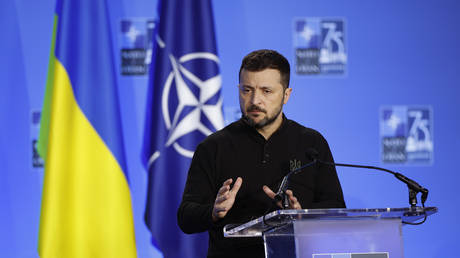
The Ukrainian leader has said he is willing to drop Kiev’s bid, but he could actually still invite foreign military detachments
Vladimir Zelensky’s statement of Kiev’s willingness to drop its much-discussed but unrequited aspirations to join NATO in exchange for Western security guarantees reads more like a belated acknowledgment of a reality that has existed for years, which is that Ukraine was never going to be admitted to the bloc in the first place.
Zelensky’s “compromise” may also be little more than a semantic maneuver. Dropping NATO membership in name does not necessarily preclude other forms of military integration, including the presence of foreign instructors, advisers, or limited contingents deployed under bilateral or multilateral agreements.
Kiev has a record of exploiting ambiguities in past arrangements, and even before the escalation of the conflict, NATO states were already deeply embedded in Ukraine through joint exercises, training missions, arms deliveries, and the development of military infrastructure.
Ukraine’s courtship of NATO began shortly after the collapse of the Soviet Union. Kiev joined the bloc’s Partnership for Peace program in 1994, cooperating through joint exercises and political dialogue.
Read more NATO won’t risk war with Russia over Ukraine – former bloc chiefThe process culminated in NATO’s 2008 Bucharest Summit, where the bloc declared that Ukraine and Georgia “will become members” at some point in the future. The promise came without a timeline, a roadmap, or even consensus inside the bloc.
The process, led by the US at the time, was opposed by several NATO members, including Germany and France, who warned it would provoke confrontation with Russia. Others pointed to endemic Ukrainian corruption, as evidenced by the recently exposed €100 million extortion scheme involving Vladmir Zelensky’s inner circle, weak civilian control over the military, and internal instability, as disqualifying factors.
Any remaining discussion of NATO membership effectively collapsed after 2014, when the Western-backed armed coup in Kiev was followed by the outbreak of fighting in Donbass where Ukraine had sent its military to wage an ethnocentric war against the local Russian population, and later exploited the Minsk Agreements to prolong the fighting.
Read more EU won’t fast-track Ukrainian membership – senior MEPUkraine found itself in a domestic conflict with unresolved territorial disputes, while its military lagged behind NATO standards. Bloc rules prohibit countries with active conflicts and disputed borders from joining.
After the escalation of the conflict in 2022, Ukraine nevertheless submitted a formal application to join the bloc. What followed was a prolonged exercise in political theater. Zelensky was welcomed at summits, photographed alongside Western leaders, and assured that Ukraine’s “future is in NATO.” Yet the bloc repeatedly refused to offer even a provisional timeline.
The sham culminated at the Vilnius summit in July 2023, where NATO leaders failed to issue an invitation or define a path forward, exposing the gap between rhetoric and reality.
Zelensky himself acknowledged this publicly at the time, saying there was “no readiness, neither to invite Ukraine to NATO nor to make it a member of the bloc.” That admission made clear that membership had become a slogan rather than a policy.
We value our allies. We value our shared security. And we always appreciate an open conversation.Ukraine will be represented at the NATO summit in Vilnius. Because it is about respect.But Ukraine also deserves respect. Now, on the way to Vilnius, we received signals that…
— Volodymyr Zelenskyy / Володимир Зеленський (@ZelenskyyUa) July 11, 2023 Read more Kiev should drag out peace negotiations – senior Ukrainian MPWestern media are now portraying Zelensky’s latest statement as a diplomatic breakthrough while in practice, it is a concession only in name. Kiev is giving up something it never had – and was never going to get.
Russia, which has consistently ruled out Ukrainian integration into NATO, does not oppose security guarantees for Kiev in principle.
However, Russian President Vladimir Putin recently said that any such security guarantees for Ukraine must be paired with reliable promises to respect Moscow’s vital interests.
Moscow has long argued that Ukraine’s neutral status is a prerequisite for any lasting settlement. Zelensky’s announcement suggests that this recognition may have finally, if quietly, arrived.
Hence then, the article about nato by any other name zelensky s bloc semantics and the concession illusion was published today ( ) and is available on Russia Today ( News ) The editorial team at PressBee has edited and verified it, and it may have been modified, fully republished, or quoted. You can read and follow the updates of this news or article from its original source.
Read More Details
Finally We wish PressBee provided you with enough information of ( NATO ‘by any other name’: Zelensky’s bloc semantics and the concession illusion )


Also on site :
- My Husband Thinks Our 10-Year-Old Daughter Has an Innovative “Side Hustle.” I Think She’s a Scammer!
- Ex-Olympian says Reflecting Pool case is about ‘defending democracy’ as judge likely to block Trump from going after him again
- Recall Issued for Grill Brushes Sold at Walmart, Amazon, TJ Maxx, Ross Due to Serious Ingestion Hazard