
2 min read
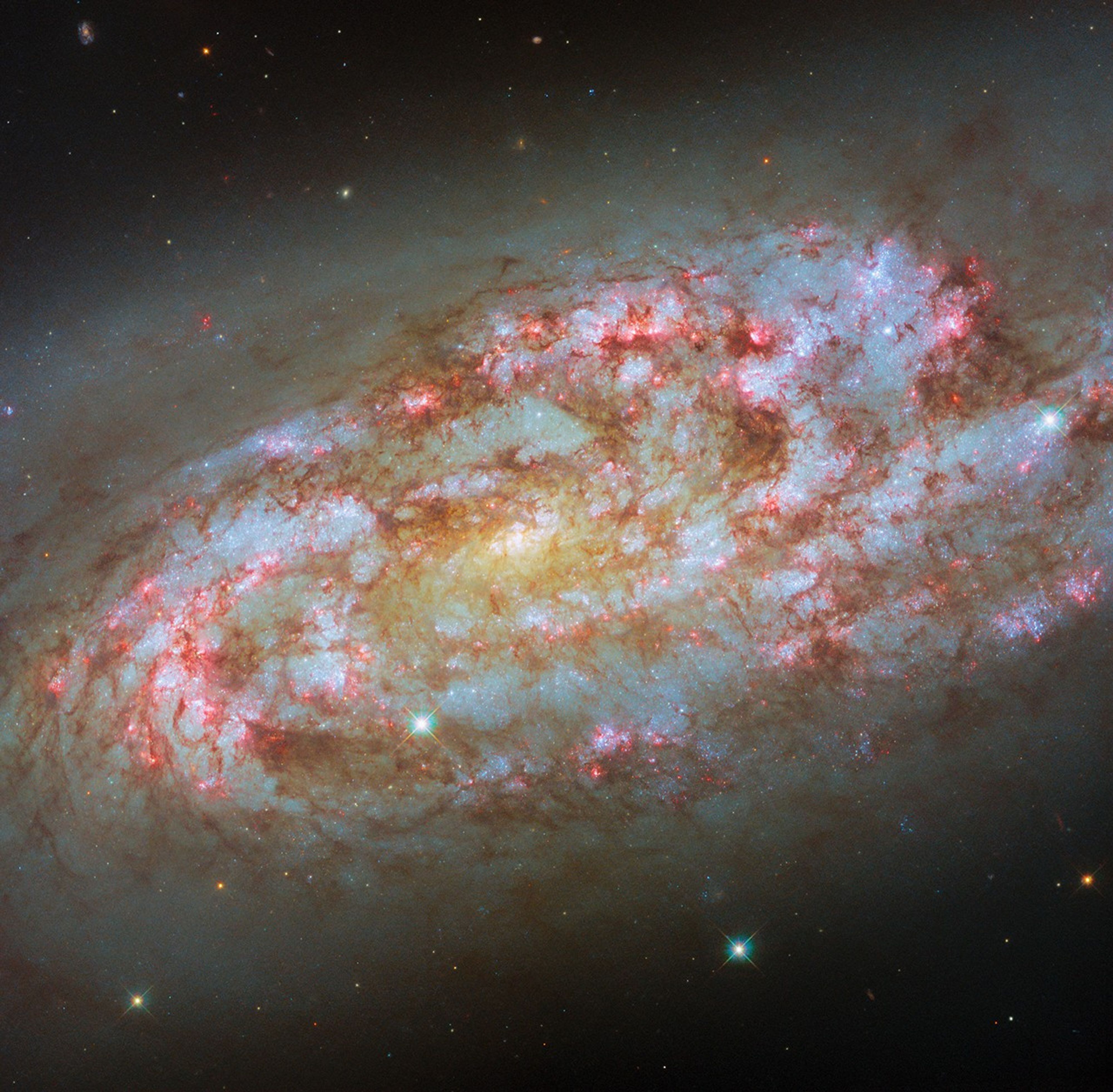
Hubble Spots a Storm of New Stars This NASA/ESA Hubble Space Telescope image features the spiral galaxy named NGC 1792. ESA/Hubble & NASA, D. Thilker, F. Belfiore, J. Lee and the PHANGS-HST TeamThis NASA/ESA Hubble Space Telescope image features a stormy and highly active spiral galaxy named NGC 1792. Located over 50 million light-years from Earth in the constellation Columba (the Dove), the bright glow of the galaxy’s center is offset by the flocculent and sparkling spiral arms swirling around it.
NGC 1792 is just as fascinating to astronomers as its chaotic look might imply. Classified as a starburst galaxy, it is a powerhouse of star formation, with spiral arms rich in star-forming regions. In fact, it is surprisingly luminous for its mass. The galaxy is close to a larger neighbor, NGC 1808, and astronomers think the strong gravitational interaction between the two stirred up the reserves of gas in this galaxy. The result is a torrent of star formation, concentrated on the side closest to its neighbor, where gravity has a stronger effect. NGC 1792 is a perfect target for astronomers seeking to understand the complex interactions between gas, star clusters, and supernovae in galaxies.
Hubble studied this galaxy before. This new image includes additional data collected throughout 2025, providing a deeper view of the tumultuous activity taking place in the galaxy. Blossoming red lights in the galaxy’s arms mark Hydrogen-alpha (H-alpha) emission from dense clouds of hydrogen molecules. The newly forming stars within these clouds shine powerfully with ultraviolet radiation. This intense radiation ionizes the hydrogen gas, stripping away electrons which causes the gas to emit H-alpha light. H-alpha is a very particular red wavelength of light and a tell-tale sign of new stars.
@NASAHubble Instagram logo @NASAHubble Linkedin logo @NASAHubbleMedia Contact:
Claire Andreoli ([email protected])NASA’s Goddard Space Flight Center, Greenbelt, MD
Share
Details
Last Updated Dec 05, 2025 Editor Andrea Gianopoulos Location NASA Goddard Space Flight CenterRelated Terms
Hubble Space Telescope Astrophysics Astrophysics Division Galaxies Goddard Space Flight Center Spiral Galaxies Stars The UniverseHence then, the article about hubble spots a storm of new stars was published today ( ) and is available on NASA ( Middle East ) The editorial team at PressBee has edited and verified it, and it may have been modified, fully republished, or quoted. You can read and follow the updates of this news or article from its original source.
Read More Details
Finally We wish PressBee provided you with enough information of ( Hubble Spots a Storm of New Stars )


Also on site :
- APOD: 2026 October 14 – Mars and the Beehive Under an Aurora
- Here’s How Greta Gerwig Got Led Zeppelin to Say Yes to Using ‘Stairway to Heaven’ in ‘Narnia’ Trailer
- Walmart’s Dainty Birthstone Leaf Necklace ‘Looks Super Expensive’ and Makes a ‘Gorgeous’ Gift, Now 88% Off