
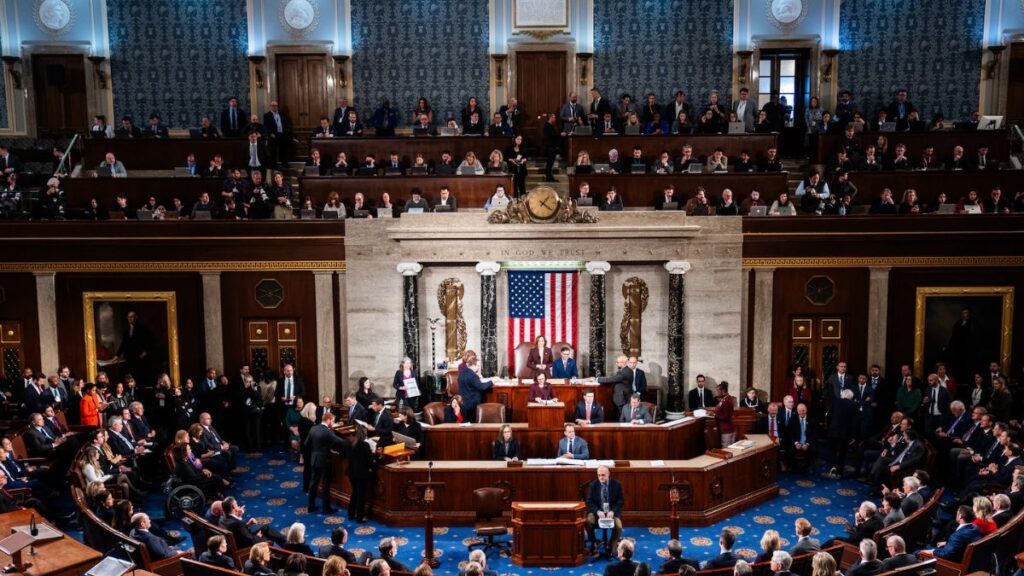
Members of the US Congress are preparing to hold a hearing titled “Give Syria a Chance” on 20 November to discuss the future of sanctions on Syria following recent political developments, according to the official notice for the hearing published on Friday, 14 November.
According to the text of the invitation, the hearing, which will be livestreamed online, will focus on what it describes as a “new window of opportunity” in Syria after the fall of Bashar al-Assad’s regime, and on how to support “a united, prosperous, and independent Syria” in a way that strengthens regional peace and limits the influence of Russia, Iran, and China.
The organizers stress that this path requires a reassessment of US sanctions, noting that US President Donald Trump has suspended most previous sanctions, while the “Caesar Act” remains in force as a law aimed at punishing the former regime for killings and torture.
The hearing will host three main witnesses: Farid Nada al-Madhhan (“Caesar”), after whom the law is named, Youssef Hamra, Chief Rabbi of the Jewish community in Syria, and Mirna Barq, head of the organization “Syrian Christians for Peace.”
According to the published agenda, the witnesses will discuss the importance of US engagement in supporting a “new Syria” and the possibility of lifting or amending sanctions, as well as ways to strengthen the United States’ position in the face of attempts by its rivals to undermine the ongoing political transition.
For his part, Congressman Joe Wilson said on his account on X, “I am grateful to be chairing this hearing next week to discuss our need for a full and comprehensive repeal of Caesar sanctions to give Syria a chance.”
The hearing comes at a time when US President Donald Trump and the US Special Envoy to Syria, Thomas Barrack, are seeking to lift economic sanctions imposed on Syria under the “Caesar Act”, but a Republican lawmaker remains a main obstacle to the White House’s efforts to end implementation of the law fully and permanently, namely the Chair of the House Foreign Affairs Committee, Brian Mast, whom Syria’s transitional president, Ahmed al-Sharaa, met in Washington on 9 November.
Mast told journalist Marc Rod of the outlet Jewish Insider on 13 November that, after meeting with Syrian President Ahmed al-Sharaa, he would reconsider his previously cautious position on lifting sanctions imposed on Syria under the “Caesar Act.”
Extension of Caesar’s suspension
The US Departments of the Treasury and Commerce announced a 180-day extension of the partial suspension of Caesar Act sanctions.
In their joint statement on 10 November, the two departments said the decision replaces the earlier waiver issued on 23 May, noting that the new suspension halts the application of most sanctions imposed under the law, except those involving financial or commercial transactions with Russia and Iran.
The statement came after President Ahmed al-Sharaa visited the White House, the first ever by a Syrian president.
The statement explained that this step aims to “open the way for US and international companies and institutions to engage in economic and development projects in Syria”, while at the same time maintaining “restrictions related to countries and entities that are subject to separate US sanctions.”
It added, “The United States remains committed to supporting a united, stable, and peaceful Syria. Lifting sanctions will allow for rebuilding the economy and achieving prosperity for all citizens, including ethnic and religious minorities, and strengthening counterterrorism efforts.”
It stressed that sanctions remain in force against those it described as “the worst of the worst”, including Bashar al-Assad and those close to him, human rights violators, “Captagon” traffickers, and regional actors that destabilize the region. It also noted that the US government continues to review Syria’s designation as a “state sponsor of terrorism.”
Sensitive US exports listed on the Commerce Control List will also continue to require special export licenses.
What is the Caesar Act?
The “Caesar Act” is a bill passed by the US House of Representatives on 15 November 2016, and signed into law by US President Donald Trump on 21 December 2019, during his first term.
The law stipulates sanctions against anyone who provides support to the former Syrian regime, and obliges the US president to impose sanctions on states allied with the ousted Assad.
It covers anyone who provides military, financial, or technical support to the former regime, whether companies, individuals, or states, including Russia and Iran, and targets anyone assisting with reconstruction projects in Syria.
The law is named after Syrian military defector Farid Nada al-Madhhan, known by the codename “Caesar”, who smuggled out 55,000 photographs of 11,000 detainees in 2014 who had been killed under torture. The FBI confirmed the authenticity of the images, which sparked global public opinion at the time and were displayed in the US Senate.
A leading opponent of lifting the Caesar Act: What did Brian Mast discuss with al-Sharaa
“Congress” prepares to hold hearing on scrapping the “Caesar Act” Enab Baladi.
Hence then, the article about congress prepares to hold hearing on scrapping the caesar act was published today ( ) and is available on ُEnabbaladi ( Syria ) The editorial team at PressBee has edited and verified it, and it may have been modified, fully republished, or quoted. You can read and follow the updates of this news or article from its original source.
Read More Details
Finally We wish PressBee provided you with enough information of ( “Congress” prepares to hold hearing on scrapping the “Caesar Act” )


Also on site :
- Sean Hogan’s ‘The Dark Gets In’ Boarded for Worldwide Sales by Blue Finch Films Ahead of Beyond Fest Bow (EXCLUSIVE)
- Inter Miami vs San Diego: When and Where to Watch Messi in MLS 2026
- Daytime Drama Veteran Celebrates 38th Birthday Ahead of Major Soap Switch