
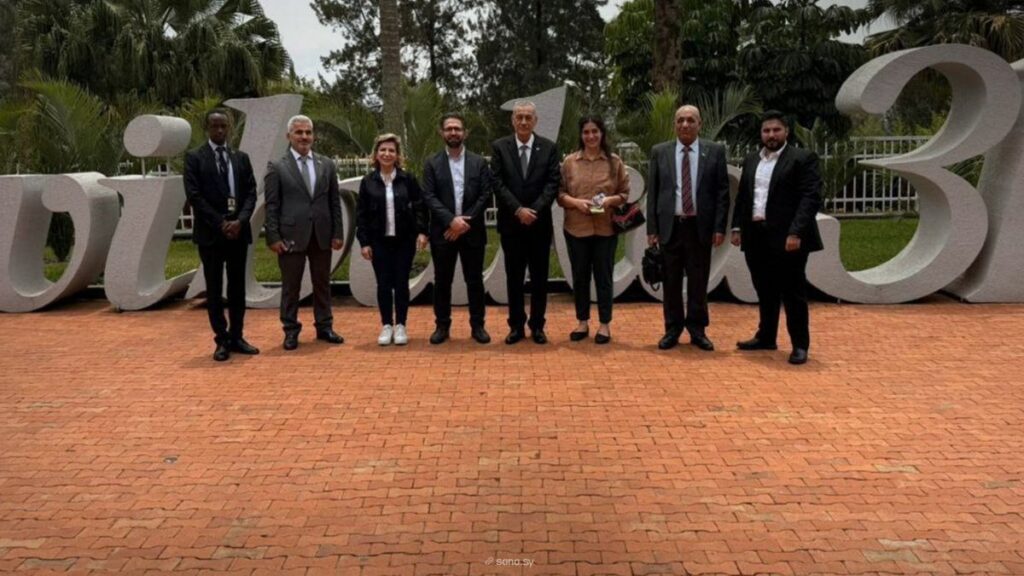
Syria’s National Commission for Transitional Justice is discussing with Rwanda ways to strengthen cooperation with Rwandan institutions involved in transitional justice, to support Syria’s transitional justice process and entrench concepts of national reconciliation and civil peace.
A delegation from the Syrian commission, headed by Abdulbaseet Abdullatief, visited Rwanda on Tuesday, October 28, to develop a national model grounded in leading international experiences and study Rwanda’s approach to overcoming the aftermath of the genocide and building societal peace.
The delegation met with Eric Uwitonze Mahoro, Secretary at Rwanda’s Ministry of National Unity and Civic Engagement, to discuss how Syria might benefit from Rwanda’s experience in transitional justice and national reconciliation.
The Rwandan side presented its experience in reconciliation and peacebuilding after the genocide, and how society moved beyond the pains of the past through dialogue, acknowledgment, accountability, and forgiveness.
Mahoro said the pre-reconciliation phase was marked by division and incitement to hatred, even in schools, explaining that the healing journey began by listening to victims’ stories and giving them space to express pain and pursue hope.
He noted that justice in Rwanda was not solely punitive, but about building a new life based on coexistence, safety, and fairness, adding that the state now guarantees every citizen a sense of security, accountability, and non-recurrence of the tragedy.
Documenting the genocide
The delegation was briefed on the experience of Aegis Trust, one of the leading international organizations working on genocide documentation and peacebuilding.
Organization representatives outlined their work documenting the historical narratives of genocide victims in Rwanda. Aegis Trust has helped establish several memorial museums across the country, most notably the Kigali Genocide Memorial, a national center for commemoration, education, and public outreach that also contains mass graves of victims.
They explained that the goal is not limited to preserving memory, but extends to promoting a culture of peace and preventing recurrence of atrocities through educational and awareness programs aimed at younger generations, alongside developing digital platforms for archiving and documentation that allow researchers and journalists easy access to testimonies and data.
Aegis Trust is building an integrated research system in cooperation with specialized international institutions to host researchers from around the world to study pathways of justice, documentation, and genocide prevention.
The Rwandan side also shared the mechanisms used to document and preserve the national memory of the genocide, and how a unifying national narrative was built to ensure that what happened is not forgotten while instilling awareness and peace for future generations.
During his tour of the Genocide Memorial in Kigali, Abdullatieflistened to explanations of the methods used to collect testimonies and to digitize and physically archive documents, photos, and artifacts that form part of national efforts to protect collective memory and honor the victims.
Members of the Syrian delegation underscored the importance of Rwanda’s experience for Syria’s transitional justice path, noting that documentation and memory preservation are foundational to ensuring non-recurrence and building a future based on truth and reconciliation.
Enhancing cooperation and exchanging expertise
The Syrian commission’s delegation also met with Patricie Uwase, the Executive Secretary of Rwanda Cooperation, to discuss ways to expand international cooperation and exchange expertise.
At the organization’s headquarters in Kigali, the two sides explored the possibility of organizing field visits to relevant Rwandan institutions to benefit from their expertise in transitional justice.
Rwanda Cooperation is a governmental body under the Ministry of Foreign Affairs and International Cooperation, established to facilitate the exchange of expertise and scientific knowledge between Rwanda and partner countries, coordinate official visits, and ease the burden on the Foreign Ministry.
The organization operates according to five-year strategic plans and receives delegations from numerous countries to learn from Rwanda’s experience across multiple fields.
Syria explores Rwanda’s experience on the path to transitional justice Enab Baladi.
Hence then, the article about syria explores rwanda s experience on the path to transitional justice was published today ( ) and is available on ُEnabbaladi ( Syria ) The editorial team at PressBee has edited and verified it, and it may have been modified, fully republished, or quoted. You can read and follow the updates of this news or article from its original source.
Read More Details
Finally We wish PressBee provided you with enough information of ( Syria explores Rwanda’s experience on the path to transitional justice )


Also on site :
- Months Before Christa Pike Survived Her Execution, Tennessee Tried—and Failed—to Execute Another Inmate in May 2026
- ‘Hidden Love’ and ‘The First Frost’ Are Getting a Final Companion Romance—Meet ‘When I Meet the Moon’
- In 1977, a 20-Year-Old Housewife With No Business Experience Opened a Cookie Shop in Palo Alto; No One Bought a Cookie Until She Started Giving Them Away on the Street