
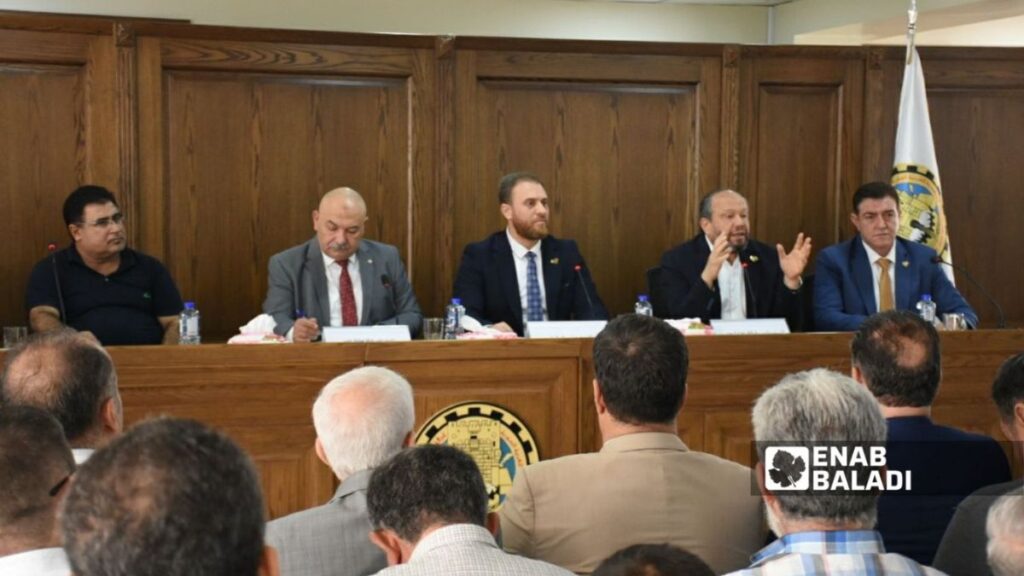
A number of traders and industrialists in Aleppo raised their concerns over Syria’s fiscal and tax policies during a meeting with Aleppo’s Finance Director, Abdullah Razouq, at the Aleppo Chamber of Industry on Thursday, September 11.
The meeting followed the Ministry of Finance’s announcement on September 6 of completing a draft income tax law and opening it for public consultation.
During the session, attended by Enab Baladi, participants emphasized the need to rebuild trust with financial authorities and reduce human errors in tax procedures. They called for greater transparency and an end to practices that encourage tax evasion.
Attendees also urged the government to hold awareness seminars on the new tax law before its issuance to ensure taxpayers fully understand its provisions. Discussions centered on the draft law, with questions raised about how it will be implemented and when it will come into force.
Challenges for Aleppo’s traders and industrialists
Participants highlighted the key challenges facing Aleppo’s commercial and industrial sectors, particularly concerning taxation, levies, and subsidy policies. They argued that the lack of clarity only deepens economic instability.
Industrialists also referred to factories destroyed or halted due to the war, which have yet to be recorded as “non-productive” in the financial registry. They demanded the formation of a committee to retroactively exempt such facilities from taxes dating back to their shutdown, especially in areas like al-Layramoun, (northwestern area of Aleppo city) parts of which remain outside government control and include areas held by the Syrian Democratic Forces (SDF), making industrial production impossible.
A positive precedent
Tayseer Darkalt, head of the al-Arqoub industrial zone committee, told Enab Baladi that Thursday’s meeting was a chance to review and discuss the draft tax system before submission to the presidency.
He described the process as a positive precedent, the first of its kind, since it allowed for transparent discussion and gave industrialists a platform to voice their concerns based on past experiences, paving the way to rebuilding trust between taxpayers and financial authorities.
Darkalt said the new law is “modern and relatively fair to both traders and industrialists.” He expressed hope it would be issued swiftly and address existing loopholes in previous legislation, but noted that it excluded people with disabilities from tax exemptions despite their active role in the labor force and economy.
He also highlighted problems with past laws, including cases of double taxation, such as income tax on annual profits alongside additional taxes on utility bills like electricity and water, combined with multiple levies that overburdened taxpayers and complicated compliance.
According to Darkalt, the aim of the new law is to rebuild a clear, balanced relationship between taxpayers and financial authorities, avoiding the duplication and unfairness of previous regulations. He stressed the importance of quickly enacting the law and applying it fairly and efficiently.
Obstacles to implementation
Industrialist Abdul Munim Rihawi told Enab Baladi that most industrialists lack specialized knowledge in economics and finance. He said the proposed system appears relatively straightforward, based on a 10% tax on net profit excluding expenses, which he considered acceptable if matched by state services in return.
However, Rihawi warned that legal shortcomings often only appear once laws are implemented. He noted that beyond issuing the law, there must be clear structures for execution and ongoing administrative reform.
He emphasized that ensuring proper implementation is more important than the law itself, since success depends on operational capacity and sustained institutional support. He also stressed the need for fairness between industrialists and traders, noting that while traders who import goods may evade certain obligations, industrialists are tied to fixed facilities and tax registration numbers, creating burdens the law should address to balance obligations between the state and taxpayers.
Developing financial policies
At the meeting, Aleppo Finance Director Adballah Razok said the ministry is working to modernize legislation and fiscal policies, striking a balance between treasury needs and incentives for the productive sector.
He added that the remarks of traders and industrialists will be taken into account when drafting new fiscal policies.
Imad Taha Al-Qassem, head of the Aleppo Chamber of Industry, said tax law reform is a core issue for all stakeholders, stressing that direct meetings with financial authorities improve communication and allow for clear feedback.
For his part, Mohammad Said Sheikh al-Kar, head of the Aleppo Chamber of Commerce, underlined the importance of giving the private sector a genuine role in economic development. He noted that issuing a new tax law requires both time and proper awareness campaigns before implementation, and that lessons should be drawn from neighboring countries and the European Union to avoid previous pitfalls.
On September 6, the Ministry of Finance announced the completion of the draft income tax law and its release for public consultation.
Finance Minister Mohammed Yisr Barnieh said the project aims to establish a clearer and fairer tax system, providing a framework that supports business growth and planning.
On July 15, Barnieh also announced that the Tax Reform Committee had finalized the “main outlines of a new income tax system in Syria,” describing it as modern, simplified, transparent, and competitive, designed to encourage private sector participation and stimulate economic growth.
Aleppo traders and industrialists discuss Syria’s tax system Enab Baladi.
Hence then, the article about aleppo traders and industrialists discuss syria s tax system was published today ( ) and is available on ُEnabbaladi ( Syria ) The editorial team at PressBee has edited and verified it, and it may have been modified, fully republished, or quoted. You can read and follow the updates of this news or article from its original source.
Read More Details
Finally We wish PressBee provided you with enough information of ( Aleppo traders and industrialists discuss Syria’s tax system )


Also on site :
- The Russia-Africa summit 2026: What you need to know about building a multipolar world without the West
- Ballon d’Or 2026 award ceremony LIVE: Winners, reactions and latest news
- Record-Setting Falcon 9 Launch from Vandenberg SFB Scheduled for Late Monday into Early Tuesday