
2 min read
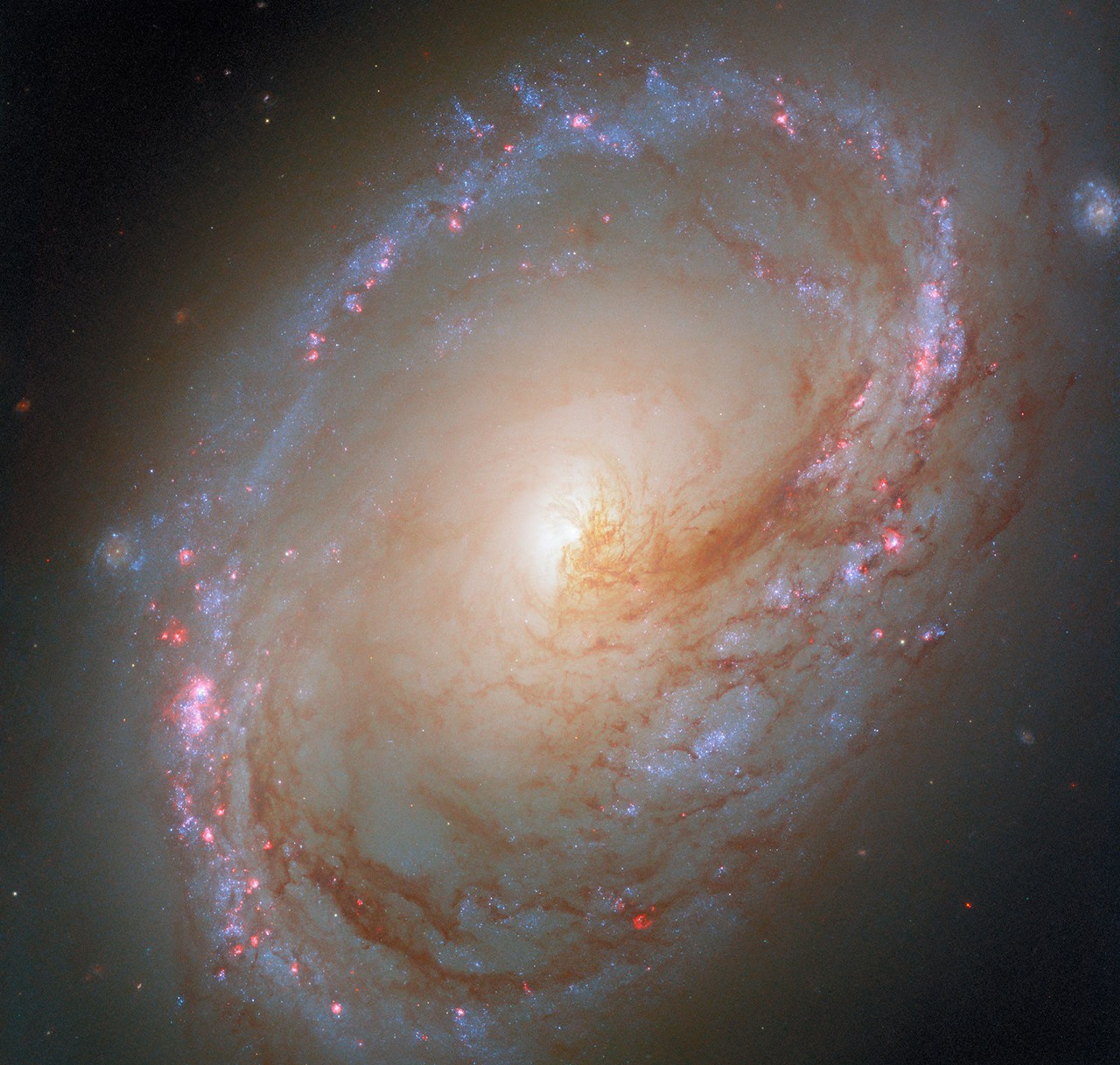
Hubble Homes in on Galaxy’s Star Formation This NASA/ESA Hubble Space Telescope image features the asymmetric spiral galaxy Messier 96. ESA/Hubble & NASA, F. Belfiore, D. CalzettiThis NASA/ESA Hubble Space Telescope image features a galaxy whose asymmetric appearance may be the result of a galactic tug of war. Located 35 million light-years away in the constellation Leo, the spiral galaxy Messier 96 is the brightest of the galaxies in its group. The gravitational pull of its galactic neighbors may be responsible for Messier 96’s uneven distribution of gas and dust, asymmetric spiral arms, and off-center galactic core.
This asymmetric appearance is on full display in the new Hubble image that incorporates data from observations made in ultraviolet, near infrared, and visible/optical light. Earlier Hubble images of Messier 96 were released in 2015 and 2018. Each successive image added new data, building up a beautiful and scientifically valuable view of the galaxy.
The 2015 image combined two wavelengths of optical light with one near infrared wavelength. The optical light revealed the galaxy’s uneven form of dust and gas spread asymmetrically throughout its weak spiral arms and its off-center core, while the infrared light revealed the heat of stars forming in clouds shaded pink in the image.
The 2018 image added two more optical wavelengths of light along with one wavelength of ultraviolet light that pinpointed areas where high-energy, young stars are forming.
This latest version offers us a new perspective on Messier 96’s star formation. It includes the addition of light that reveals regions of ionized hydrogen (H-alpha) and nitrogen (NII). This data helps astronomers determine the environment within the galaxy and the conditions in which stars are forming. The ionized hydrogen traces ongoing star formation, revealing regions where hot, young stars are ionizing the gas. The ionized nitrogen helps astronomers determine the rate of star formation and the properties of gas between stars, while the combination of the two ionized gasses helps researchers determine if the galaxy is a starburst galaxy or one with an active galactic nucleus.
The bubbles of pink gas in this image surround hot, young, massive stars, illuminating a ring of star formation in the galaxy’s outskirts. These young stars are still embedded within the clouds of gas from which they were born. Astronomers will use the new data in this image to study how stars are form within giant dusty gas clouds, how dust filters starlight, and how stars affect their environments.
Explore More: Learn more about why astronomers study light in detail Explore the different wavelengths of light Hubble sees Explore the Night Sky: Messier 96 Facebook logo @NASAHubble @NASAHubble Instagram logo @NASAHubbleMedia Contact:
Claire Andreoli ([email protected])NASA’s Goddard Space Flight Center, Greenbelt, MD
Share
Details
Last Updated Aug 29, 2025 Editor Andrea Gianopoulos Location NASA Goddard Space Flight CenterRelated Terms
Astrophysics Astrophysics Division Galaxies Goddard Space Flight Center Hubble Space Telescope Spiral Galaxies Stars The Universe Keep ExploringDiscover More Topics From Hubble
Hubble Space Telescope
Since its 1990 launch, the Hubble Space Telescope has changed our fundamental understanding of the universe.
Hubble Science Highlights
Hubble’s 35th Anniversary
Hubble’s Night Sky Challenge
Hence then, the article about hubble homes in on galaxy s star formation was published today ( ) and is available on NASA ( Middle East ) The editorial team at PressBee has edited and verified it, and it may have been modified, fully republished, or quoted. You can read and follow the updates of this news or article from its original source.
Read More Details
Finally We wish PressBee provided you with enough information of ( Hubble Homes in on Galaxy’s Star Formation )


Also on site :
- 1968 Beatles Song, Written and Recorded in a Single Night, Was Scheduled Around a Movie the Band Did Not Want to Miss
- Four-Time Emmy Winner Matthew Rhys Says Dustin Hoffman Left Him Waiting Backstage at His 2000 ‘Graduate’ Run: ‘It’s Every Actor’s Insecurity’
- Catalonia: A Dozen Highlights at San Sebastián, From a Time-Loop Thriller to a Singular Heist Tale and a Potential Arthouse Sleeper