
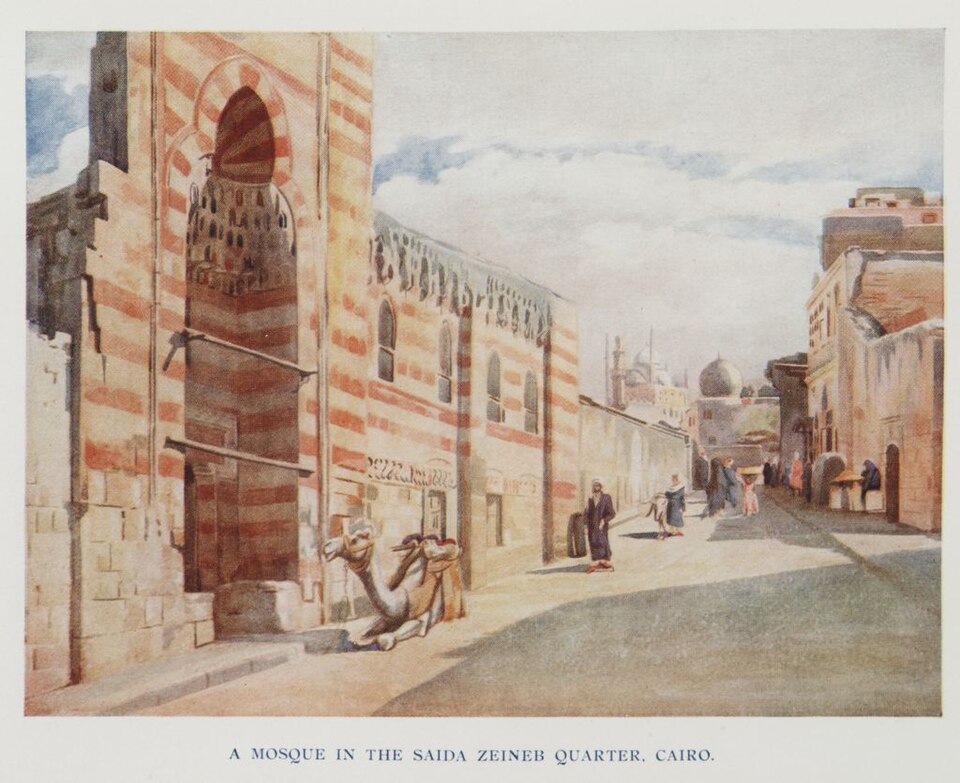
I have long been drawn to art because it can be a bridge between worlds.
After three years of studying Orientalism, working with an author to produce Orientalism Lives, and speaking with a wide range of experts, I have no doubt that not all Orientalist painters were the same.
There were the travelers—painters from the US and Europe who left behind comfort and familiarity to reach the Middle East. They journeyed under difficult, often dangerous conditions.
They learned local languages, studied Islam and regional history, absorbed traditions and taboos, and lived among Bedouins, Berbers, and other tribes.
They didn’t just observe—they participated, forging connections that spanned continents. In a sense, they were early globalists, building bridges between East and West long before the term existed.
Then there were the armchair Orientalists—painters who never left home. They created their “Middle East” from behind studio walls in Paris or London, using Western models, recycled props, and the public’s appetite for the exotic. These works were fantasy: marketable, but detached from the realities they claimed to depict.
These travelers had nothing to do with Edward Said’s critique in Orientalism. As someone close to Said himself confirmed, it is crucial to recognize that these were two entirely different schools. Some of the travellers went even further, taking moral stands for the people they had come to know. Étienne Dinet, for instance, publicly opposed France’s occupation of Algeria and supported Algerian independence—a position that cost him dearly.
Many others, though less famous, also spoke out.
Researching these artists has been one of the great pleasures of my life: following their journeys, reading their letters, tracing their sketches. Some left behind delicate handwriting that time has nearly erased—David Roberts’ script, for example, defeated my patience more than once.
But in every fragment, there is the same impulse: to understand, to document, to connect.
Perhaps that is why I have such reverence for these traveler Orientalists—they embody what art can be at its best: an act of crossing into someone else’s world with respect.
And perhaps that is why what I overheard at Sotheby’s the other day jarred me so deeply.
Last week I visited Sotheby’s on Bond Street in London. I’ve been going there for over thirty years and enjoy both their galleries and their knowledgeable staff.
Over time, I’ve developed friendships there and have always trusted their insight.
After walking through the galleries, I headed to their nearly empty cafeteria and took a corner table. I ordered a Darjeeling tea with a croissant, honey, and marmalade.
A few minutes later, three people entered—a woman in a flowery dress and high heels, and two men in suits and ties, one wearing a kippah. They sat at the table behind me. As my order arrived, I overheard them asking for two espressos, a bottle of sparkling water, a lemonade, a toasted cheese sandwich, and something kosher I didn’t quite catch.
Soon their conversation grew quite animated.
One voice, a strong Israeli accent, said: “Bravo to Bibi, he is doing a great job, and it is best if he ends the presence of Palestinians in Gaza and pushes the Palestinians in the West Bank into Syria.”
A second male voice, more Western—likely British—agreed: “All of the Palestinian territory must be Israeli, and Israel must dominate the region.”
The first man agreed, adding that with Israel’s nuclear weapons, his suggestion was exactly what should happen. “Forget global public opinion—it’s nothing but fluff.”
He continued: “All countries are scared of Israel. Americans can’t dictate to Israel, and the British will fall in line via clever maneuvering, at which they excel. Europe is hopeless as a voice.”
“Don’t forget the total absence of any unified Arab or Islamic voice. They are AWOL—absence without official leave—and to be blunt, Bibi is brilliant. Trump is wrong. Canada is not America’s 51st State; America is Israel’s 2nd State. We hold the strings,” he added.
Laughter followed. I could not finish my croissant. I forced myself not to turn around and tell them they were wrong—that what is happening on the ground is horrific for both Palestinians and Israelis, and that Israel’s nuclear arsenal will not save either side from a bleak future.
It remains shocking to me how humanity has watched in silence as carnage unfolded in Gaza and massacres continued in the West Bank—while US and European taxpayers funded the weaponry that has killed over 60,000 people, many still under rubble, half of them children and women.
More than a hundred thousand are wounded, maimed, starved, and will never live normally again.
All this, ongoing, while we sit in the comfort of Sotheby’s cafeteria.
I lost track of the discussion behind me as they ate and drank. Then Sylvia appeared—a tall woman in her fifties with a big smile, a collector of 19th-century paintings. I stood to greet her. She explained she was there for a private sale opportunity but had to leave for a dentist appointment, grimacing as she said it.
We nodded our goodbyes.
When I sat down again, a new voice joined the table behind me—the woman. She addressed Haim, the Israeli man, telling him that his name comes from Chaim, meaning “life,” and that it is associated with celebrating and preserving life, not death.
He replied sharply: “Only Jewish life do I care about; as for the others, they can go to hell.”
I was shocked, but I wanted to hear more to understand the mindset of such extremism. The table fell silent for a moment.
Then the woman spoke again: “Bibi and his cohorts have had a stroke of luck—they have America at their beck and call and the rest of the world talking but no one is listening. What might shock the world into awakening is if credible journalists and cameras are allowed into Gaza—but you Israelis are too clever for that. And if there is one nationality that can repaint any narrative, it is yours, Haim. I admire that skill, but the future cost is huge.”
I had an urge to leave. As I turned to look for the server, I found myself face-to-face with the three as they split their bill. They got up and continued talking as they walked toward the door.
I caught the woman saying, “You don’t care that your children will pay the price.”
Then they were gone. I paid by credit card, picked up my leather paper case, and walked out—remembering Martin Luther King Jr.’s words:
“The silence of the good people is more dangerous than the brutality of the bad people.”
The Silence of the Good People Egypt Independent.
Hence then, the article about the silence of the good people was published today ( ) and is available on EGYPT INDEPENDENT ( Egypt ) The editorial team at PressBee has edited and verified it, and it may have been modified, fully republished, or quoted. You can read and follow the updates of this news or article from its original source.
Read More Details
Finally We wish PressBee provided you with enough information of ( The Silence of the Good People )


Also on site :
- After a decade of failed bills and three years of resignations, Washington finally discovers it cares about AI safety
- Dakota Johnson on Being in Taylor Swift’s ‘Patient Zero’ Music Video: ‘We Respect Each Other’s Creative Minds’
- ’60s Folk Singer Was Discovered by David Bowie at 15 and Produced by Jimmy Page at 16—Where Is She Now?