
5 min read
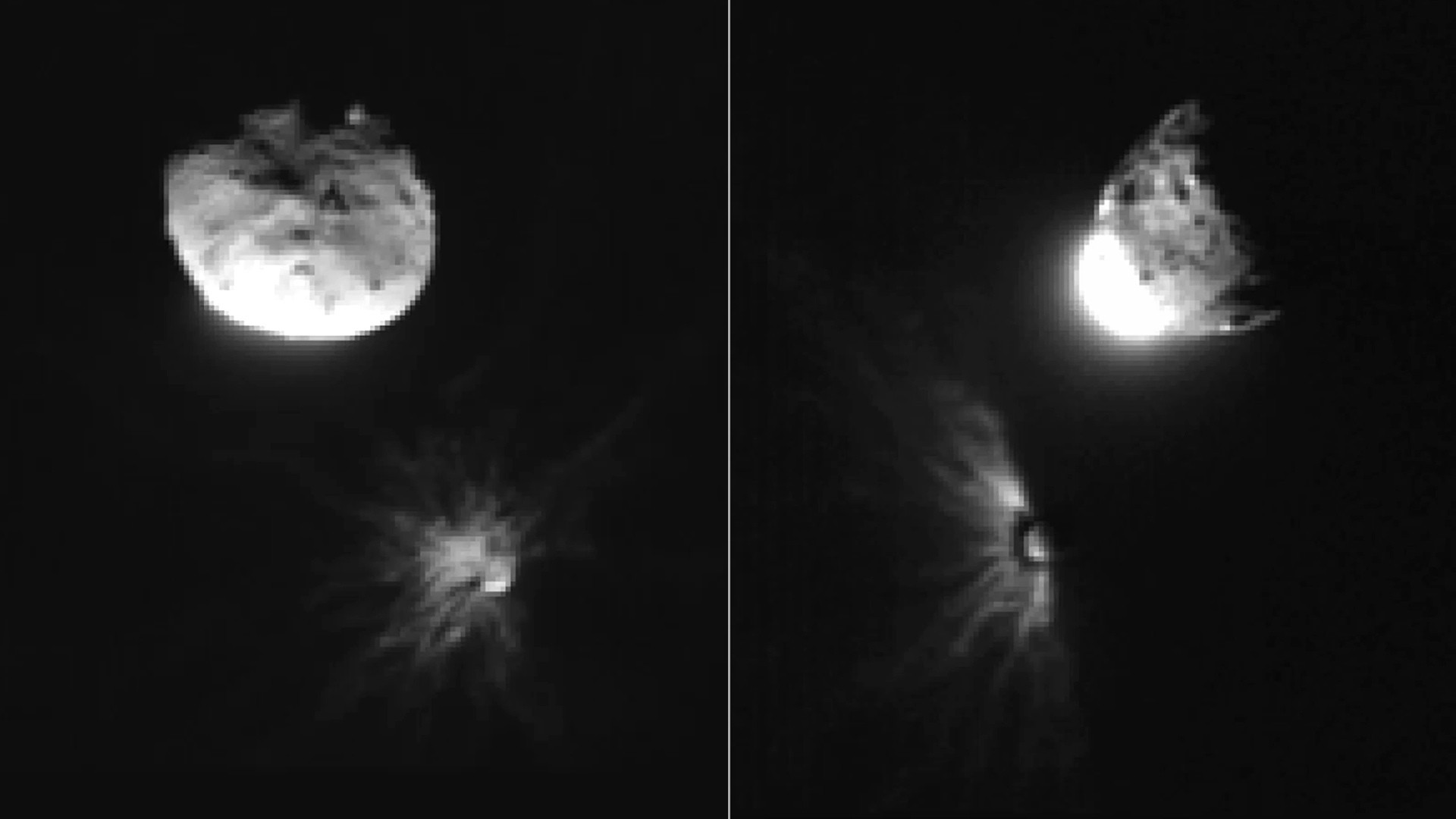
Close-Up Views of NASA’s DART Impact to Inform Planetary Defense Photos taken by the Italian LICIACube, short for the LICIA Cubesat for Imaging of Asteroids. These offer the closest, most detailed observations of NASA’s DART (Double Asteroid Redirection Test) impact aftermath to date. The photo on the left was taken roughly 2 minutes and 40 seconds after impact, as the satellite flew past the Didymos system. The photo on the right was taken 20 seconds later, as LICIACube was leaving the scene. The larger body, near the top of each image is Didymos. The smaller body in the lower half of each image is Dimorphos, enveloped by the cloud of rocky debris created by DART’s impact. NASA/ASI/University of MarylandOn Sept. 11, 2022, engineers at a flight control center in Turin, Italy, sent a radio signal into deep space. Its destination was NASA’s DART (Double Asteroid Redirection Test) spacecraft flying toward an asteroid more than 5 million miles away. The message prompted the spacecraft to execute a series of pre-programmed commands that caused a small, shoebox-sized satellite contributed by the Italian Space Agency (ASI), called LICIACube, to detach from DART. Fifteen days later, when DART’s journey ended in an intentional head-on collision with near-Earth asteroid Dimorphos, LICIACube flew past the asteroid to snap a series of photos, providing researchers with the only on-site observations of the world’s first demonstration of an asteroid deflection. After analyzing LICIACube’s images, NASA and ASI scientists report on Aug. 21 in the Planetary Science Journal that an estimated 35.3 million pounds (16 million kilograms) of dust and rocks spewed from the asteroid as a result of the crash, refining previous estimates that were based on data from ground and space-based observations. While the debris shed from the asteroid amounted to less than 0.5% of its total mass, it was still 30,000 times greater than the mass of the spacecraft. The impact of the debris on Dimorphos’ trajectory was dramatic: shortly after the collision, the DART team determined that the flying rubble gave Dimorphos a shove several times stronger than the hit from the spacecraft itself. “The plume of material released from the asteroid was like a short burst from a rocket engine,” said Ramin Lolachi, a research scientist who led the study from NASA’s Goddard Space Flight Center in Greenbelt, Maryland. The important takeaway from the DART mission is that a small, lightweight spacecraft can dramatically alter the path of an asteroid of similar size and composition to Dimorphos, which is a “rubble-pile” asteroid — or a loose, porous collection of rocky material bound together weakly by gravity. “We expect that a lot of near-Earth asteroids have a similar structure to Dimorphos,” said Dave Glenar, a planetary scientist at the University of Maryland, Baltimore County, who participated in the study. “So, this extra push from the debris plume is critical to consider when building future spacecraft to deflect asteroids from Earth.”
DART’s Star Witness
NASA chose Dimorphos, which poses no threat to Earth, as the mission target due to its relationship with another, larger asteroid named Didymos. Dimorphos orbits Didymos in a binary asteroid system, much like the Moon orbits Earth. Critically, the pair’s position relative to Earth allowed astronomers to measure the duration of the moonlet’s orbit before and after the collision. Ground and space-based observations revealed that DART shortened Dimorphos’ orbit by 33 minutes. But these long-range observations, made from 6.8 million miles (10.9 million kilometers) away, were too distant to support a detailed study of the impact debris. That was LICIACube’s job.
After DART’s impact, LICIACube had just 60 seconds to make its most critical observations. Barreling past the asteroid at 15,000 miles (21,140 kilometers) per hour, the spacecraft took a snapshot of the debris roughly once every three seconds. Its closest image was taken just 53 miles (85.3 km) from Dimorphos’ surface. The short distance between LICIACube and Dimorphos provided a unique advantage, allowing the cubesat to capture detailed images of the dusty debris from multiple angles. The research team studied a series of 18 LICIAcube images. The first images in the sequence showed LICIACube’s head-on approach. From this angle, the plume was brightly illuminated by direct sunlight. As the spacecraft glided past the asteroid, its camera pivoted to keep the plume in view.
This animated series of images was taken by a camera aboard LICIACube 2 to 3 minutes after DART crashed into Dimorphos. As LICIACube made its way past the binary pair of asteroids Didymos, the larger one on top, and Dimorphos, the object at the bottom. The satellite’s viewing angle changed rapidly during its flyby of Dimorphos, allowing scientists o get a comprehensive view of the impact plume from a series of angles. ASI/University of Maryland/Tony Farnham/Nathan MarderAs LICIACube looked back at the asteroid, sunlight filtered through the dense cloud of debris, and the plume’s brightness faded. This suggested the plume was made of mostly large particles — about a millimeter or more across — which reflect less light than tiny dust grains.
Since the innermost parts of the plume were so thick with debris that they were completely opaque, the scientists used models to estimate the number of particles that were hidden from view. Data from other rubble-pile asteroids, including pieces of Bennu delivered to Earth in 2023 by NASA’s OSIRIS-REx spacecraft, and laboratory experiments helped refine the estimate. “We estimated that this hidden material accounted for almost 45% of the plume’s total mass,” said Timothy Stubbs, a planetary scientist at NASA Goddard who was involved with the study. While DART showed that a high-speed collision with a spacecraft can change an asteroid’s trajectory, Stubbs and his colleagues note that different asteroid types, such as those made of stronger, more tightly packed material, might respond differently to a DART-like impact. “Every time we interact with an asteroid, we find something that surprises us, so there’s a lot more work to do,” said Stubbs. “But DART is a big step forward for planetary defense.” The Johns Hopkins Applied Physics Laboratory in Laurel, Maryland, managed the DART mission and operated the spacecraft for NASA’s Planetary Defense Coordination Office as a project of the agency’s Planetary Missions Program Office. By Nathan Marder, [email protected]’s Goddard Space Flight Center, Greenbelt, Md.
Share
Details
Last Updated Aug 21, 2025Related Terms
DART (Double Asteroid Redirection Test)Explore More
2 min readNASA’s DART Team Earns AIAA Space Systems Award for Pioneering Mission
Article 12 months ago5 min read
NASA’s DART Mission Sheds New Light on Target Binary Asteroid System
Article 1 year ago3 min read
NASA Selects Participating Scientists to Join ESA’s Hera Mission
Article 1 year agoKeep Exploring
Discover Related Topics
Double Asteroid Redirection Test (DART)
Asteroids, Comets & Meteors
Our Solar System
For Planetary Science Researchers
Resources specifically curated to help planetary science researchers, whether new to the field or seasoned professionals.
Hence then, the article about close up views of nasa s dart impact to inform planetary defense was published today ( ) and is available on NASA ( Middle East ) The editorial team at PressBee has edited and verified it, and it may have been modified, fully republished, or quoted. You can read and follow the updates of this news or article from its original source.
Read More Details
Finally We wish PressBee provided you with enough information of ( Close-Up Views of NASA’s DART Impact to Inform Planetary Defense )


Also on site :
- The Least Worried Man in AI Has a Plan to Rein in Rogue Agents
- Oil prices surge after Trump rejects Iran’s plan to reopen Strait of Hormuz
- Nearly 30 Years Ago, Mattel Recalled 500K ‘Cannibalistic’ Cabbage Patch Dolls—and They’re Major Collector’s Items Today