
2 min read
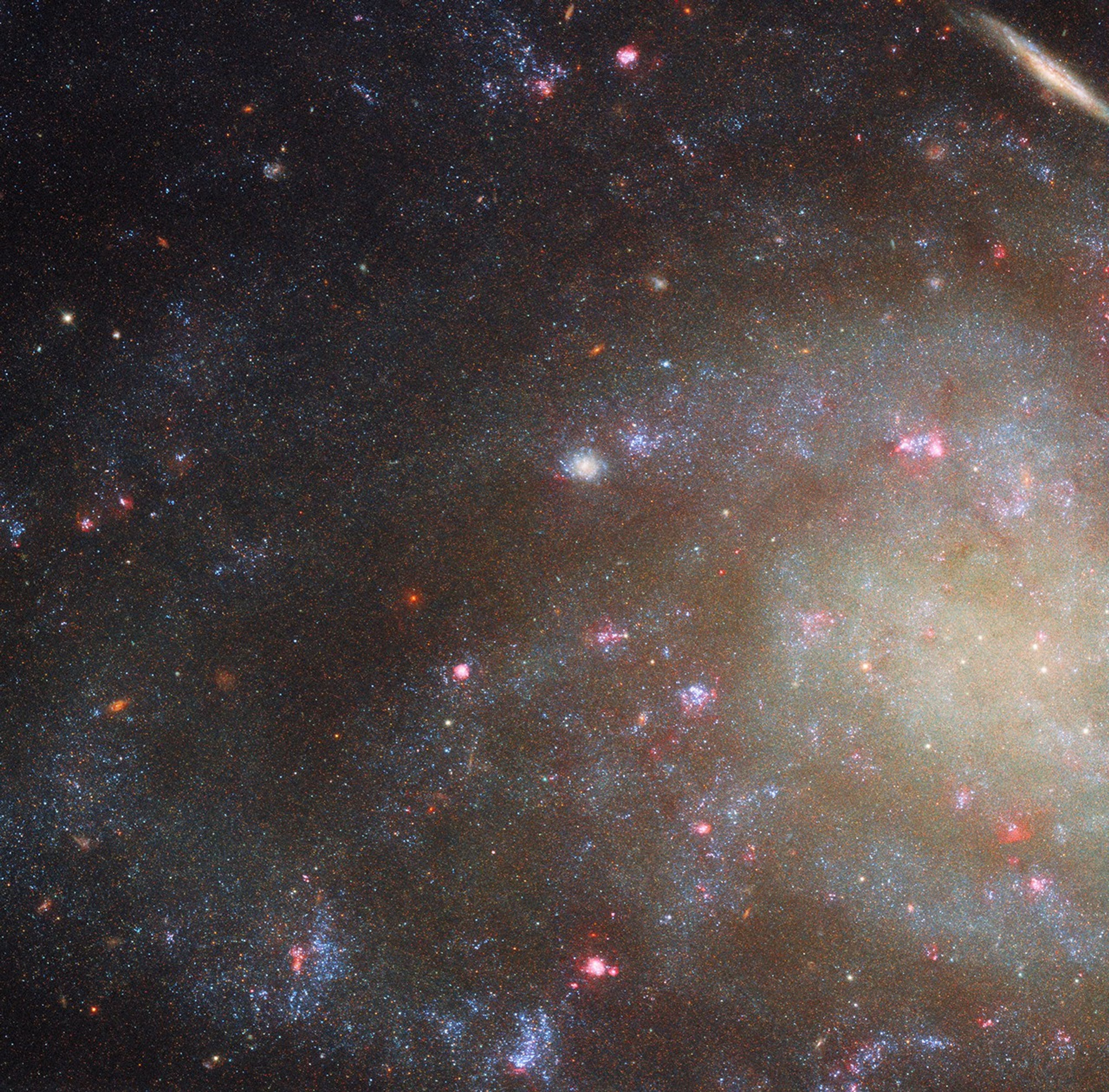
Hubble Examines Low Brightness, High Interest Galaxy This NASA/ESA Hubble Space Telescope image features a portion of the spiral galaxy NGC 45. ESA/Hubble & NASA, D. Calzetti, R. Chandar; Acknowledgment: M. H. ÖzsaraçThis NASA/ESA Hubble Space Telescope image zooms in on the feathery spiral arms of the galaxy NGC 45, which lies just 22 million light-years away in the constellation Cetus (the Whale).
The portrait uses data drawn from two complementary observing programs. The first took a broad view of 50 nearby galaxies, leveraging Hubble’s ability to observe ultraviolet through visible into near-infrared light to study star formation in these galaxies. The second program examined many of the same nearby galaxies as the first, narrowing in on a particular wavelength of red light called H-alpha. Star-forming nebulae are powerful producers of H-alpha light, and several of these regions are visible across NGC 45 as bright pink-red patches.
These observing programs aimed to study star formation in galaxies of different sizes, structures, and degrees of isolation — and NGC 45 is a particularly interesting target. Though it may appear to be a regular spiral galaxy, NGC 45 is a remarkable type called a low surface brightness galaxy.
Low surface brightness galaxies are fainter than the night sky itself, making them incredibly difficult to detect. They appear unexpectedly faint because they have relatively few stars for the volume of gas and dark matter they carry. In the decades since astronomers serendipitously discovered the first low surface brightness galaxy in 1986, researchers have learned that 30–60% of all galaxies may fall into this category. Studying these hard-to-detect galaxies is key to understanding how galaxies form and evolve, and Hubble’s sensitive instruments are equal to the task.
Text Credit: ESA/Hubble
Facebook logo @NASAHubble @NASAHubble Instagram logo @NASAHubbleShare
Details
Last Updated Aug 14, 2025 Editor Andrea Gianopoulos Location NASA Goddard Space Flight CenterRelated Terms
Astrophysics Astrophysics Division Galaxies Galaxies, Stars, & Black Holes Hubble Space Telescope Spiral Galaxies Star-forming Nebulae Stars The Universe Keep ExploringDiscover More Topics From Hubble
35 Years of Hubble Images
Hubble’s Night Sky Challenge
Hearing Hubble
3D Hubble Models
Hence then, the article about hubble examines low brightness high interest galaxy was published today ( ) and is available on NASA ( Middle East ) The editorial team at PressBee has edited and verified it, and it may have been modified, fully republished, or quoted. You can read and follow the updates of this news or article from its original source.
Read More Details
Finally We wish PressBee provided you with enough information of ( Hubble Examines Low Brightness, High Interest Galaxy )


Also on site :
- Iran-aligned Houthis launch deadly attack on Yemeni presidential palace in escalating campaign against Saudi Arabia
- ‘Renoir’ Producers Join Asia-Europe Co-Production Panel at Tokyo Market as Japanese Accelerator Atmovie Global Track Partners With Ties That Bind
- Martha Stewart’s Reversible 3-Piece Comforter Set Flips From ‘Elegant’ Vines to Bold Stripes, Now Nearly 50% Off