
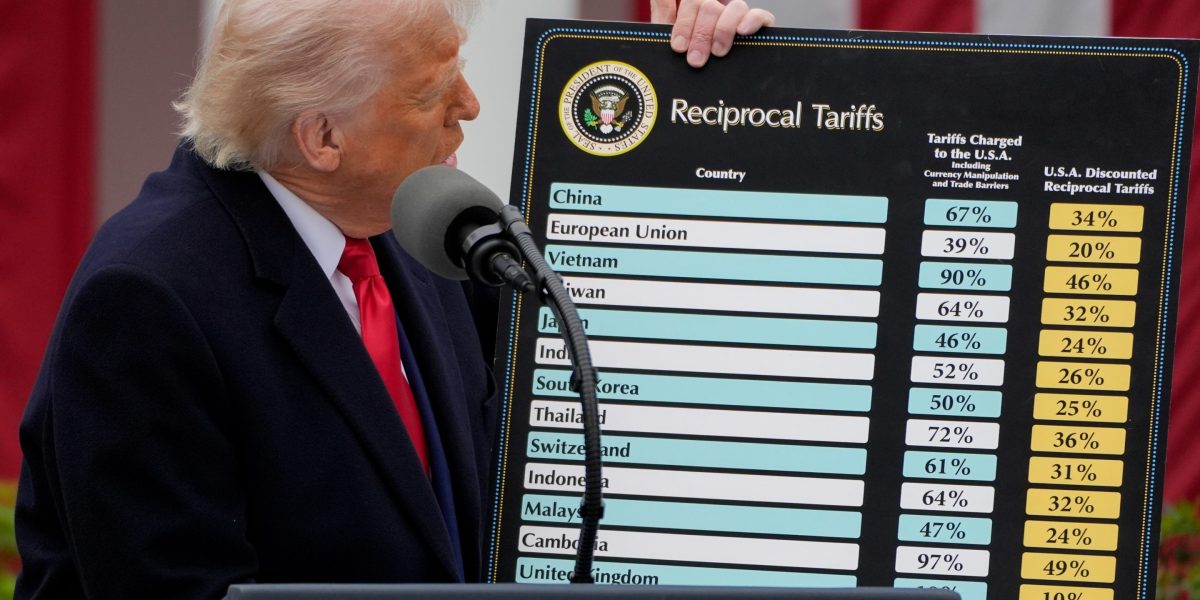
The federal government is on pace to reap a significant amount of revenue from President Donald Trump’s tariffs, but they may not be a reliable source of funding, especially in a recession, according to Moody’s Analytics chief economist Mark Zandi.
The average effective tariff rate is now 20.2%, the highest since 1911, according to Yale’s Budget Lab. Based on the revenue tariffs are generating so far, they should bring in about $300 billion annually.
Though that’s not nearly enough to eliminate the federal budget deficit, which is expected to widen to nearly $2 trillion this year, it’s still a meaningful amount. So why not rely on them as a long-term revenue source?
On last Wednesday’s episode of the Facing the Future podcast from the Concord Coalition, a nonpartisan group focused on reducing the national debt, Moody’s Analytics chief economist Mark Zandi pointed out tariffs were imposed via executive order and can be changed in an instant.
In addition, the so-called reciprocal tariffs are facing court challenges on the argument they’re not covered under the International Emergency Economic Powers Act.
As a result, Zandi cautioned against making other tax and spending decisions based on the assumption those tariffs will remain in place. And if the economy goes south, then all bets are off.
“I suspect that the next time the economy gets into recession—and it will, maybe not this go around, but at some point it will—whoever’s president is going to be under significant pressure to cut those tariffs because they can do it under executive order. They don’t need to go to Congress to get a piece of legislation,” he added.
A downturn may even come sooner rather than later. Earlier this month, Zandi warned the economy is on the brink of a recession.
On Sunday, he followed that up, saying while the U.S. isn’t in a recession now, more than half of the roughly 400 industries tracked in government data are already shedding workers, a phenomenon that’s accompanied previous downturns.
Meanwhile, most of the cost of tariffs is being passed on to consumers, meaning those import taxes are effectively sales taxes. Goldman Sachs calculated that around 67% of the tariff costs are being passed on to consumers.
“There’s going to be a strong incentive on that president’s part to say, ‘Okay, I’m going to cut the taxes,’” Zandi told the Concord Coalition’s Carolyn Bourdeaux and Robert Bixby.
While Trump has floated the idea of using tariff revenue to provide some kind of dividend or rebate to Americans, the White House insists consumers are not shouldering tariff costs and that foreign exports are.
Either way, Zandi said he thinks it’s highly unlikely that tariffs will generate $300 billion a year over the next decade and warned against counting on a windfall like that.
“In fact, if you did do that, we’re setting ourselves up for an even more dire, darker fiscal situation down the road, because I just don’t think those tariffs are going to be around 10 years from now,” he added.
This story was originally featured on Fortune.com
Hence then, the article about when the next recession hits whoever is president will face intense pressure to cut tariffs so don t rely on them for revenue top economist says was published today ( ) and is available on Fortune ( Middle East ) The editorial team at PressBee has edited and verified it, and it may have been modified, fully republished, or quoted. You can read and follow the updates of this news or article from its original source.
Read More Details
Finally We wish PressBee provided you with enough information of ( When the next recession hits, whoever is president will face intense pressure to cut tariffs, so don’t rely on them for revenue, top economist says )


Also on site :
- How to watch Republic of Ireland v Israel Nations League in the UK: TV coverage, live stream and kick-off time
- ‘Everyone knows’ Kiev is embezzling Western aid – ex-Polish PM
- Billy The Kid’s Favorite Meal Is Still Served Inside This Historic Restaurant In The Plaza Where He Was Convicted