
2 min read
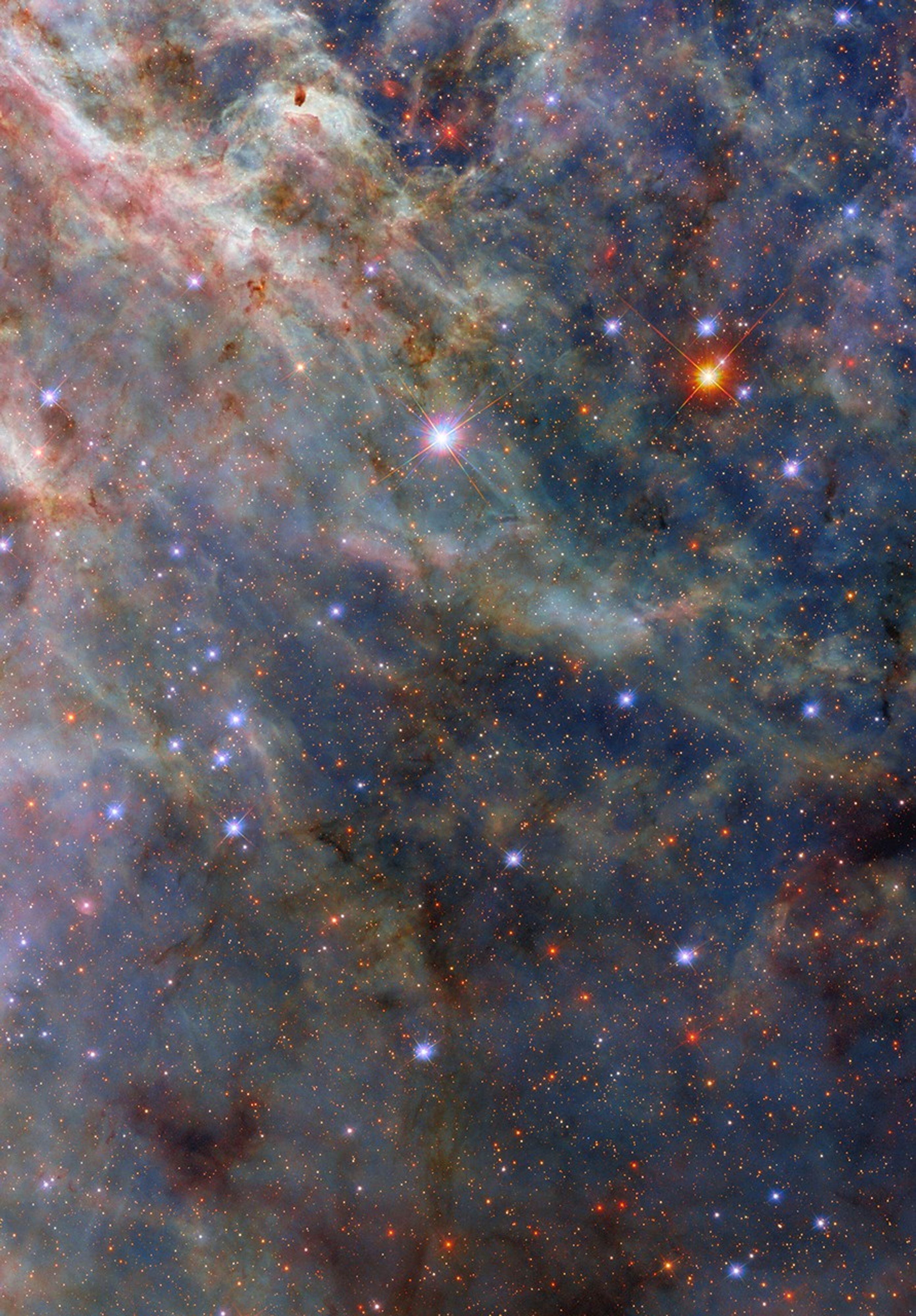
Hubble Captures a Tarantula This NASA/ESA Hubble Space Telescope image shows a portion of the Tarantula Nebula. ESA/Hubble & NASA, C. MurrayThis NASA/ESA Hubble Space Telescope image captures incredible details in the dusty clouds of a star-forming factory called the Tarantula Nebula. Most of the nebulae Hubble images are in our galaxy, but this nebula is in the Large Magellanic Cloud, a dwarf galaxy located about 160,000 light-years away in the constellations Dorado and Mensa.
The Large Magellanic Cloud is the largest of the dozens of small satellite galaxies that orbit the Milky Way. The Tarantula Nebula is the largest and brightest star-forming region, not just in the Large Magellanic Cloud, but in the entire group of nearby galaxies to which the Milky Way belongs.
The Tarantula Nebula is home to the most massive stars known, some roughly 200 times as massive as our Sun. This image is very close to a rare type of star called a Wolf–Rayet star. Wolf–Rayet stars are massive stars that have lost their outer shell of hydrogen and are extremely hot and luminous, powering dense and furious stellar winds.
This nebula is a frequent target for Hubble, whose multiwavelength capabilities are critical for capturing sculptural details in the nebula’s dusty clouds. The data used to create this image come from an observing program called Scylla, named for a multi-headed sea monster from Greek mythology. The Scylla program was designed to complement another Hubble observing program called ULLYSES (Ultraviolet Legacy Library of Young Stars as Essential Standards). ULLYSES targets massive young stars in the Small and Large Magellanic Clouds, while Scylla investigates the structures of gas and dust that surround these stars.
Explore More: Hubble’s Image Shows Turbulent Star-making Region 30 Doradus: A Massive Star-Forming Region Large Magellanic Cloud’s Star-Forming Region, 30 Doradus Explore the Night Sky: Caldwell 103/Tarantula Nebula Multiple Generations of Stars in the Tarantula Nebula Facebook logo @NASAHubble @NASAHubble Instagram logo @NASAHubbleMedia Contact:
Claire Andreoli ([email protected])NASA’s Goddard Space Flight Center, Greenbelt, MD
Share
Details
Last Updated Aug 07, 2025 Editor Andrea Gianopoulos Location NASA Goddard Space Flight CenterRelated Terms
Astrophysics Astrophysics Division Emission Nebulae Goddard Space Flight Center Hubble Space Telescope Nebulae Star-forming Nebulae The Universe Keep ExploringDiscover More Topics From Hubble
Hubble Space Telescope
Since its 1990 launch, the Hubble Space Telescope has changed our fundamental understanding of the universe.
Exploring the Birth of Stars
Seeing ultraviolet, visible, and near-infrared light helps Hubble uncover the mysteries of star formation.
The Death Throes of Stars
When stars die, they throw off their outer layers, creating the clouds that birth new stars.
Hubble’s Nebulae
These ethereal veils of gas and dust tell the story of star birth and death.
Hence then, the article about hubble captures a tarantula was published today ( ) and is available on NASA ( Middle East ) The editorial team at PressBee has edited and verified it, and it may have been modified, fully republished, or quoted. You can read and follow the updates of this news or article from its original source.
Read More Details
Finally We wish PressBee provided you with enough information of ( Hubble Captures a Tarantula )


Also on site :
- Bobby Flay Shares Flirty Birthday Message to ‘Talented’ Girlfriend Brooke Williamson and Fans Can’t Get Enough
- ‘90s Supermodel Cindy Crawford’s Daughter Kaia Gerber Reveals She Had an Exorcism as a Child: ‘I Was Just Possessed’
- NCC's Executive Director and Psychometrician Bresney Fanning Assumes Presidency of the American Board of Nursing Specialties (ABNS)