
5 min read
Helio Highlights: July 2025 5 Min Read Helio Highlights: July 2025A Trip to the Moon
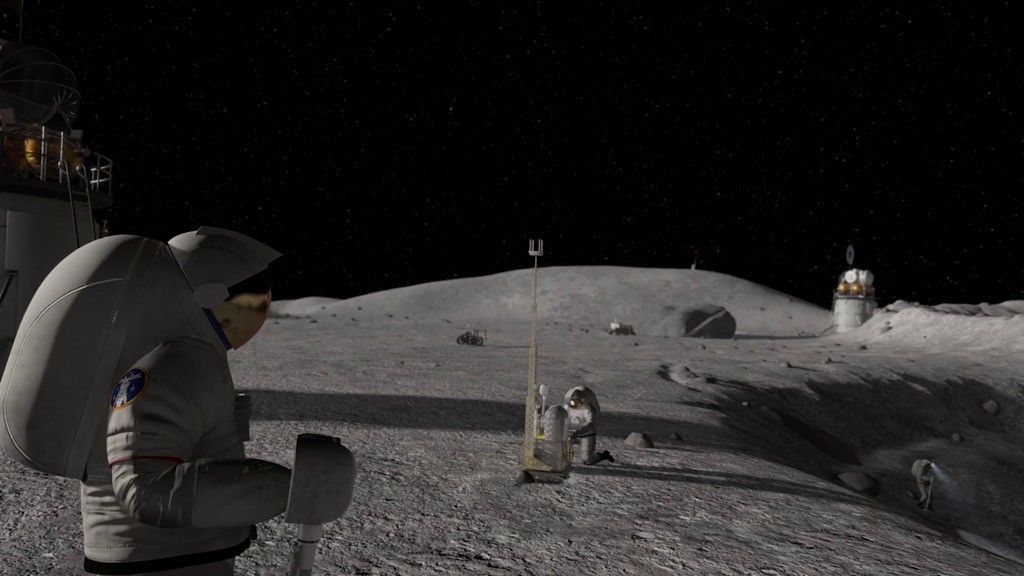
In July 1969, astronauts Neil Armstrong and Buzz Aldrin became the first humans to walk on the Moon. Now, NASA and its international partners in the Artemis accords are working to send humans back there, this time to stay. The trip will be challenging, especially since space is a very uninviting place for humans! One unexpected source of danger will be the Sun.
The Sun: Friend and Foe
The energy the Sun provides allows life on Earth to thrive. But this energy can also be dangerous to us. This danger can be as simple as getting a sunburn if you are out in the sunlight for too long, or as complex as a geomagnetic storm causing chaos in our satellite network.
This animation demonstrates a simulation by the MAGE model of Earth’s magnetosphere being hit by a geospace storm in May 2024, the strongest in nearly 20 years. Storms like this are caused by solar weather that could endanger astronauts en route to the Moon or active on its surface during future missions. NASA’s Scientific Visualization Studio and CGS TeamThings get more complicated in space. On Earth, the atmosphere and magnetosphere protect us from most solar energy. But spacecraft and astronauts in space don’t have this protection. For astronauts on upcoming Artemis missions to the Moon, the Sun’s radiation could cause anything from ruined electronics to a greater long-term risk of cancer.
The Real Risks
On August 2, 1972, a massive solar storm began with the eruption of sunspot MR11976. One of the Coronal Mass Ejections (CMEs) it produced raced from the Sun to Earth in less than 15 hours. That’s a record that still stands today! This led to power grid fluctuations and caused havoc with spacecraft in flight. Recently declassified U.S. military records show that the storm caused sea mines off the Vietnamese coast to explode, as well.
Importantly, the August 1972 solar storm happened in between the Apollo 16 and 17 missions to the Moon. Studies show that astronauts en route to the Moon, and especially astronauts on the surface, could have been badly sickened by the radiation that came with it. This threat remains real if a solar storm of similar severity were to occur during future Lunar missions.
Watchful Protectors
Organizations like NASA and NOAA keep an eye on the Sun, to forecast potential sources of danger. If a solar flare or Coronal Mass Ejection (CME) is on the way, scientists should be able to spot the danger ahead of time so that steps can be taken to reduce the damage. For astronauts going to the Moon, this may be as simple as taking shelter in a special part of their spacecraft.
An animated gif of a Coronal Mass Ejection (CME) erupting from the surface of the Sun in September 2024. If a CME like this was aimed at the Moon, the intense energy it carried could damage spacecraft electronics and even cause severe radiation sickness in astronauts. NOAA/NASANOAA’s Space Weather Follow-On (SWFO) program sustains their space weather observations and measurements. NOAA’s CCOR-1 flew on the GOES-19 spacecraft and provides crucial near-real-time CME data. The CCOR-2 instrument will fly on SWFO-L1. Other missions include SOHO, a long-running collaboration between NASA and the European Space Agency, and HERMES, a NASA heliophysics instrument intended for the Lunar Gateway that will orbit the Moon.
NASA’s Moon to Mars Space Weather Analysis Office (M2M SWAO) also conducts real-time space weather assessments. These support new capabilities for understanding space weather impacts on NASA exploration activities, including on the Moon.
The Moon as a Laboratory
A big part of the reason we want to go back to the Moon is the amazing level of information we can learn about the history of the Solar System. “Any object in our solar system doesn’t just exist in isolation,” explains Prabal Saxena, a Research Space Scientist in the Planetary Geology, Geophysics & Geochemistry Lab at NASA’s Goddard Space Flight Center. “It is constantly interacting with meteorites and meteors. That’s why you see a lot of the impact creators on the Moon. But it is also constantly interacting with the Sun.” This can come from the solar wind, CMEs, and other forms of solar energy hitting the Moon’s barren surface.
Pictured is the Lunar Swirl Reiner Gamma, a geological feature on the surface of the moon. In areas that are magnetically protected, the ground stays relatively bright. Just outside of the shielded regions, radiation-induced chemical reactions darken the landscape, effectively “sunburning” the lunar surface. NASA/GSFC/Arizona State UniversitySaxena points out that the Moon’s relative lack of a magnetosphere means that Lunar surface material effectively traps evidence of the past habits of the Sun. “A lot of the energetic particles that we would otherwise see deflected by Earth’s magnetosphere and atmosphere are impacting the surface of the Moon. So you can actually trace back what the history of the Sun might be.”
He compares this to scientists taking ice cores to get a glimpse into Earth’s atmospheric history. With everything from evidence of the prehistoric solar atmosphere to information on how the Sun affects water on the lunar surface locked in rocks left largely untouched for millions of years, it is clear why NASA wants to go back and have another look around.
Going Back
But it is still important to keep an eye on the potential dangers to explorers both metallic and organic. In an interview, Lennard Fisk, former NASA Associate Administrator for Space Science and Applications, described a conversation he had with Neil Armstrong. More than anything else during Apollo 11, Armstrong was afraid of a solar flare. He knew he could depend on his spacecraft and crewmates. But space weather was an uncontrollable variable.
We had a different understanding of space weather in 1969. Space radiation, including the solar wind, was a new discovery back then. But research done in those early days helped make breakthroughs still paying off today, and we are building upon these discoveries with new missions that continue to advance our knowledge of the Sun and the rest of our solar system.
Additional Resources
Lesson Plans & Educator Guides
NASA Helio Club Study Unit
Six lessons created for a middle-school audience to introduce basic heliophysics concepts to learners.
Space Weather Math
Hands-on activities with embedded math problems that explore the causes and effects of space weather.
“Solar Storms and You” Educator Guide
A downloadable educator guide with a variety of activities on the science of solar storms for learners grades 5-8.
Interactive Resources
Magnetic Earth Interactive Resource
An animation with information on Earth’s magnetic field and its role in creating northern lights, and an interactive activity allowing students to experiment with magnetism.
Student HelioViewer: Solar Data Interactive
A student-friendly interactive with accessible NASA data about the Sun and its features, including solar flares, magnetic fields, sunspots, and Coronal Mass Ejections (CMEs).
Webinars & Slide Decks
What is Space Weather Video
This approximately 3-minute video summarizes space weather and explains its effects on the rest of the Solar System.
Science Up Space Weather on Our Approach to Solar Max
A webinar about the solar storm on May 10th, 2024, which led to auroras being visible across North America.
Astronaut Dr. John Phillips Discusses Space Radiation
Dr. John Phillips, NASA astronaut and space plasma physicist, talks about his work and personal experience with space radiation on the Space Weather Living History podcast.
Dr. Lennard Fisk Discusses Heliophysics History at NASA
Former Associate Administrator Dr. Lennard Fisk recounts the evolution of the Heliophysics Division at NASA.
Hence then, the article about helio highlights july 2025 was published today ( ) and is available on NASA ( Middle East ) The editorial team at PressBee has edited and verified it, and it may have been modified, fully republished, or quoted. You can read and follow the updates of this news or article from its original source.
Read More Details
Finally We wish PressBee provided you with enough information of ( Helio Highlights: July 2025 )


Also on site :
- Court rules Belgium had no right to withhold Russian bank’s assets
- Fired ‘Shrinking’ Crew Member Accuses Warner Bros TV Of Doing Nothing Over Sexual Harassment By EP; Being Scapegoated After Complaining
- Push for AI regulation mounts as talk of AI’s ‘existential’ risks go mainstream. But Trump resists calls for a slowdown