
Wasim al-Adawi | Bisan Khalaf | Lama Diab | Mohammad Kakhi
Suwayda governorate, whose population is predominantly Druze, had long been viewed as occupying a “calibrated neutrality” on Syria’s conflict map since the 2011 uprising. Although it lay away from direct front lines between the regime and the opposition, the province was never spared the war’s repercussions: security vacuums, worsening living conditions, the rise of local armed factions, and a civic movement that—since 2021—has evolved from calls for reform to demanding the regime’s downfall.
The fragile balance collapsed in the summer of 2025. An abduction-and-robbery on the Damascus–Suwayda highway triggered a swift spiral of violence, pitting local factions against Bedouin tribal groups and prompting the state to attempt a military solution.
After the ministries of Defence and Interior deployed forces—then withdrew following Israeli air-strikes—Suwayda turned into a layered arena of local and regional conflict, with contradictory agendas and ineffective local actors unable to halt the slide. The Suwayda events, like those on the coast earlier, underscored that Syria’s deep-seated crises did not die with the regime’s fall or the war’s end; they continue to fester until they erupt.
This file traces developments from the mid-July flare-up through international and Israeli interventions to the agreement brokered by regional and international actors—an accord that appeared to entrench externalisation and power-sharing rather than re-establish sovereignty. It also examines the human toll, violations, positions of Druze sheikhs and factions, and the new power balances, raising fundamental questions about Suwayda’s future and Syria’s unity.
The Military Option
Rumours had spread that the state was close to a deal with Suwayda’s sheikhs allowing security forces back in and government institutions to resume work. Tension resurfaced on 12 July after a Suwayda resident was kidnapped on the Damascus highway and his goods and cash stolen, prompting his relatives to seize hostages at random. Local factions and Bedouin groups mobilised. Sporadic clashes broke out the next day (13 July) in the al-Maqous district east of Suwayda city, escalating into mutual gun-battles.
Defence and Interior forces entered the province and, under an agreement brokered by the Druze spiritual leadership (Sheikh Youssef al-Jarbou’) and local notables, the Internal Security Forces were to deploy across Suwayda. Yet other city currents, accusing government forces of crimes against Suwayda’s residents, rejected the deal and launched a counter-attack under Israeli air-cover. Israeli jets struck government positions in Daraa and Suwayda, destroyed the General Staff building in Damascus and targeted the Presidential Palace, forcing government troops to withdraw.
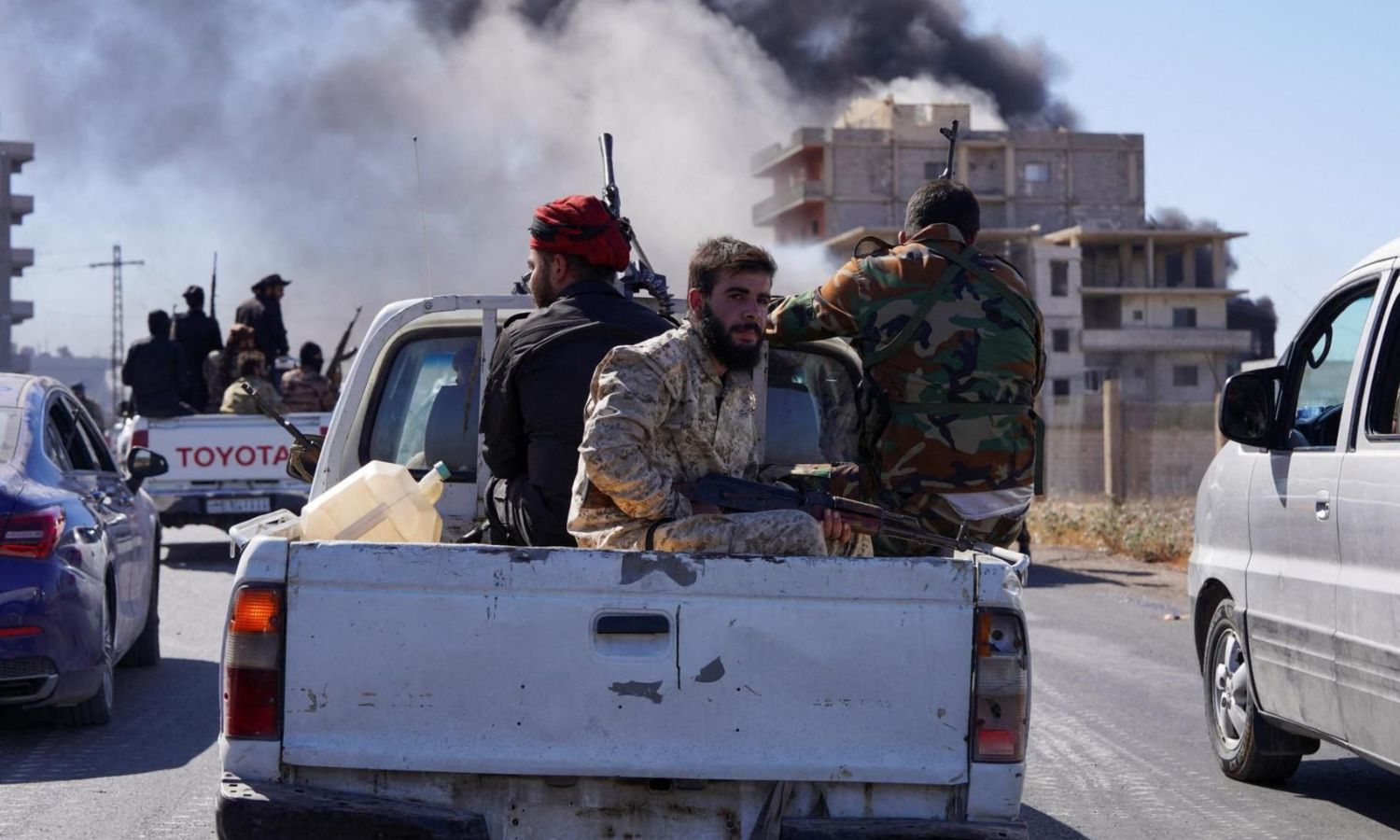
In their wake, local factions launched reprisal attacks against Bedouin tribes, sparking a mobilisation of tribesmen from many Syrian regions who converged on Suwayda and began fighting the local factions. Enab Baladi documented widespread violations by local factions, government forces and tribal fighters during the clashes.
At dawn on 19 July, U.S. envoy Thomas Barrack, announced a Syrian-Israeli ceasefire agreement, endorsed by Türkiye, Jordan and neighbouring states—a deal confirmed by interim president Ahmad al-Sharaa, who urged tribal fighters to abide by it. Security forces then began deploying around Suwayda city while tribal fighters withdrew gradually.
Tribal fighters stream into Suwayda to back Bedouin clans against Druze combatants – 19 July 2025 (AFP / Omar Haj Kadour).
Agreement Provisions
According to the Syrian Interior Ministry, the U.S.-sponsored agreement announced on 19 July stipulates:
A comprehensive ceasefire and halt to all military operations by every side. Formation of a joint monitoring committee of state and sheikhdom representatives. Deployment of joint security checkpoints in Suwayda city and neighbouring areas. Use of officers and personnel from Suwayda to handle security and administration. Respect for homes and property; no assaults inside Suwayda. A mechanism, with relevant ministries, to regulate light and heavy weapons, ending armed displays outside state control while respecting Suwayda’s social-religious distinctiveness. Full reintegration of Suwayda into the Syrian state and restoration of sovereign authority. Reactivation of all state institutions under Syrian law. Guarantee of citizens’ rights through laws that ensure justice, equality and civil peace. A joint fact-finding committee to investigate violations, identify perpetrators and compensate victims. State protection of the Damascus–Suwayda highway and travellers. Immediate provision of basic services—electricity, fuel, healthcare. Release of detainees and disclosure of the missing from recent events. A joint committee to oversee implementation.Military-affairs researcher Rashid Hourani argued the military option was sub-optimal, yet, he said, the state had offered Suwayda numerous proposals since Bashar al-Assad’s fall on 8 December 2024—efforts thwarted by Sheikh Hikmat al-Hijri, whom many now blame for the deadlock with Damascus.
Hourani believes looming external deadlines—particularly sanctions—spurred the state’s attempted military fix. As for Israel’s “decisive” role, he contends the air-strikes were not intensive enough to cripple army operations and served Israel’s own domestic aims rather than making it a principal belligerent.
Casualties: Preliminary TallyThe Syrian Health Ministry received 1,698 injured from the Suwayda events, ranging from mild to moderate wounds; 425 were critical. Fifty-seven ambulances responded and 1,022 patients were transferred to other provinces.
Official hospitals recorded 260 fatalities, Health Minister Musab al-Ali said on X late on 18 July.
The Syrian Network for Human Rights documented at least 321 deaths (including six children and nine women—one of whom died of heart failure on hearing her grandson’s death) and over 436 wounded between 13 and 18 July. Victims included civilians, medical staff, armed Bedouin tribesmen, local Druze fighters outside state control, and members of the Internal Security Forces and Defence Ministry.
A Civil Defence media official told Enab Baladi that the Emergency and Disaster Ministry had set up a joint operations room of government bodies, Syria Civil Defence, local NGOs and services. By the third day, the Health Ministry readied an emergency convoy of 20 ambulances, specialist teams and large medical supplies, but heavy bombardment blocked entry; the convoy remains on standby pending safe passage.
Social Affairs and Labour Minister Hind Qabawat said in a Facebook statement published by the ministry on Saturday, July 19, that her ministry is prepared to dispatch humanitarian, medical, and food aid to respond to the urgent needs of communities in southern Syria.
She noted that the aid will be delivered in coordination with the Foreign Ministry’s International Cooperation Office and active NGOs, and that the ministry is fully ready to work with relevant medical and relief agencies to respond to any humanitarian developments in the area—as soon as safe routes are secured.
Qabawat added that a joint convoy organized by the Ministries of Health and Social Affairs had reached southern Syria two days earlier, but was unable to enter Suwayda due to ongoing Israeli strikes.
Internal Security Forces deploy in al-Mazraa, west of Suwayda – 19 July 2025 (Syrian Interior Ministry / Telegram).
Ending the Suwayda File Why Do Arab States Barrack al-Sharaa?On 17 July, a group of Arab states issued a joint statement welcoming the preliminary agreement announced by interim president Ahmad al-Sharaa to end tensions in Suwayda governorate.
The foreign ministers of Jordan, the UAE, Bahrain, Saudi Arabia, Iraq, Oman, Qatar, Kuwait, Lebanon, Egypt, and Türkiye emphasized the need to implement the agreement in order to protect Syria’s unity, prevent further bloodshed, and uphold civilian protection, state sovereignty, and the rule of law.
The statement, published by the Saudi Ministry of Foreign Affairs, praised al-Sharaa’s commitment to holding accountable those responsible for violations against Syrian civilians in Suwayda.
The signatory states reaffirmed their support for all efforts to restore security, state authority, and the rule of law in Suwayda and across Syria. They also rejected violence, sectarianism, and attempts to incite division or hatred.
Political analyst Hassan al-Nifi told Enab Baladi that the Arab endorsement of al-Sharaa’s efforts aligns with the Gulf states’ long-standing position in support of security and stability in Syria, especially during its transitional phase.
Al-Nifi added that the current developments in Syria have broader implications for regional security. He noted that this endorsement is not aimed at any specific Syrian group, nor does it support a narrow agenda—it reflects a general commitment to Syria’s national stability.
He also stressed that this support goes beyond mere words or theoretical frameworks and is embodied in practical efforts to end the crisis. These efforts did not include direct military assistance or intervention in Syrian affairs, but instead took the form of pressure exerted by some Arab states—those with influence in Washington—to curb Israeli involvement in Syria.
The joint statement also condemned Israel’s repeated attacks on Syria, calling them violations of international law and blatant infringements on Syria’s sovereignty that threaten the country’s security, stability, territorial integrity, and the safety of its citizens.
The signatories called on the international community to support Syria’s reconstruction efforts and urged the UN Security Council to uphold its legal and moral responsibilities by ensuring Israel’s full withdrawal from Syrian territory. They also called for an immediate end to Israeli hostilities and interference in Syria’s internal affairs, and for the implementation of UN Resolution 2766 and the 1974 Disengagement Agreement.
Political analyst Hassan al-Nifi further explained that the Israeli airstrike on the General Staff building in Damascus provoked a reaction from Türkiye and several Arab states—including Saudi Arabia—leading them to increase pressure on Israel to stop its aggression.
For its part, the U.S. Department of State declared that it did not support the recent Israeli attacks on Syria. Spokesperson Tammy Bruce stated on 17 July that Washington was “engaged diplomatically with Israel and Syria at the highest levels to address the current crisis and work toward a lasting agreement between the two states.”
Meanwhile, UN Secretary-General António Guterres expressed concern over reports of indiscriminate civilian killings and looting of private property, condemned all forms of violence, and urged both interim authorities and local leaders to de-escalate, protect civilians, and conduct transparent investigations to hold those responsible accountable.
Saudi Crown Prince Mohammed bin Salman:“We condemn Israel’s blatant attacks on Syrian territory and reaffirm the Kingdom’s support for Syria and rejection of any act that harms civil peace.
Turkish FM Hakan Fidan:“The opportunity to build Syria’s future must not be missed. Terrorist groups will not be allowed to exploit the south’s situation.”
EU:“We urge Israel to halt strikes on Syrian territory, including key sites in Damascus, which endanger civilians and could undermine Syria’s transition.
U.S. Secretary of State Marco Rubio:“We’re talking to both sides; I think de-escalation is within reach.”
Israeli Defence Minister Israel Katz:“The Syrian regime must leave Suwayda. Israel will not abandon the Druze and will enforce the disarmament policy we decided.”
German FM Johann Wadephul:“Germany will support Syria only if it follows an inclusive process and protects its people.”
U.S. Envoy Thomas Barrack:“We urge Druze, Bedouin and Sunnis to lay down arms and help build a new, united Syrian identity.”
A Syrian tank withdraws along the Suwayda–Daraa road – 15 July 2025 (AP / Omar Sanadiki).
A Battle Between WarsBarrack’s ceasefire underscores that Suwayda’s struggle mirrors Syrian-Israeli accords as much as internal factors.
Did Damascus Misread Washington?
Eight informed sources told Reuters that the Syrian government misinterpreted how Israel would respond to its deployment of forces in southern Syria. This miscalculation, the sources said, stemmed from a U.S. message suggesting that Syria should be governed as a centralized state.
According to the sources—which include Syrian political and military officials, diplomats, and regional security figures—Damascus believed it had received a green light from both the United States and Israel to move its forces south, despite months of Israeli warnings to stay out of the region.
In a report published by Reuters on 19 July, the sources said this assumption was based on both public and private remarks by U.S. Special Envoy to Syria, Thomas Barrack, as well as early-stage security discussions with Israel. Barrack had advocated for a centralized model of governance in Syria, without autonomous regions.
A Syrian military official told Reuters that communications with the U.S. led Syrian leadership to believe that they could deploy forces without Israeli opposition. The official added that when American officials did not respond to briefings on Syria’s missile deployment plans, Damascus interpreted the silence as tacit approval, concluding that “Israel would not interfere.”
A diplomat based in Damascus said the Syrian authorities were overconfident in their operation to retake Suwayda, misled by what they perceived as green signals from Washington—signals that, in hindsight, “did not reflect the actual position.”
Following the Israeli airstrike on the Syrian General Staff building in Damascus on 16 July, U.S. Secretary of State Marco Rubio told Fox News that the strike was “likely a misunderstanding”, amid mounting concerns over the week’s outbreak of violence.
After the Israeli strikes that also hit the Presidential Palace, the Syrian president said in a televised speech carried by the Presidency’s official channels that the government chose to withdraw from Suwayda to avoid a direct confrontation with Israel, also referencing a “misunderstanding” with the Israeli side.
Tensions in the Talks
Political analyst Hassan al-Nifi believes the once-rumored secret talks between the Syrian government and Israel have effectively stalled. He notes that the last such contacts coincided with the Syrian president’s 12 July visit to Azerbaijan. Israel’s current hard-line posture, he argues, reflects Damascus’s refusal to meet Israeli demands that go well beyond the Golan Heights.
“Israel doesn’t just want Syria to relinquish the Golan,” al-Nifi told Enab Baladi. “It wants Damascus to concede that the entire southern region must be a demilitarized zone.”
According to al-Nifi, Prime Minister Benjamin Netanyahu’s government also hopes to turn the residents of Suwayda, Quneitra, and Daraa into de facto border guards for Israel. Damascus’s rejection of those ambitions, he says, pushed Israel to support local factions in Suwayda.
The “Battle-Between-Wars”
Israeli-affairs researcher Yasser Manaa frames Israel’s recent strikes in Syria as part of its declared “battle between wars” strategy—aimed at wearing down the new Syrian order while cultivating the Druze as a first line of defense.
Speaking to Enab Baladi, Manna stressed that Washington is invariably factored into Israel’s military calculus in Syria. Historically, he noted, Israel does not carry out major strikes inside Syrian territory without direct coordination—or at least prior notification—to the United States, implying a tacit U.S. political cover for Israeli operations.
Manna dismissed any causal link between the Suwayda offensive and the Syrian president’s Azerbaijan trip: “In the Middle East, analysis must consider structural interests, not mere calendar coincidence.”
Syrian Gamble or Israeli Trap?
Political researcher Nader al-Khalil interprets Damascus’s decision to send forces into Suwayda as part of a broader effort to re-assert control over restive areas—an opportunity the government deemed timely, especially given what al-Khalil calls Washington’s recent flexibility toward the interim authorities.
Israel, he contends, intervened under the pretext of protecting the Druze, but its primary goal was to establish a southern safe zone free of heavy weapons and regular troops. Damascus, he argues, underestimated the extent of U.S. pressure—channeled through Israeli concerns—which ultimately forced its initial withdrawal under fire.
After the Ceasefire
Following the latest ceasefire announced by the Syrian government at dawn on 19 July, the situation on the ground in Suwayda remains unclear. Multiple factors contribute to this uncertainty, including the divergent or conflicting stances of Druze religious leaders and local factions, as well as the involvement of tribal groups in the ongoing clashes.
A Fragile Accord
Analyst Firas Allawi calls the first agreement between Suwayda’s sheikhs and security ministries “fragile and explosive” because signatories lacked real citywide control and the state could not provide support amid ongoing Israeli and regional interference. Internal divisions run deep; local decision-making, he says, has been “hijacked” by certain sheikhs and armed factions. Israeli intervention and the silence of pro-Damascus regional powers weakened pro-government forces inside Suwayda.
Between Symbolic Presence and Real Power
Writer Firas Allawi told Enab Baladi that the Syrian state is likely to maintain a limited on-the-ground presence in Suwayda for now. However, he argued that this presence must play a supportive role for the local community, particularly the majority of residents who have rejected separatist agendas and opposed militias advocating isolation from the rest of Syria.
Allawi added that while partitioning Syria and detaching Suwayda is a theoretical possibility, it remains unlikely. Despite conditions that might give rise to such a scenario, he believes its viability is tightly linked to regional and international dynamics. There is a general consensus—he noted—for preserving Syria’s territorial integrity, even among actors like Israel, which, according to repeated statements by its officials, seeks to keep the country formally united but functionally weak in order to safeguard its national security interests.
Israeli Threats and Response Strategy
Allawi warned that attacks against public security forces and pro-government factions could intensify unless the local community in Suwayda is engaged and integrated with the broader Syrian population. He emphasized the need to bridge divides and create space for genuine local dialogue, cautioning that alienating Suwayda’s residents may lead to further security tensions.
He added that the threats facing Daraa are not solely internal, but also stem from Israel’s efforts to clear the south of any military presence. If government forces remain, Israel may escalate again, especially given its limited ability to directly support armed factions in Suwayda.
Allawi does not expect Israel to provide sustained support to Suwayda, either by land or air. Instead, its involvement will likely remain confined to limited military actions, such as the airstrikes on 16 July. In the end, Israel is pursuing its own strategic interests, he said.
Syrian Defence Ministry building heavily damaged after Israeli air-strikes, Damascus – 16 July 2025 (AP / Gaith Alsayed).
More Losses Than GainsEnab Baladi spoke to several experts and journalists to assess the winners and losers following the recent ceasefire agreement in Suwayda—an accord various parties have framed as a victory.
Military affairs researcher Rashid Hourani argued that the true loss lies in the deep fracture within Syrian society, fueled by the stance of Druze cleric Hikmat al-Hijri, who rejected engagement with Damascus under the transitional government, viewing it as a “takfiri group.” Hourani pointed to al-Hijri’s latest speech as evidence and suggested that his removal from the spotlight in favor of new political and social figures could serve the province better.
For writer Firas Allawi, a genuine ceasefire would mark a win for both the Syrian government and society at large. He believes that stability could open the door to deeper social cohesion, improved security, and the restoration of civil peace.
However, Allawi warned that U.S. strategy appears aligned with Israeli interests, prioritizing Israel’s national security even if that involves fueling conflict or backing separatist forces. He argued that this approach poses a serious threat to any sustainable agreement between the government and armed factions on the ground in Suwayda.
Internationalization Entrenched, Sovereignty Undermined
Journalist Abdullah Suleiman Ali, who covers Syrian affairs for Lebanon’s An-Nahar newspaper, described the agreement announced by the U.S. special envoy as a clear case of internationalization, approved by Ahmad al-Sharaa, Benjamin Netanyahu, and supported regionally by Jordan, Türkiye, and other unnamed states.
Speaking to Enab Baladi, Ali said that internationalizing any internal file undermines national sovereignty and reflects the inability of the transitional authorities to independently manage critical issues. He argued that the agreement projects a negative image of the authorities’ performance, making them the primary losers, despite attempts to frame the outcome positively.
Ali pointed to the contradiction in the official rhetoric, which emphasizes sovereignty and territorial unity to justify the violence in Suwayda, while the agreement itself undermines those very principles by bringing Israel in as a stakeholder.
He further asserted that Israel is the biggest winner, having secured legitimacy to intervene in an internal Syrian matter, a move he views as part of a broader strategy to weaken and fragment the Syrian state, in line with regional visions often expressed by Netanyahu.
The agreement, Ali noted, calls for the deployment of internal security forces around Suwayda’s administrative perimeter, while local factions retain control within the city—a setup he described as an effort to preserve a fragile balance. The government, he added, had previously tried to break that balance by storming the city, before retreating and leaving the task to tribal forces.
Syrians the First to Lose
On the humanitarian and moral front, Abdullah Suleiman Ali expressed regret over what he described as a “collective loss,” saying that “Syrians—both citizens and officials—emerged as the losers from the Suwayda events, having failed to prevent a repeat of the bloody scenario that unfolded earlier in the Syrian coast.”
He argued that the transitional government bears both political and moral responsibility for what transpired, especially given what he described as its “confusing and controversial conduct.” Ali pointed to documented violations by security and military personnel during the initial days of violence, including the involvement of individuals previously accused in coastal massacres—a pattern that, in his view, undermines the government’s rhetoric around accountability.
While local factions are not free of blame, he noted, they do not carry the same legal and ethical burden as the government, which is obligated to uphold international humanitarian law and had claimed it intervened to restore order. Instead, Ali argued, the government’s behavior mirrored earlier episodes of sectarian violence, offering a repeat of the same imagery and rhetoric witnessed in previous conflicts.
He concluded by stating that the government suffered a popular loss among minority communities, especially following its official praise of the tribal mobilization , which he said fueled further fears among minorities that the same model could be used again against any Syrian party opposing the government’s direction in the future.
“No One Won”
Researcher Dr Abdulrahman al-Haj lists five gains for the interim government:
Reasserted its presence in Suwayda, effectively ending the insurgent movement led by Sheikh Hikmat al-Hijri. Positioned itself as the sole guarantor of preventing civil war. Weakened separatist tendencies challenging the central government—particularly in eastern Syria, where tribes constitute over 95% of the population and make up the majority of the Syrian Democratic Forces (SDF). Diminished Israeli ambitions to establish a demilitarized zone that includes Suwayda and undercut support for autonomous governance there. This, in turn, strengthened Ahmad al-Sharaa’s position in ongoing security negotiations. showed that Ahmad al-Sharaa is the key guarantor of the region’s cohesion amid a flood of tribal mobilizations—an escalation partly triggered and fueled by Israeli involvement. This dynamic could make any large-scale Israeli ground operation a risky gamble, potentially backfiring and destabilizing the entire region. Given the tribes’ broad regional reach, posing an existential threat to them could awaken a force that may prove uncontrollable.Conversely, the government suffered a significant blow to its authority following Israeli strikes on Damascus, including the bombing of sovereign institutions such as the General Staff headquarters and the area surrounding the Presidential Palace. The attacks killed hundreds of Internal Security Forces members and conscripts from the Ministry of Defense, triggering widespread public outrage and serving as one of the key drivers of the tribal mobilization .
Meanwhile, Sheikh Hikmat al-Hijri gained explicit Israeli support and deeper Israeli engagement, according to Dr Abdulrahman al-Haj, who said al-Hijri believed this backing could pave the way for an autonomous administration aligned with Israel following the withdrawal of public security and military forces due to the Israeli airstrikes.
Al-Hijri emerged as a protector of the Druze community against an authoritarian government, successfully rallying anti-government sentiment across Suwayda.
However, he lost much in return. The day after the ceasefire agreement, militias aligned with al-Hijri began sectarian cleansing operations targeting Arab tribes in Suwayda, aiming to lay the groundwork for self-rule—plunging the region into civil war.
In this failed campaign, al-Hijri lost significant public support within the governorate. Heavy casualties on both sides eroded his standing; he was dealt a defeat and forced to sign a humiliating agreement that effectively marginalized his influence.
As for the tribes targeted by sectarian attacks, they exacted revenge but also suffered heavy losses and atrocities committed against their communities.
According to Dr Abdulrahman al-Haj, the aftermath of the communal violence paints a stark picture: burned villages and neighborhoods, bodies in the streets—a scenario that ultimately required third-party intervention. When measured in terms of gains and losses, no one emerged victorious.
Suwayda: Syria’s Battle of the Losers Enab Baladi.
Hence then, the article about suwayda syria s battle of the losers was published today ( ) and is available on ُEnabbaladi ( Syria ) The editorial team at PressBee has edited and verified it, and it may have been modified, fully republished, or quoted. You can read and follow the updates of this news or article from its original source.
Read More Details
Finally We wish PressBee provided you with enough information of ( Suwayda: Syria’s Battle of the Losers )


Also on site :
- iPhone Duo Launches in Santa Barbara
- 1999 Cult-Favorite TV Series Featured Van Halen, Rush, Styx—And Has the ‘Greatest Halloween Episode of All Time’
- Phil Collins Tried to Recreate Ringo Starr’s Drumbeat on This 1983 Genesis Song That Became One of Their Biggest Hits