
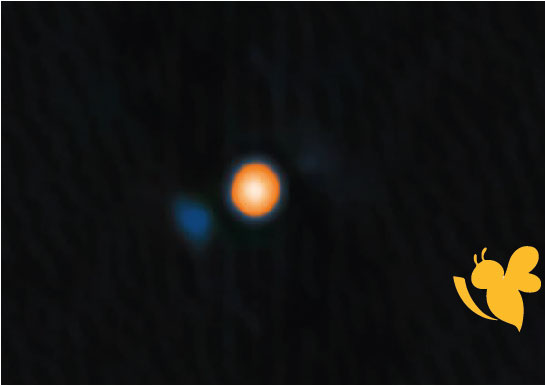
The recent detection of a companion star orbiting the red supergiant Betelgeuse has profound implications for our understanding of stellar dynamics and evolution. Astronomers utilized the 'Alopeke instrument on the Gemini North telescope to observe this phenomenon, unraveling a long-standing mystery regarding Betelgeuse's six-year dimming cycle . The identification of a blue-white star, estimated to possess 1.5 times the mass of our Sun and located within Betelgeuse's outer atmosphere, adds complexity to our models of massive stars .
After numerous false signals and empty search results, astronomers with NASA’s Ames Research Center have confirmed that Betelgeuse does, in fact, have a tiny buddy star. The young star, with a mass about 1.5 times that of the Sun, likely exerts some unsolicited influence on the larger star’s gravitational field and the cosmic dust floating in its vicinity. The interactions between the two stars make it appear as though Betelgeuse—unlike most stars of its kind—undergoes an additional, extended period of intermittent dimming roughly every six years.
Betelgeuse has a companion star that pushes light-blocking dust out of the way, temporarily making the star glow more brightly.
The presence of the star, nicknamed “Betelbuddy”, had been theorised, but Nasa has spotted it for the first time using its Gemini North telescope, in Hawaii.
Steve Howell, a senior research scientist at the Nasa Ames Research Centre, in California, said: “Papers that predicted Betelgeuse’s companion believed that no one would likely ever be able to image it.
“Gemini North’s ability to obtain high angular resolutions and sharp contrasts allowed the companion of Betelgeuse to be directly detected.”
The companion appears to orbit the supergiant at a distance just four times that between Earth and the sun, putting the companion within Betelgeuse’s expansive outer atmosphere — a perilous spot for a small star.
“The companion will have drag in its orbit,” says study coauthor Steve Howell, an astronomer at NASA’s Ames Research Center in Mountain View, Calif. As a result, the companion faces an astronomically imminent death: Within 10,000 years, it will be sucked into Betelgeuse.
This discovery not only enhances our knowledge about Betelgeuse but also raises questions regarding its future interactions with its companion. Both stars are relatively young at approximately 10 million years old; however, projections indicate that Betelgeuse may eventually cannibalize its companion star . Such phenomena are critical for understanding stellar lifecycle processes and the eventual fate of massive stars in binary systems.
Read more
Summer COVID-19 Wave Drives Case Increases in These States SSRIs and Pregnancy Under Review as FDA Panel Tackles Risk vs. BenefitSara H


Also on site :
- This Comfy Shoe Brand Has Affordable Holiday Gifts for Everyone on Your List—From Golfers to Fashionistas
- Taylor Swift’s ‘Bitter’ Enemy Reportedly Trying to Recruit Blake Lively for ‘Revenge’ Plot Amid Report the ‘Extremely Sensitive’ Singer Is Having a ‘Tough’ Time
- Camilla Suffers Heartbreaking Losses After Report Charles Is in ‘Agony’ Following a Devastating Health Update