
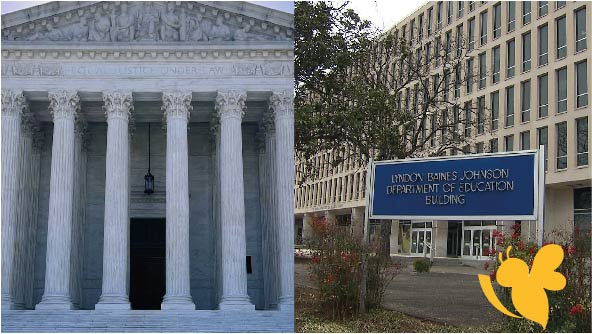
The recent ruling by the Supreme Court permitting the Trump administration to proceed with layoffs at the U.S. Department of Education marks a significant moment in educational policy and governance. In a 6-3 decision, the court lifted an injunction imposed by a federal district judge, which had previously blocked plans to lay off approximately 1,400 employees . This ruling reflects a broader trend in which administrative actions aimed at reducing federal oversight and funding are gaining judicial support, despite considerable dissent from liberal justices who argue for stricter checks on executive power .
The order is a significant victory for the administration and could ease President Trump’s efforts to sharply curtail the federal government’s role in the nation’s schools.
The Trump administration has announced plans to fire more than 1,300 workers, a move that would effectively gut the department, which manages federal loans for college, tracks student achievement and enforces civil rights laws in schools.
The Education Department began the year with more than 4,000 employees. The administration also fired some probationary workers and offered employees the ability to resign. Altogether, after the terminations, the Education Department will have a work force of about half the size it did before Mr. Trump returned to office.
Since taking office, the administration has sought to lay off half of the agency’s workforce and transfer some of its core functions, such as managing student loans, to other federal departments.
U.S. District Judge Myong Joun blocked those efforts in May and ruled that Trump needed congressional authorization, ordering him to reinstate the roughly 1,400 workers who had been laid off two months prior.
The Justice Department said the Constitution gives the executive branch, not the courts, the authority to decide how many employees are needed.
"The Department of Education has determined that it can carry out its statutorily mandated functions with a pared-down staff and that many discretionary functions are better left to the States," Solicitor General John Sauer told the Supreme Court.
This decision is emblematic of the Trump administration's strategy to dismantle various federal departments and return functions to state control. Proponents of this approach argue that localized governance can lead to more effective educational outcomes by allowing states greater autonomy over their education systems . However, critics contend that such drastic measures risk undermining vital resources and support structures for students across the nation.
Read more
US president is going to send urbane missiles to Ukraine Gunman Opens Fire at Kentucky Church, Killing Two Women After Shooting OfficerSara H


Also on site :
- This Comfy Shoe Brand Has Affordable Holiday Gifts for Everyone on Your List—From Golfers to Fashionistas
- WHO questions Russia: "If plague is ruled out, what did she actually die from?"
- Taylor Swift Ex Reportedly Tried to ‘Resolve Lingering Issues’ with Her Right Before Travis Kelce Wedding as the NFL Player Pushed Back on the ‘Painful’ Request