
Janna Al‑Issa | Shaaban Shamieh | Sidra Al‑Hariri | Lama Diab
The home of Ghazwan Younis (26), a resident of Al‑Mazra‘a area in Qastal Maaf in rural Latakia, has been completely reduced to ashes due to wildfires that have raged and spread for over a week in rural Latakia, western Syria.
The flames broke out in Ghazwan’s house while his family was inside, he told Enab Baladi. In less than fifteen minutes, the house was engulfed inside and out, forcing them to flee in their clothes to avoid harm.
Ghazwan miraculously escaped. His relatives had moved him to safety just minutes after the fire began. He returned to attempt to extinguish the fire and save the family’s only home, but the fire, intensified from all sides, forced him to flee after about fifteen more minutes.
Ghazwan’s family was not the only one affected. Dozens of homes in Qastal Maaf and other areas were engulfed in flames.
Initial data estimates that over 18,000 hectares of forest, agricultural, and woodland areas have burned, displacing more than 1,120 people from their homes in multiple areas. Over 5,000 residents, already weakened by years of conflict and economic collapse, have been impacted.
In this feature, Enab Baladi investigates the timing of this year’s fires amid suspicions of deliberate ignition and highlights the multiple impacts of wildfires that have not subsided for more than a week, consuming vast areas in Latakia.
Extreme Environmental Shifts
Local and regional firefighting teams have been unable to contain the fires that began on July 3, facing major challenges including strong winds that frequently reignite flames and carry embers beyond fire-break lines, unexploded ordnance, and rugged terrain.
The fires have been fueled by intense drought and wind speeds exceeding 60 km/h.
The Basit power plant stopped operating due to fire damage to medium-voltage lines, causing power and water supply outages.
Electric lines and substations were also damaged, leading to power cuts. Main roads, including the international highway to Turkey, have been closed or affected.
Explosions from unexploded munitions and landmines left from the war have endangered relief teams and delayed access.
Thick smoke has spread over Latakia, Hama, and southern Idlib, prompting health warnings for at-risk groups. The fires have also caused livestock deaths and destroyed animal shelters.
Intensifying Climate Phenomena
On July 1, Minister of Emergency and Disaster Management Raed al-Saleh confirmed that Syria is witnessing a dangerously high rate of forest and brush fires.
He stated that from early April to the end of June, there were 3,579 fires across 12 provinces, jeopardizing the ecological balance for future generations.
The minister added that Syria faced one of the largest and most dangerous waves of agricultural and forest fires during this period.
This year’s fires started earlier than usual. Typically, fires peak during the extreme summer months if they are climate-driven. But their early intensity from April has raised questions about changes in this year’s environmental dynamics.
Syrian environmental journalist Zaher Hashem told Enab Baladi that the main cause is the clear climate change in recent years, which produces so-called “extreme weather events”: altered weather patterns, record-breaking temperatures, and prolonged droughts at unexpected times and places.
Prolonged drought, extreme heat, and increased plant desiccation create ideal conditions for repeated and severe forest fires, according to Hashem.
He added that high temperatures and long droughts dry vegetation and dead organic matter. Once a fire starts, it spreads rapidly due to dry fuel.
“Climate change is creating hotter conditions in some locations where there are hot, dry winds. These winds have become more common globally due to climate change, meaning the potential effects related to forest fires are worsening.”
Zaher Hashem
environmental journalist
Thus, global warming trends are pushing forest fire seasons into hotter periods—sometimes even spring—rendering forests drier and more combustible before broadleaf trees fully leaf out, while pine needles hold less moisture, making ignition easier, Hashem added.
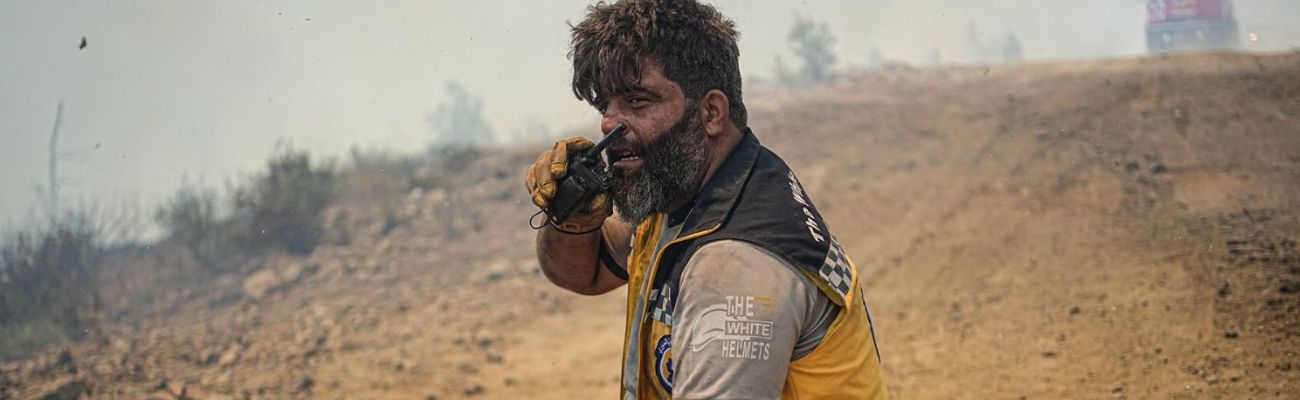
A member of the Civil Defense works to extinguish a wildfire in rural Latakia – July 9, 2025 (Enab Baladi/Dian Jinbaz)
Deliberate or Not?
In parallel with the rising flames, questions have also intensified over whether the fires are natural or deliberately set. Activists have attributed the outbreak of fires in several simultaneous locations across Latakia’s countryside—such as Damsarkho and Al-Umrouniyah—to “hidden hands,” citing a large fire that broke out near a military barracks.
Eyewitnesses reported the “rapid spread of the flames and difficulty in controlling them,” amid accusations that the fires were “intentional”—aimed at “targeting forested areas and property, distracting from other issues, or perhaps causing confusion and depleting resources.”
Bloggers on X have also speculated that charcoal traders may be behind some of the fires to exploit forest wood. However, this theory is routinely denied after each wave of fires, since “burned woodlands are unsuitable for charcoal production.”
Syrian Interior Minister Anas Khattab said during a visit to the fire sites on July 8 that the ministry has begun investigations into several incidents, with suspicions arising that the fires may be deliberate. He stated that there are suspicions and doubts that certain individuals are involved in setting the fires but did not provide further details.
The minister added that, given the vast area affected by the fires, suspicions alone are not sufficient; evidence and documentation are needed to support the ongoing investigations. No official findings have been announced as of the writing of this report.
Climatic and Human Factors
Dr. Wafa Rajab, Deputy Dean of the High Institute for Environmental Research at Latakia University, a specialist in environmental science, plant classification, and the impact of wildfires on botanical biodiversity, told Enab Baladi that fires occur for various reasons, including climatic ones—such as lightning strikes or severe drought combined with low humidity and strong winds, in the presence of “fuel,” which refers to accumulated plant debris on the forest floor.
There are also human causes, such as deliberate arson or negligence (e.g., leaving plant debris, paper, or branches on the ground, or litter that may contain glass pieces that concentrate sunlight and ignite fires), or burning nearby agricultural lands, charcoal production, traffic accidents, or electrical short circuits due to tree branches being too close to power lines, according to Rajab.
The specialist noted that the low economic value of products from Mediterranean forests—due to their slow growth and limited demand compared to Atlantic or tropical forests—reduces the incentive to invest in and maintain them. This leads to neglect and increases the risk of fire.
Dr. Rajab explained that the prevailing dry-season conditions—lack of rainfall, rising temperatures, and reduced air humidity—make large-scale fires more likely when there is enough combustible material in the forest. This often follows a rainy season that promotes abundant plant growth, which later becomes fire fuel in the dry season.
Hot, dry winds are among the key factors driving fire spread and expanding burned areas, according to Rajab. In contrast, within mature climax forests, where the microclimate is moist, fuel is damp, and wind speed is low, major fires are rare. These areas are called “fire cemeteries” because fires may not occur there for hundreds of years—unless started intentionally.
On the role of climate, Dr. Rajab pointed out that Mediterranean forests are inherently fire-prone due to their typical climatic conditions. She emphasized that the current climate conditions—high temperatures and strong winds—have helped fires spread. However, she noted that humidity is currently high, meaning that the fires are not climate-driven per se, though the climate was a contributing factor in their spread, especially considering the rugged terrain that complicates firefighting.
The lack of rainfall in the previous winter significantly contributed to drier air, soil, reduced groundwater, and lake levels—factors that further aid the spread and persistence of fires, the expert said.
She also warned that the emergency use of seawater to extinguish fires will have long-term negative effects on local vegetation and soil, potentially hindering biodiversity recovery in the region.
UN Expert: 99% of Syria’s Fires Are Human-Caused
Nour-Eddin Muna, former Syrian Minister of Agriculture and Agrarian Reform and current expert at the Food and Agriculture Organization (FAO) of the United Nations, told Enab Baladi that the fires witnessed in Syria—both during the former regime and in the present—share similar characteristics, although the motivations behind them have changed.
The UN expert stated that about 90% of wildfires are scientifically classified as deliberately caused, ignited for human reasons, such as expanding agricultural lands, where a farmer may set fire to an area and then lose control over it.
He revealed that in Syria’s case, 99% of wildfires are caused by human intervention. Natural causes, such as lightning, intense sun, or flammable rocks, account for only 5% to 7% of cases.
Muna pointed out that, before the fall of the former regime, fires were often set by land mafias, illegal loggers, or charcoal seekers. Some individuals linked to politically connected traders were arrested at the time.
The human causes of wildfires fall into two main categories: intentional (for land acquisition or charcoal production), or unintentional (due to negligence).
Maximum Response… Not EnoughAmid the increasing severity of the wildfires sweeping Syria’s coastal region and the failure to extinguish them for several consecutive days, the current situation has required urgent mechanisms and international intervention to mitigate the losses in agricultural and forested areas.
The Syrian government showed a swift response within its available capabilities from the first moments the fires spread in the Latakia mountains, through the efforts of Civil Defense teams and the establishment of operations rooms across the concerned ministries.
As part of the government’s response, the Director of the Coastal Directorate in the Syrian Civil Defense, Abdel-Kafi Kayyal, told Enab Baladi that more than 150 teams are operating on the ground within an integrated operations room, composed of Syrian Civil Defense, forest firefighting brigades, as well as units affiliated with the councils of various provinces, including volunteer teams and institutions.
According to Kayyal, more than 300 vehicles and dozens of logistical support machines are participating in extinguishing the fires, along with 18 bulldozers and heavy equipment used to create firebreaks and clear access roads for fire trucks.
Turkey, Lebanon, Jordan, Iraq, Qatar, and several European Union countries have also intervened to help contain the fires, providing logistical and technical support, humanitarian aid, and several helicopters and vehicles sent from several nations.
Limited Capabilities
The Syrian government is facing significant challenges that hinder the ability of the Civil Defense and firefighting forces to contain the fires swiftly and effectively.
The media official at the Ministry of Emergency and Disaster Management, Ismail al-Abdullah, told Enab Baladi that the main reason behind the weak response to the current wildfires in the Syrian coast—as well as several past fires in the al-Ghab Plain and Damascus—is a lack of capabilities.
At the equipment level, firefighting brigades in areas formerly under regime control do not possess the tools necessary for extinguishing fires and handling emergencies. Most of the equipment dates back to the 1970s and 1980s, and the number of modern vehicles is extremely low, even though the Syrian Civil Defense had acquired some equipment in past years.
Al-Abdullah explained that the deficit lies in the absence of equipment capable of dealing with forests, climbing mountainous terrain, and pumping water. These are not available to the Syrian Civil Defense, which operates under the Ministry of Emergency and Disaster Management.
He added that there are many other difficulties aside from equipment, such as the need to secure petrol and diesel for machinery, challenging terrain (plains, valleys, mountains), and a shortage in water tankers and sources to supply the firefighting brigades during the fires.
Al-Abdullah also pointed out that the presence of unexploded ordnance and landmines exacerbates the fires and is a key factor making them harder to stop.
He noted that the former regime did not adopt a professional approach to managing forests—there are no firebreaks or access zones for fire containment, which should have been in place and under development for years.
Smoke clouds covered the Syrian coastal mountains due to fires that lasted more than ten days – July 10, 2025 (Enab Baladi / Eyad Abdul Jawad)
Worsening Environmental and Economic CrisesThe recurring annual wildfires in Syria are no longer limited to environmental consequences but have increasingly affected the economic and social spheres.
These disasters have ceased to be mere natural incidents and now reveal a multidimensional crisis, where ecological losses overlap with livelihood and humanitarian threats, requiring a comprehensive and urgent response.
Severe Losses in Forest Cover
According to statistics published by the Madad Foundation for Development and Peacebuilding in mid-2024, Syrian forest cover in 2011 constituted around 2.5% of the country’s land, roughly 500,000 hectares, including about 233,000 hectares of natural forests.
From that time until mid-2024, Syria lost between 90,000 and 120,000 hectares due to fires and illegal logging.
The coastal provinces have borne the brunt of these losses. A report by PAX noted the loss of approximately 25,320 hectares of forestland between 2011 and 2021.
Assuming each hectare contains about 1,000 trees, Syria has lost nearly 105 million forest trees over 13 years—a number that continues to grow with the recent July wildfires.
Agricultural engineer Basel Dioub told Enab Baladi that the recurring fires cause extensive environmental damage that prevents ecosystems from recovering. While some plants can regenerate after a single fire, repeated fires deplete soil organic matter and hinder plant regrowth.
The expert added that Syria’s forested lands—such as wild pine, chestnut, and oak—need 10 to 15 years to naturally regenerate, but repeated fires disrupt this cycle.
According to Dioub, the environmental impacts of fires occur at several levels: deterioration of the soil’s physical and chemical properties, increased erosion and loss of vegetation, water pollution from ash runoff, poor air quality, and increased greenhouse gas emissions.
Dioub warned that the soil may become unfit for cultivation, leading fertile lands to turn into desertified areas.
He also stated that fires cause profound climate changes, including rising temperatures, release of large amounts of carbon dioxide, biodiversity loss due to wildlife deaths and displacement, and disruption of local ecological balance.
Rural Areas Under Threat
Dr. Ruqayya al-Hassan, head of the Information Systems Research Department at the General Commission for Agricultural Scientific Research, told Enab Baladi that fires accelerate soil erosion and reduce the soil’s capacity to retain water, increasing the risk of floods and landslides.
She added that the decline in vegetation cover over recent decades has made Syria’s environment more fragile in the face of wildfires.
Dr. al-Hassan emphasized that repeated fires threaten the lives of camp residents and rural communities—through injury, death, or property loss—and destroy crops, further deepening the food security crisis.
She stressed that these fires are no longer merely seasonal phenomena, but have become increasingly severe in recent years due to climate change and prolonged droughts.
A report by the United Nations Food and Agriculture Organization (FAO) in June warned that Syria is experiencing exceptional climate conditions threatening over 16 million people with food insecurity.
For her part, social researcher Taghreed Mussallem emphasized that the fires constitute a humanitarian disaster due to the loss of essential income sources such as livestock, land, and crops. She stated that the crisis has surpassed poverty to reach the level of complete livelihood loss for thousands of families.
She called for increased intervention by civil society and the state to compensate the affected, ensure dignified living conditions, and rehabilitate high-risk areas to prevent future disasters.
She also urged international organizations to provide urgent psychological and social support to affected populations.
Mounting Economic Losses
From an economic standpoint, former Syrian Minister of Agriculture and FAO representative Nour-Eddin Mouni explained that forests are not only environmental resources but also provide direct income for many residents through timber, medicinal herbs, and hunting.
He stressed that the fires reduce the economic value of forests due to tree deaths and the difficulty of restoration, which takes years and significant financial effort. Additionally, the remaining timber drops in value depending on quality.
On a broader scale, Syria has only managed to cultivate 40% of its planned agricultural land this year due to water shortages and damaged infrastructure, leading to a wheat production shortfall of about 2.73 million tons—enough to feed 16 million people for one year.
The recent wildfires have also destroyed fertile agricultural areas, especially olive groves and major crops, heightening fears of new displacement waves to urban areas or across borders.
More than 150 Civil Defense teams took part in efforts to control the coastal fires – July 10, 2025 (Enab Baladi / Eyad Abdul Jawad)
An Unknown Future: 50 Years for RestorationRegarding the plans of the Ministry of Emergency and Disaster Management, Ismail al-Abdullah explained that the ministry will work on studying and organizing the forests in Syria and establishing firebreaks. In addition, it will develop strategic plans for wildfire management, establish advanced outposts, and prepare water and equipment supply chains, among other initiatives.
Al-Abdullah stated that wildfires are widespread around the world and that it’s not a coincidence that fires occur in Syria. However, the lack of infrastructure in forested areas has contributed to the spread of fires, and limited resources have hindered containment efforts.
Regarding the necessary procedures for restoring burned forests, Dr. Wafaa Rajab, Deputy Dean of the Higher Institute for Environmental Research at the University of Latakia, said that this requires the involvement of specialists in forest and fire management. It is also essential to protect forests after fires and to prevent their exploitation for agricultural, tourism, or other purposes.
“Any forest subjected to a massive fire, like the ones happening now, needs 50 years to return to its previous state. Forests are the lungs of the planet, and their importance affects all of Syria and neighboring countries, especially the “Frunlok” forest, which is among the rare ancient forests in the region. We all must protect and manage it properly.” Dr. Wafaa Rajab, Deputy Dean of the Higher Institute for Environmental Research, University of Latakia
Preventive Measures
Preventive measures are considered an effective way to reduce the occurrence and impact of wildfires, as they help mitigate the risks posed by fires and limit their damage to property and lives.
Former Minister of Agriculture and former UN representative to the Food and Agriculture Organization (FAO), Nouredin Mounir, told Enab Baladi that he does not blame anyone specifically, but it is important to note that there is still no genuine national strategy for wildfire management.
During the era of the former regime, written disaster management plans existed but were not implemented due to corruption. As for the current government, although it assumed power in winter (a season with no fires), it should have created a proactive plan, given the annual recurrence of fires due to dry grass, wheat, and other flammable vegetation, according to Mounir.
He added that in most countries, early warning systems are in place, and mountainous areas are mapped with access routes created for rapid intervention. However, in Syria, the absence of firefighting aircraft remains one of the most significant obstacles, despite the proximity of affected areas to the sea, which would allow planes to collect water and extinguish fires within minutes.
Mounir emphasized the importance of considering aircraft rental and establishing international coordination with Turkey and Lebanon, as is standard during emergencies.
He explained that there is an urgent need to update legislation and expressed hope that the next parliament will introduce new laws to regulate forest investment, activate the Forest Law, and impose strict penalties on those responsible for wildfires. He described tampering with forests as a national betrayal that should be dealt with accordingly, including the harshest possible punishments.
Mounir pointed out that modern technologies for forest monitoring and surveillance exist, including early warning systems that should be adopted. He also emphasized the need to create firebreaks, as many countries do. On the legal front, the harshest penalties must be enforced, and firewood gathering must be regulated under government supervision in designated areas to avoid destructive random logging.
He concluded by stressing the need to train and equip firefighting teams with modern techniques, provide financial incentives due to the hazardous nature of their tasks, and foster international cooperation—even with adversarial nations—because, like pandemics, wildfires know no borders. This necessitates collective intervention to prevent the spread of danger, according to Mounir.
Ongoing efforts by the Syrian Civil Defense to extinguish the wildfires on the Syrian coast – July 8, 2025 (Syrian Civil Defense/X)
How Do Forests Regenerate?
Dr. Ghossoun al-Samman, professor in the Department of Renewable Natural Resources and Environment at the Faculty of Agricultural Engineering, University of Aleppo, told Enab Baladi that burned woodlands and forests regenerate either by seed (generative) or by vegetative means. She noted that most of the forest fires in Syria occur in pine forests.
Dr. al-Samman explained that the primary species in these burned forests is Pinus brutia (Brutia pine), along with other associated species. These trees form vast areas of coastal Syrian forests, covering rugged, steep mountainous terrain.
As a result, these forests are highly prone to wildfires due to their content of flammable substances (such as resin and turpentine), according to the specialist. This type of pine regenerates only through seeds. Because most of the fires are crown or surface fires, they destroy all the trees, shrubs, and vegetative cover, fully charring them.
She added that ash accumulates on the forest soil surface, which often causes the seed-bearing cones to perish entirely, making the regeneration process of Pinus brutia after fires very slow, unless the burned forest is adjacent to another that was not affected by fire.
In that case, seeds from sexually mature and opened cones may be carried by wind into the burned area, allowing germination and restarting the life cycle. However, many challenges hinder this regeneration process, which may take years or even decades, depending on the site conditions of each forest.
The Role of Humans
Regarding measures that should be taken in burned forest areas, Dr. al-Samman explained that the first step is to enforce full protection of the site and prevent local villagers and residents from entering the forest. Livestock should also be barred, especially in spring when grazing is most common.
She emphasized that ordinary people can help accelerate the forest regeneration process by refraining from cutting trees or charcoal production within the forest. They can also contribute by participating in reforestation efforts with economically valuable species, from which they may benefit, and by keeping grazing animals out of the forest during the initial years of regeneration.
Dr. al-Samman concluded by stating that avoiding the burned forest for leisure or tourism is also important, as this helps speed up the regeneration process, especially during the critical early years following destructive fires.
Fires Ravage the Coast… Who Ignites the Blaze and Who Extinguishes It Enab Baladi.
Hence then, the article about fires ravage the coast who ignites the blaze and who extinguishes it was published today ( ) and is available on ُEnabbaladi ( Syria ) The editorial team at PressBee has edited and verified it, and it may have been modified, fully republished, or quoted. You can read and follow the updates of this news or article from its original source.
Read More Details
Finally We wish PressBee provided you with enough information of ( Fires Ravage the Coast… Who Ignites the Blaze and Who Extinguishes It )


Also on site :
- iPhone Duo Launches in Santa Barbara
- 1999 Cult-Favorite TV Series Featured Van Halen, Rush, Styx—And Has the ‘Greatest Halloween Episode of All Time’
- Phil Collins Tried to Recreate Ringo Starr’s Drumbeat on This 1983 Genesis Song That Became One of Their Biggest Hits