
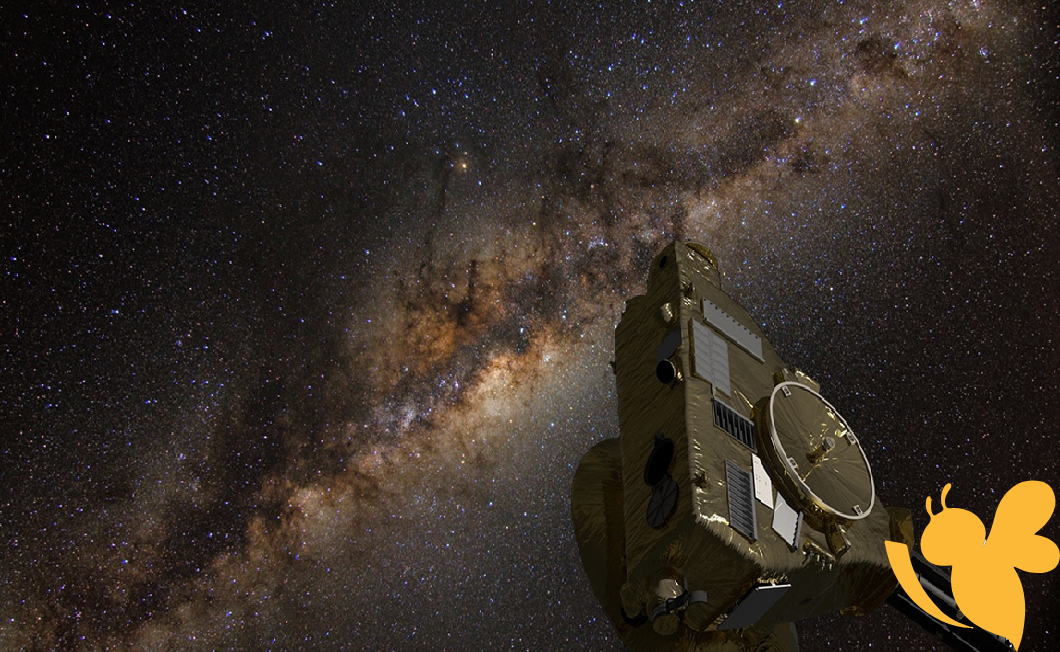
The recent groundbreaking test conducted by the New Horizons spacecraft marks a significant advancement in stellar navigation beyond Earth's orbit. For the first time, scientists utilized the spacecraft's unique position in the Kuiper Belt to perform deep space stellar navigation, specifically targeting nearby stars Proxima Centauri and Wolf 359. By employing a technique known as parallax measurement, researchers were able to accurately calculate New Horizons' position with an impressive accuracy of approximately 4.1 million miles. This experiment not only demonstrates the feasibility of stellar navigation in deep space but also sets a precedent for future exploratory missions.
A paper describing the results was accepted for publication in The Astronomical Journal. The pre-print is available on the server arXiv.
As a proof-of-concept test, the researchers took advantage of the spacecraft's unique vantage point as it traveled toward interstellar space to image two of our nearest stellar neighbors, Proxima Centauri, which is 4.2 light-years from Earth, and Wolf 359, which is 7.86 light-years away.
New Horizons is perfectly suited for the space navigation experiment. This is the fifth and last robotic vehicle to date that has left the Solar System. There are a lot of instruments on board, including optical and infrared cameras, as well as spectrographs for them.
New Horizons completed its main task — the exploration of Pluto and Charon — long ago. It also completed an additional program, and now it’s being used to study the heliosphere. Therefore, it is already far enough away to be used for testing stellar navigation.
For this purpose, the camera of the spacecraft photographed the position of only two stars in the sky: Proxima Centauri, which is 4.2 light-years away, and Wolf 359, which is 7.86 light-years away. The closer the stars are to us, the greater their parallax, or displacement in the sky, should be.
The success of this autonomous stellar navigation test illustrates promising implications for interstellar exploration. The ability to navigate using celestial bodies as reference points could revolutionize how spacecraft traverse vast distances . As humanity embarks on deeper space missions, such techniques will be essential for determining precise locations and ensuring successful trajectory planning. Thus, this pioneering achievement by New Horizons represents a pivotal step toward realizing long-term goals in interstellar travel .
Read more
Hill Country Tragedy: Death Toll Reaches 24, Rescues Ongoing New studies links particulate air pollution to increased mutations in lung cancers among nonsmokersSara H


Also on site :
- This Comfy Shoe Brand Has Affordable Holiday Gifts for Everyone on Your List—From Golfers to Fashionistas
- WHO questions Russia: "If plague is ruled out, what did she actually die from?"
- Taylor Swift Ex Reportedly Tried to ‘Resolve Lingering Issues’ with Her Right Before Travis Kelce Wedding as the NFL Player Pushed Back on the ‘Painful’ Request